


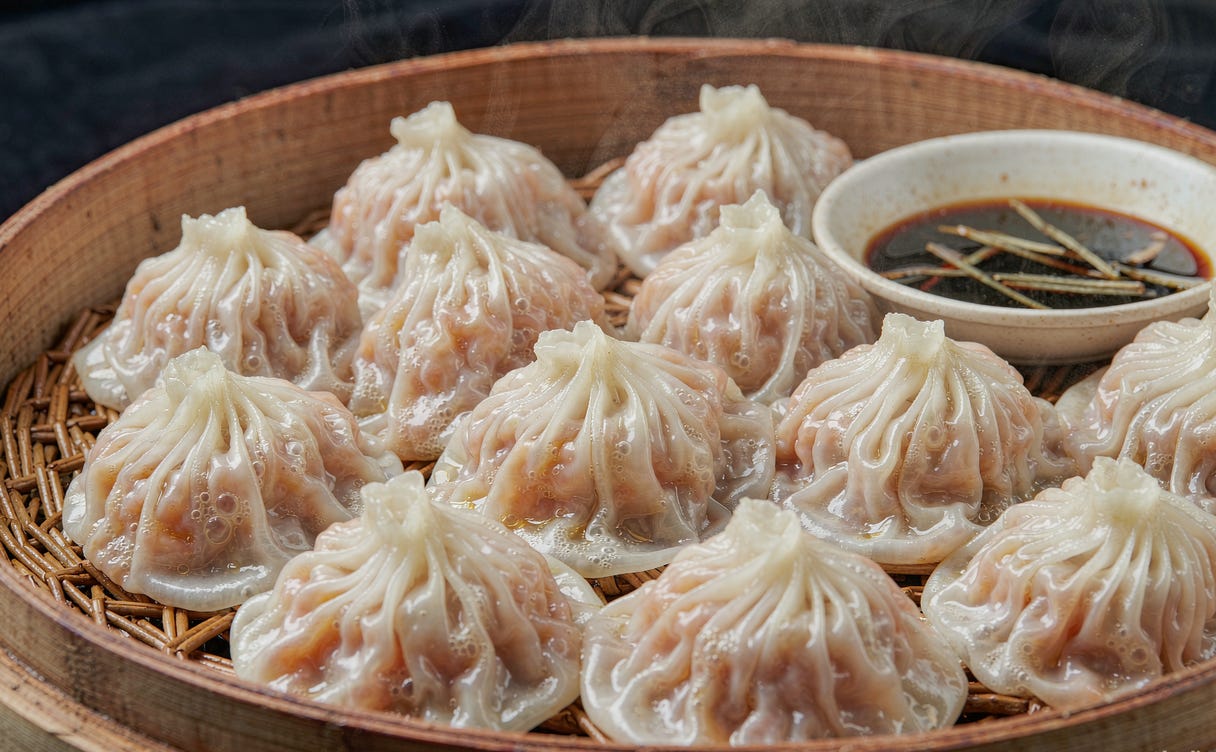
In Yangzhou, breakfast can last three hours.
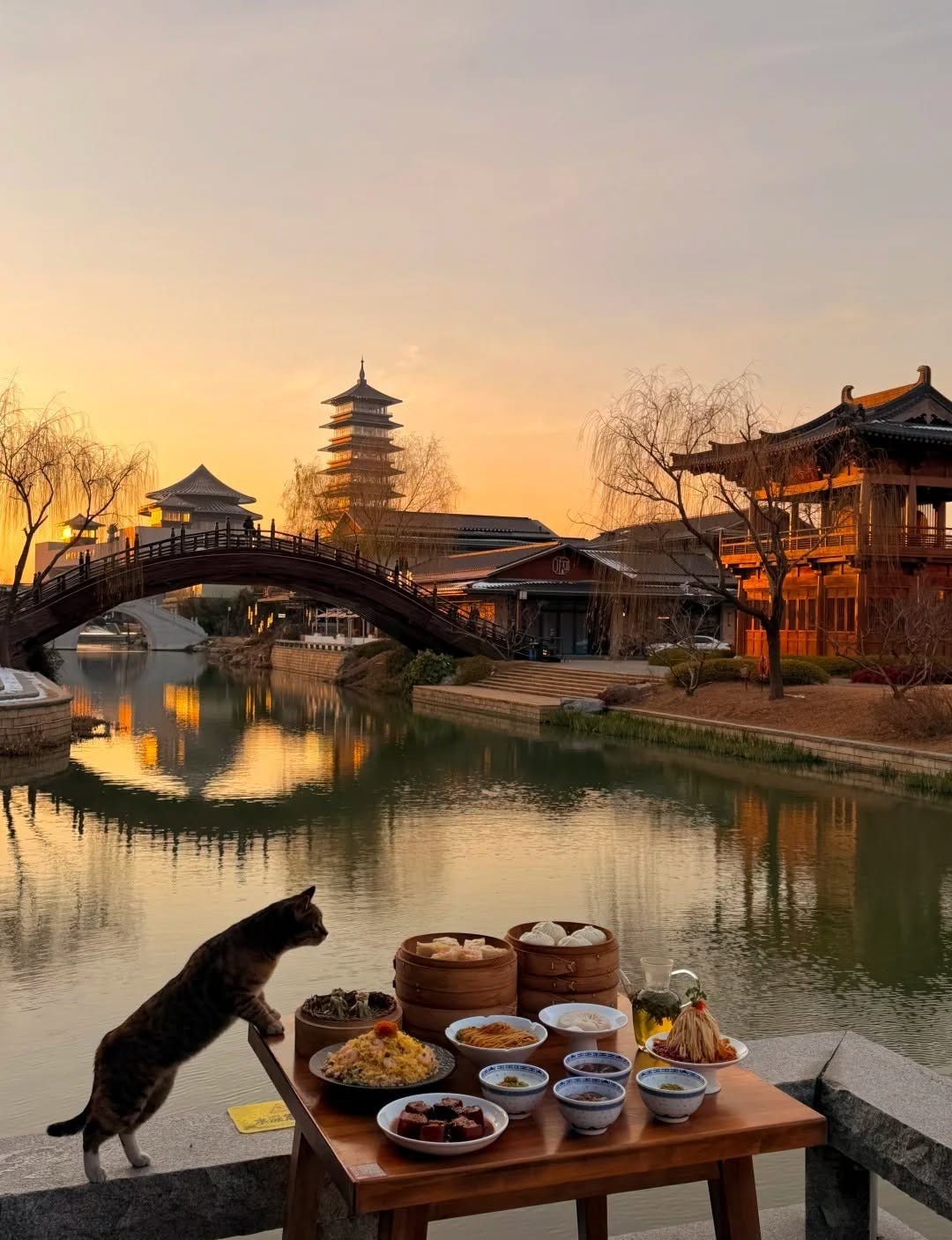
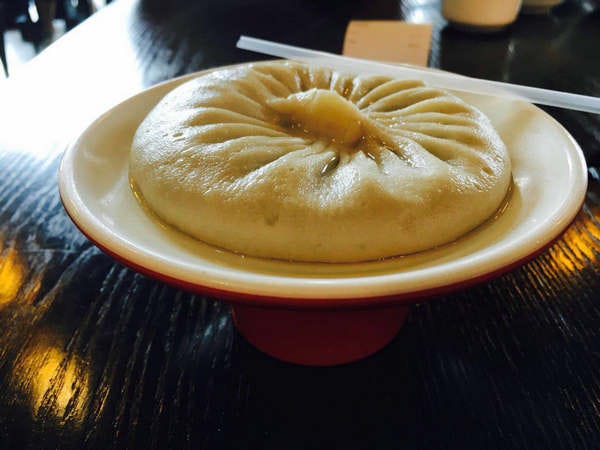
Steamed buns arrive in bamboo baskets. Dried tofu is sliced into threads so fine they float in the broth. Tea is poured from tall kettles with long spouts. Around the tables, people talk, eat, order another dish and settle in for a little longer. There is no obvious urgency to the morning.
To understand why this matters, consider what Yangzhou once was.
For centuries, the city’s fortunes were tied to salt. The imperial salt monopoly made Yangzhou one of the wealthiest places in China, concentrating enormous fortunes among the merchants who managed the trade. Their wealth found expression in gardens, cuisine, scholarship and art. They competed not only in how much they accumulated, but in what they could cultivate. They helped turn Yangzhou into one of the great centres of Chinese cultural life.
Then the economic foundation weakened. The salt monopoly ended, commercial routes shifted and the wealth that had sustained the city’s elite dispersed. Yangzhou lost much of the economic power that had made it exceptional.
Something curious happened, the city did not lose all the things that its wealth had built.
The gardens remained and the culinary traditions continued to develop. The old city retained much of its distinctive character; the morning tea culture once enjoyed by a prosperous commercial society continued as an ordinary part of urban life.
The wealth is gone. The merchants who built their fortunes here are long gone, too. Yet Yangzhou still draws people who want to understand its cuisine, its gardens and the traditions that made it exceptional.
Every morning, the tables fill again. The tea is poured and the dishes arrive. A practice once sustained by extraordinary wealth continues as an ordinary part of life.
Yangzhou is no longer what it once was. But neither has it become an ordinary city.
Somewhere between the disappearance of its fortune and the persistence of its distinction lies a story worth understanding.
The Historical System
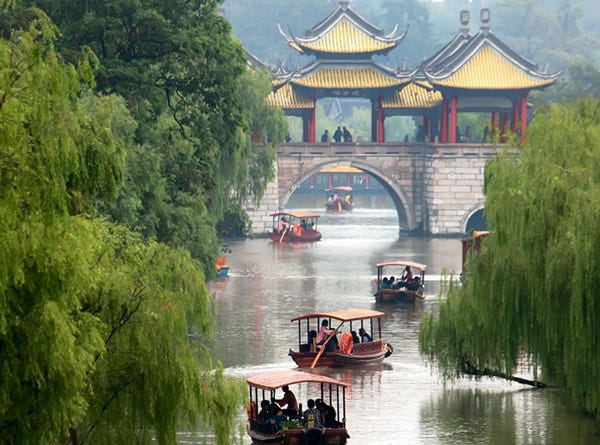
Yangzhou’s original position was not built primarily on what it produced. It was built on what it controlled.
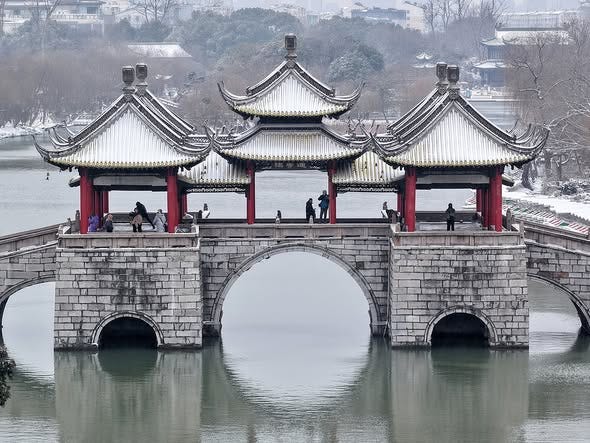
The city occupied a strategic point in China’s inland transport network, where the Yangtze River met the Grand Canal, connecting the country’s east-west natural waterway with its north-south artificial one. This geography made Yangzhou an important commercial and administrative node. But geography alone cannot explain the extraordinary fortunes that accumulated here. What transformed the city’s position was the imperial salt monopoly.1
For centuries, salt was one of the most important sources of state revenue in China. It was a necessity of life, and the imperial government regulated its production, distribution and sale through a system of licences and designated trading territories. Access to this system was restricted to privileged merchants, whose commercial opportunities depended on their relationship with the state. Yangzhou became one of the principal centres of the trade, serving as the southern administrative hub of a distribution network connected to the Grand Canal, with Tianjin playing a corresponding role in the north.2
The merchants who operated within this system accumulated extraordinary fortunes, in some cases on a scale comparable to the wealth of the imperial treasury.3 But the significance of these fortunes extended beyond the accumulation of money. They financed a cultural transformation that would shape Yangzhou long after the commercial system itself had weakened.
The salt merchants occupied an unusual position in Chinese society. They possessed immense wealth but did not automatically enjoy the status of the scholar-official elite. Cultural patronage offered another way to establish distinction. They built elaborate gardens, commissioned banquets from accomplished chefs, funded scholarship, collected art, and competed with one another in displays of learning and refinement.4
Their rivalry helped sustain a city in which cultural achievement became another measure of status. Yangzhou developed into an important centre of literary and artistic production, associated with the Yangzhou School and its distinctive approaches to scholarship, practical learning, and cultural life.5
The resulting system depended on several conditions working together: imperial policy, privileged access to the salt trade, the Grand Canal’s commercial importance, and the merchants’ ability to convert their profits into cultural distinction.
None of these conditions was permanent.
During the nineteenth century, reforms to the salt administration weakened the system that had sustained the merchants’ privileged position.6 Over time, changes in transport and trade further eroded the Grand Canal’s commercial importance, while the fortunes of the merchant families declined or dispersed. Yangzhou’s economic position diminished, and by the early twentieth century it had become a provincial city far removed from the prominence it had enjoyed during its commercial heyday.
The system that had concentrated wealth in Yangzhou had weakened. The commercial privileges that sustained its leading merchants no longer provided the same foundation for the city’s prosperity.
Yet the end of that system did not erase the city it had helped create.7
Yangzhou entered a different historical period carrying the physical and cultural consequences of its former prosperity. What those remnants amounted to, whether they represented little more than a memory of past greatness or contained the basis of something that could endure, remained to be discovered.
That is where the story of Yangzhou’s irreplaceability begins.
Discovery
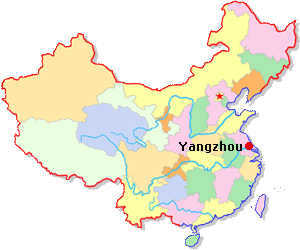
The wealth was gone. The question was what remained.
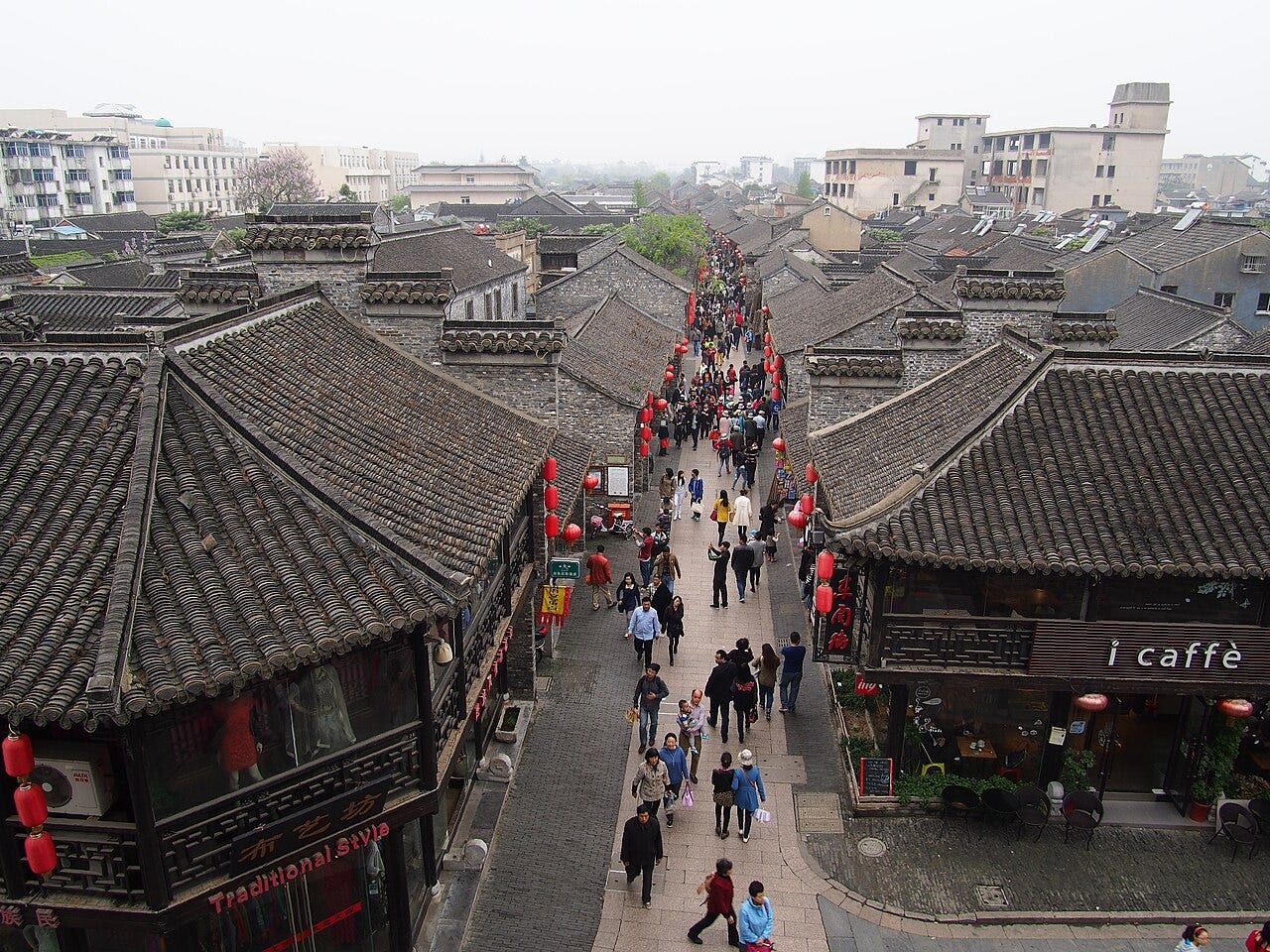
The salt merchants had left, but the world they had built had not entirely disappeared with them. Their houses still stood. The gardens they had commissioned and dozens of private retreats scattered through the old city, survived as physical evidence of the fortunes once concentrated here.8 The streets on which they had lived, including 东关街 and 南河下, retained their historic layouts and many of their original buildings.9 Yangzhou’s old city was not a ruin, it was still inhabited.
But a surviving building is not necessarily an enduring source of distinction. Buildings can be restored, and streets can be reconstructed. The more important question was whether anything beyond the physical fabric of the old city had survived.
The practice can outlast the people who made it prosperous.
The Yangzhou expression 早上皮包水 (Morning water) captures the city’s morning tea tradition: the idea that the morning belongs at the tea house, over 烫干丝 (Hot dried shreds), steamed buns and conversation. This was part of the daily rhythm of the salt merchant era.10 Yet when the merchants disappeared, the habit continued. It passed into the ordinary life of the city, practised by people who had never known the fortunes that had helped sustain it.11 The tea houses, the rituals, and the shared expectations of a proper morning tea remained.
What survived, then, was not simply a collection of old customs. It was a practice that continued to organise everyday life.
Practice can carry a standard.
The salt merchants had demanded refinement. Their wealth allowed them to employ cooks who could transform humble ingredients into elaborate dishes, cutting tofu into threads so fine they could float in broth. They cultivated an expectation that food should be more than nourishing: it should demonstrate precision, beauty and skill.12
When the merchants disappeared, that expectation did not disappear with them. It had become embedded in Yangzhou’s culinary culture, carried through the judgements of cooks, the habits of diners, and the accumulated knowledge of what constituted good food.13 The original patrons were gone, but the standard they had helped cultivate continued to shape the work of people who came after them.
A tradition could therefore survive not only because people continued to practise it, but because they continued to recognise the difference between an ordinary performance and an accomplished one.
A standard could be reproduced institutionally.
In 1983, Yangzhou established what became a landmark in the formal education of Chinese cuisine: a higher education programme dedicated to the subject.14 The Culinary Arts Department of Jiangsu Commercial College, later incorporated into Yangzhou University, represented something beyond the transmission of recipes or the training of individual cooks. It created a setting in which culinary knowledge could be taught systematically, developed and passed on to successive generations.
Over time, this educational infrastructure expanded into a broader pipeline spanning vocational training, undergraduate education, postgraduate study and doctoral research.15 What had once depended heavily on the relationship between a skilled cook and an individual patron could now be supported by institutions capable of training practitioners and developing knowledge across generations.
The significance was not simply that Yangzhou had preserved its culinary heritage. It was that the city was building the capacity to reproduce the expertise on which that heritage depended.
The people establishing these institutions may have understood their immediate purpose as education and professional training. But the longer term consequence was more far reaching: Yangzhou was developing the means to sustain and extend its culinary distinction even without the wealth that had originally nurtured it.
Activation
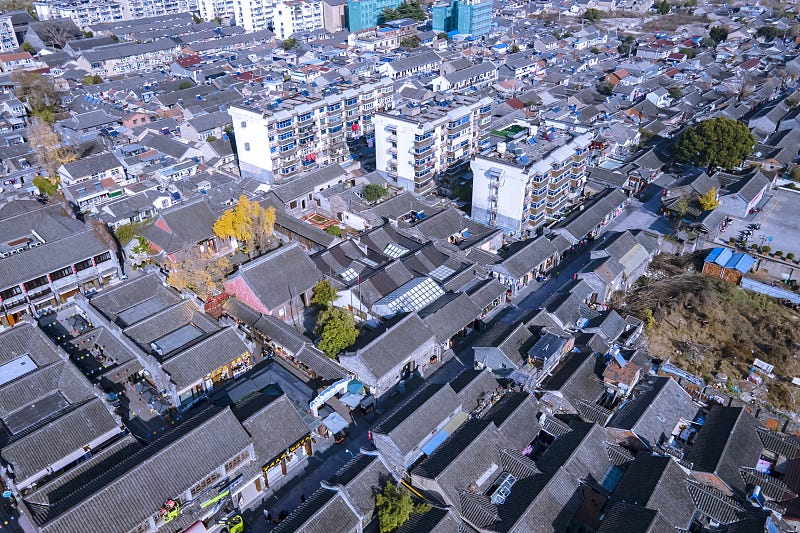
The city did not simply inherit its past. Through preservation policy, educational infrastructure and formal recognition, it turned that inheritance into a position that could be maintained, extended and recognised beyond its borders.
The process operated across three reinforcing layers.
Protecting the Living City
In the 1980s, Yangzhou imposed a 24 metre height limit on new buildings in the old city.16 The 2017 Yangzhou Ancient City Protection Ordinance subsequently established a legal framework for protecting the historic environment.17
The principle was tested in Dongguan Street. When a proposed widening threatened the existing street pattern, residents objected and the city abandoned the plan. Renewal proceeded incrementally, retaining original residents and the character of the neighbourhood.18 In Renfengli, the city introduced a leasing model for vacant historic houses, allowing new cultural businesses to enter without requiring the wholesale replacement of existing life.19
The decision was consequential, Yangzhou could modernise its historic districts without treating their existing urban fabric as an obstacle to development.
Building the Knowledge Institution
The second development was the expansion of culinary education into a system of formal training and research.
Yangzhou University’s culinary education programme developed over four decades. In 2026, the university reported that it had achieved integrated undergraduate, master’s and doctoral education in the catering field.20 Its curriculum combined practical culinary training with subjects including food science, nutrition, sensory analysis, history and aesthetics.21
In January 2026, the university also hosted the launch of the Huaiyang Cuisine Digital Protection Project.22 The initiative set out to document culinary techniques, master lineages, and cultural knowledge using digital technology and food science.23
These developments extended the work of individual practitioners. Culinary knowledge could now be taught through formal programmes, investigated through research and systematically documented for future transmission.
Extending the Position
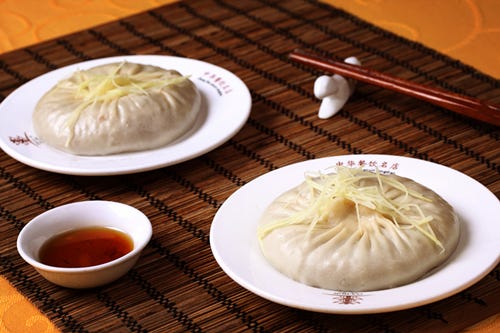
In 2019, UNESCO designated Yangzhou a Creative City of Gastronomy. The designation was formally unveiled in April 2020, placing the city within UNESCO’s international Creative Cities Network.24
The recognition gave Yangzhou an international platform for its culinary identity.25 Subsequent initiatives in culinary heritage protection, international exchange and the promotion of Huaiyang cuisine extended that presence.26
Meanwhile, the city’s approach to heritage renewal sought to bring old and new economic activity together.27 Traditional streets and established businesses continued alongside cultural enterprises, contemporary visitor experiences and new commercial uses.28
The Conversion
Yangzhou’s transformation was not simply the preservation of a glorious past.
The city used policy to protect its historic environment, institutions to develop and transmit culinary knowledge, and formal recognition to extend its standing beyond the local context.
The salt monopoly had once given Yangzhou a privileged position in a state controlled commercial system. Its later position rested on a different combination of assets: a distinctive tradition, the institutions capable of sustaining it, and recognition that connected it to wider networks.
The source of Yangzhou’s wealth changed. Its basis for distinction changed with it.
The Doctrine

Wealth and authority are not the same thing.
Wealth is the capacity to generate, accumulate or control value. Authority is the recognised position from which a standard is defined, transmitted and judged.
Wealth can disappear when the system that produces it collapses. Authority can survive, provided it has been embedded in institutions and practices that no longer depend on the original source of wealth.
A system that wants its position to outlast its prosperity must do more than accumulate wealth. It must convert some of that wealth into the capacity to define and reproduce a standard.
That conversion requires three conditions.
Surplus must build reproductive capacity, not merely finance consumption.
The difference is structural. Consumption uses resources in the present. Institutions can turn resources into capabilities that persist and develop over time. The decisive question is not how much wealth a system spends, but what its expenditure enables future generations to do.
Capacity must become independent of its original patrons.
Knowledge and capability tied to one individual, family or commercial enterprise remain vulnerable to the disappearance of their sponsor. Embedded in universities, public systems, legal protections and collective practices, they can continue beyond the people who established them. The objective is to turn private advantage into an enduring institutional capability.
Inheritance must be activated.
Surviving institutions do not automatically produce authority. A tradition can remain intact yet lose its relevance; a school can continue operating without defining a field; a historic city can preserve its buildings without acquiring a contemporary role. Activation occurs when a system recognises what it has inherited and builds a new position around it.
Together, these conditions explain how an economic system can decline without taking all its accumulated capabilities with it. They also explain why survival alone is insufficient: what remains must be reproduced, developed, and recognised.
The strategic barrier is not the product. It is the authority to define the standard.
Products can travel, recipes can be copied, techniques can be taught and factories can be built elsewhere. But the recognised position from which a standard is defined cannot be transferred so easily. It rests on accumulated expertise, institutions, historical continuity and the collective recognition of practitioners and audiences.
This is what makes authority strategically different from an ordinary asset. Competitors can reproduce a product or match its price without necessarily displacing the institution or place against which quality is judged.
Authority is not permanent, nor is it impossible to challenge. It must be sustained through continued practice, institutional credibility, and the capacity to evolve. But where these conditions hold, it creates a form of defensibility that money alone cannot readily buy.
The Authority Conversion Principle.
Wealth becomes durable authority when surplus is converted into institutions that preserve, develop and reproduce a standard beyond the lifetime of the system that financed them. The conversion requires institutional independence, deliberate activation, and continuing recognition. The result is not merely an asset that can be owned or a product that can be sold, but a position from which others come to learn, evaluate, and define what excellence means.
Position in the Fortress
The Authority Conversion Principle belongs to an existing doctrine family: Certification Sovereignty. Its contribution is to explain how a system can acquire and sustain the authority to define a standard even after the economic system that originally funded it has disappeared.
Family X | Certification Sovereignty
Doctrine Family
The question this family asks is: Who decides what is real?
The cities in this family derive their irreplaceability from their position in defining, validating or authenticating a standard. Yancheng institutionalises certification. Zibo codifies craft knowledge into intellectual property. Shigatse governs spiritual legitimacy. Lishui originates its own standard. Foshan (Shunde) establishes the rules by which a field is judged. Pingxiang houses the authority that defines quality.
Yangzhou belongs to this family because its distinctive position rests on its recognised relationship to Huaiyang cuisine. Not simply as a producer of the food, but as a reference point for its standards and refinement.
What distinguishes Yangzhou is not the type of authority it holds, but the mechanism through which that authority was sustained. Its story concerns the conversion of commercial wealth into institutions capable of reproducing knowledge long after the original source of wealth declined.
The Distinction from Other Principles
Yangzhou’s closest relationships within the Fortress reveal what this mechanism adds.
Zibo: Certification Sovereignty.
The city codified accumulated craft knowledge into intellectual property. Yangzhou’s culinary institutions also formalise knowledge, but its distinctive mechanism is the conversion of commercial surplus into structures that teach and reproduce a standard. Zibo’s emphasis is on codification; Yangzhou’s is on institutional reproduction.
Tainan: Origin Sovereignty.
The Precedence Principle derives irreplaceability from occupying the first position in a historical sequence. Yangzhou’s position also draws on historical continuity, but its distinctive contribution is not precedence alone. It is the development of institutions that sustain a standard across generations. Tainan’s barrier is historical precedence; Yangzhou’s is accumulated institutional capacity.
Yibin: Origin Sovereignty.
Yibin’s Cultivated Origin Principle rests on the long relationship between a living organism, its environment and place bound knowledge. Yangzhou likewise depends on accumulated knowledge, but its principal barrier is institutional rather than biological. The time and collective effort required to develop, transmit, and maintain an established body of expertise.
Xinzhou: Hidden Value Recognition.
The activation of an ecosystem of embodied knowledge is the basis of Zinzhou’s position. Yangzhou shares this dependence on living expertise, but adds a distinct emphasis on the institutions that reproduce it. The question is not only how existing knowledge is recognised, but how it is made transmissible beyond individual practitioners.
Huai’an: Hidden Value Recognition.
Huai’an identifies value in the residue of extraction. Yangzhou offers a different kind of inheritance. Its enduring assets are not primarily physical residues of the salt economy, but the cultural practices, knowledge and institutional capabilities that accumulated around it.
These comparisons establish a distinction between the source of an advantage and the mechanism that sustains it. Yangzhou’s particular contribution is to make that mechanism explicit.
The New Contribution
The Fortress already accounts for authority that is built, inherited, codified or activated from an existing ecosystem. Yangzhou adds a temporal dimension that authority can emerge from the institutional residue of an economic system that no longer exists.
This is not a claim that every declining economy leaves behind a durable advantage. Wealth may disappear without creating anything capable of surviving it. The critical condition is that some of the accumulated surplus must have been converted into institutions, practices and bodies of knowledge that can reproduce a standard beyond the original patrons and commercial arrangements.
Nor does survival alone guarantee authority. The inheritance must remain active, develop over time, and continue to be recognised.
Yangzhou therefore contributes a specific proposition to the Fortress:
Irreplaceability can outlive the economy that financed it when wealth has been converted into institutions capable of reproducing a recognised standard.
The asset that survives is not the original wealth, nor simply the memory of past prosperity. It is the institutional capacity that the wealth helped establish.
City in Five
1. The wealth was never the asset.
2. The real inheritance was what the wealth made possible: institutions that could reproduce a standard.
3. Yangzhou lost the economic system that made it rich. It retained the foundations of its authority.
4. The food travels. The standard setter does not.
5. Irreplaceability can outlive the economy that created it, when the institutions that sustain it survive.
Reflection
You have probably seen this pattern before, even if you did not have a name for it.
A company loses the product that made it successful, but retains the training systems, standards, and expertise that shaped its industry. It remains influential because it helped establish how the product should be made.
A family loses its fortune, but retains the habits, expectations, and standards that shaped the household. The money disappears but the inheritance continues in how its members work, build and treat others.
A person develops a skill that technology eventually makes commonplace. The skill loses its scarcity, but the judgement, relationships and way of seeing developed through years of practice remain available for whatever comes next.
A community loses its industry, but keeps the institutions through which people organise, learn and support one another. The factory closes. The community’s capacity to function does not necessarily close with it.
In each case, the question is the same.
What did the period of prosperity build that can continue without it?
This is not a question about frugality or saving for difficult times. It is about whether resources were converted into enduring capabilities, whether the surplus produced something that could be transmitted, developed and used by people who did not create it.
But capability alone is not enough. An inheritance can survive for generations without ever becoming the foundation of a new position.
That requires a second question:
Have you recognised what you inherited and what it could make possible?
People and institutions often treat the residue of an earlier era as nostalgia, obligation or heritage to be preserved. They maintain what remains without examining what it might enable. The institution continues, but its potential goes unused. The tradition survives, but its possibilities remain unexplored.
Yangzhou offers a different way to look at inheritance. What survives the disappearance of wealth need not serve as a memorial to the system that created it. It can become the foundation of something new.
The past does not guarantee that outcome. Institutions can decay, knowledge can lose relevance, and authority can be displaced. What survives must be recognised, activated and sustained.
So the question is not simply what you have lost.
What did that loss leave behind and what could you build from it?
Next Week: Jinhua
The next city teaches something different from Yangzhou.
Yangzhou showed how authority can outlive the economy that created it, how institutions of reproduction become the permanent asset when the original wealth disappears.
The next city shows how a place becomes indispensable by becoming the only place where the entire thing can be done. Not a single asset, not a single institution. A complete system: every set, every service, every skill, every supplier, every support function, assembled in one location at a density that competitors cannot match and cannot reassemble.
It began with a single street built in four months for a single film. Three decades later, it produces two thirds of China’s historical dramas and has become the global center for a format that now surpasses cinema in market size .
It is not a city in the conventional sense. It is a production ecosystem that became a city.
Antonia Finnane, "Yangzhou: A Central Place in the Ming and Qing Dynasties," in Speaking of Yangzhou: A Chinese City, 1550–1850 (Cambridge, MA: Harvard University Asia Center, 2004), 23–25.
Pauline D Loh, "Solid Gold Salt," China Daily Europe, February 26, 2017.
Ibid2
ibid1
Lee Won-seok, "Practical Learning Thought and the Movement to Change Daily Culture of Yangzhou Scholars in the Mid-Qing Period," History and Discourse 51 (2008): 143–184.
ibid2
ibid1
Yangzhou Municipal People’s Government, “Yangzhou Gardens: Ge Garden”
Jiangsu Provincial Local Chronicles, "Yangzhou Ancient Streets and Alleys: Nanhexia," July 4, 2022.
Guan Shijun and Wang Rong, "Humanities History: The Morning Tea Culture of Yangzhou's 'Three Springs,'" Study Strong Nation, August 29, 2020.
Su Yan, Du Qian, and Chen Chen, "Yangzhou's Dongguan Street: Keeping Old Neighbors, Reviving Old Crafts," Guangming Daily, May 12, 2026.
Yangzhou University School of Tourism and Culinary Arts, "Introduction to the Department of Cuisine and Nutrition,"
ibid12
Yangzhou University School of Tourism and Culinary Arts, "School Introduction,"
Yangzhou University, "Overseas Chinese Affairs Office Chinese Cuisine Prosperity Base: Yangzhou University School of Tourism and Culinary Arts Meets You," April 6, 2016.
National People's Congress, "Ten Years of Rule of Law Nourishing the Ancient City, A Thousand Years of Cultural Heritage in Youth," September 23, 2025.
Jiangsu Provincial People's Government, "Yangzhou Continues to Promote Ancient City Protection and Revival," November 10, 2025.
Jiangsu Provincial Local Chronicles, "Yangzhou Ancient Streets and Alleys: Nanhexia," July 4, 2022.
Su Yan, Du Qian, and Chen Chen, "Yangzhou's Dongguan Street: Keeping Old Neighbors, Reviving Old Crafts," Guangming Daily, May 12, 2026.
Xinhua News Agency, "Yangzhou University School of Tourism and Culinary Arts Achieves Full Coverage of Integrated Undergraduate-Master-Doctoral Education in the Catering Field," September 9, 2026.
Yangzhou University School of Tourism and Culinary Arts, "Culinary and Nutrition Education Undergraduate Talent Training Program (25th Edition)," December 7, 2025.
Jiangsu News, "Cooking Can Also Earn a Doctorate! Yangzhou University Welcomes China's First Doctoral Student in Food Science and Technology," September 8, 2026.
China News Service, "Jiangsu Huaiyang Cuisine Intangible Cultural Heritage Protection Project Launched in Yangzhou," January 15, 2026.
Ibid.
Yangzhou Municipal People’s Government, “Yangzhou Ancient City Protection Ordinance,” January 1, 2017.
Ministry of Culture and Tourism, "Yangzhou Holds 'World Food Capital' Unveiling Ceremony," April 20, 2020.
People's Daily, "'Slow Simmering' Blends Old Flavors with New Vitality," November 10, 2025.
Yangzhou News, "Star Check-ins + International Exchange: Connecting the World Through Taste Buds, Yangzhou Huaiyang Cuisine Frequently Goes Viral," July 28, 2026.