



Hengdian is a place built to stand in for somewhere else.
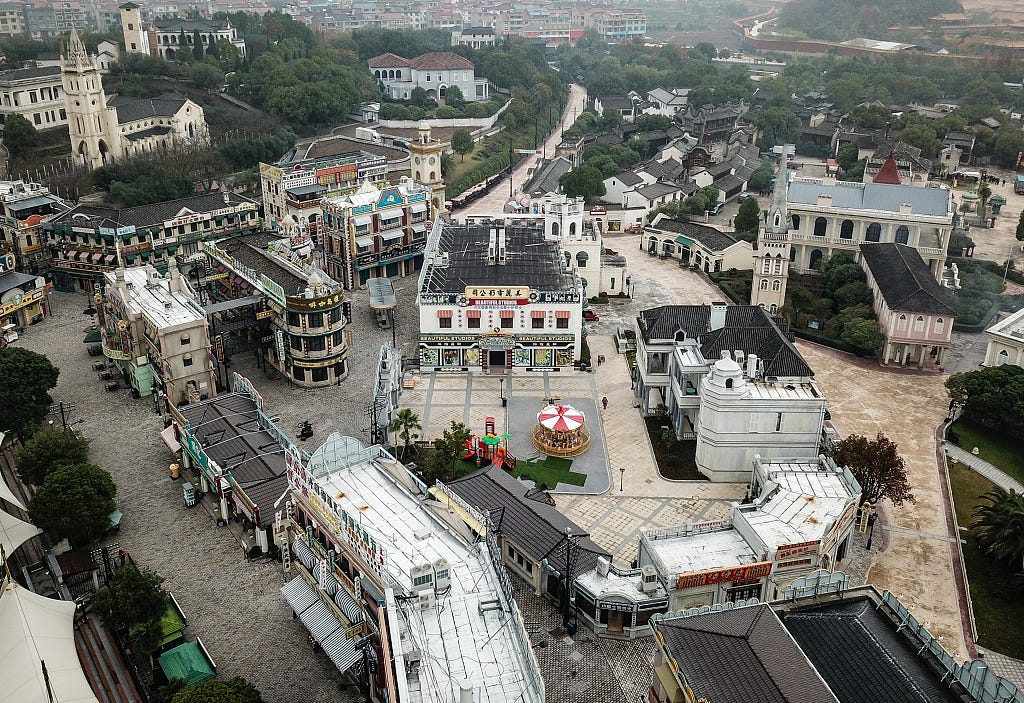
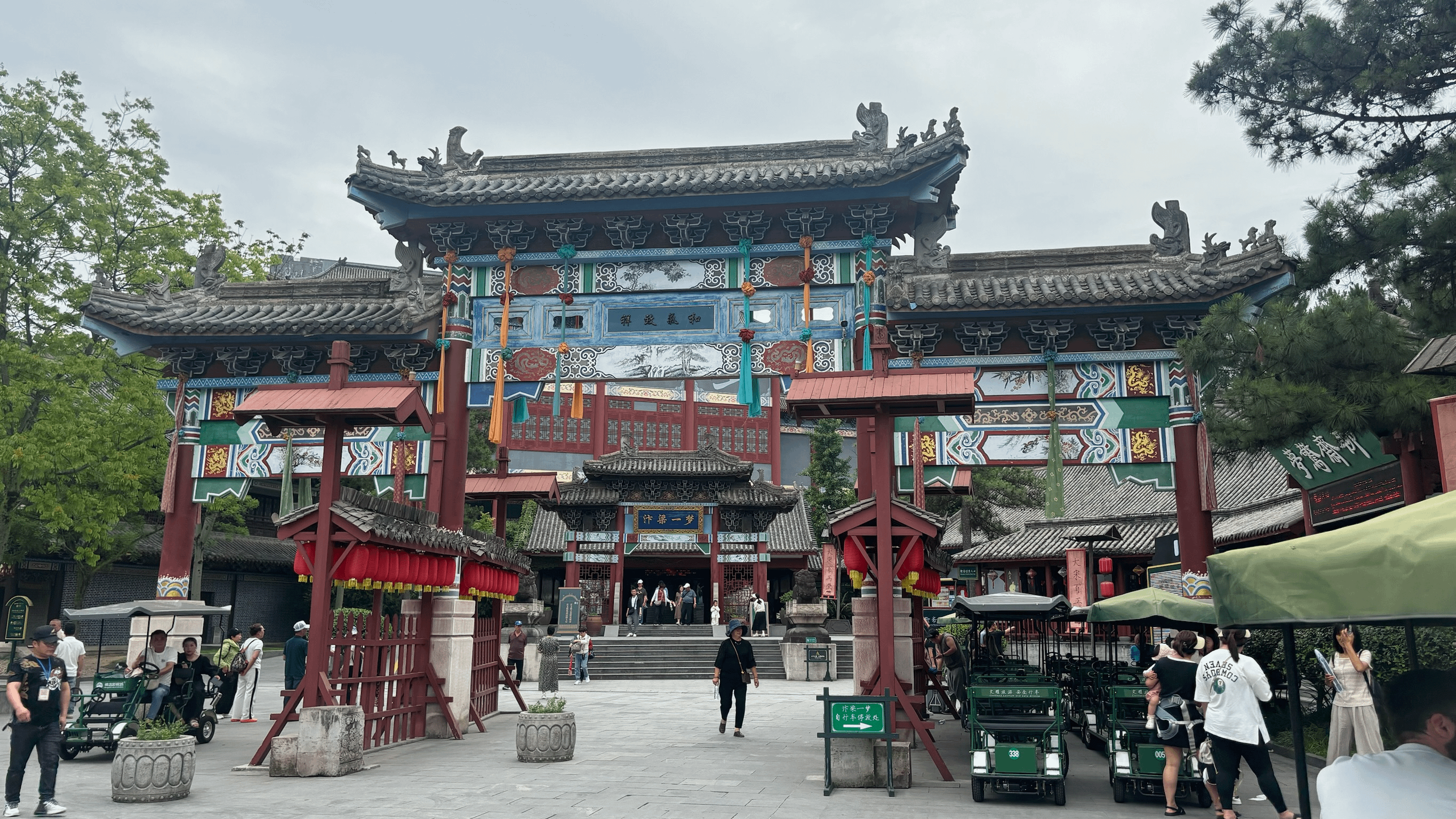
A Forbidden City rises in Zhejiang, a Shanghai street meets a Tang dynasty palace with a Guangzhou neighbourhood giving way to a battlefield. These places look as though they belong to different cities, different centuries, different worlds. In Hengdian, they stand within reach of one another, waiting for the next production.
The sets can be built, the scenes can be staged and even the architecture can be replicated elsewhere.
But the industry that has gathered around them is harder to reproduce.
A production arriving in Hengdian does not encounter an isolated film set. It enters an environment where locations, crews, performers, equipment, suppliers and production services have accumulated around the work of making films and television dramas. Each new production draws on that concentration, while adding to the activity that makes the next production easier to organise.
This creates a peculiar kind of advantage. Hengdian does not have to be the best possible location for every production, or the only place capable of accommodating it. It has to be the place where the practical case for going elsewhere becomes harder to justify.
That is a different threshold from excellence. Excellence wins a comparison. A default can make the comparison unnecessary.
The question is not how Hengdian became a film production centre. It is how it became the answer that can be chosen before the alternatives are seriously considered.
At what point does accumulated density become gravity, drawing more activity towards a place until using what already exists requires less effort than building somewhere else?
The Historical System
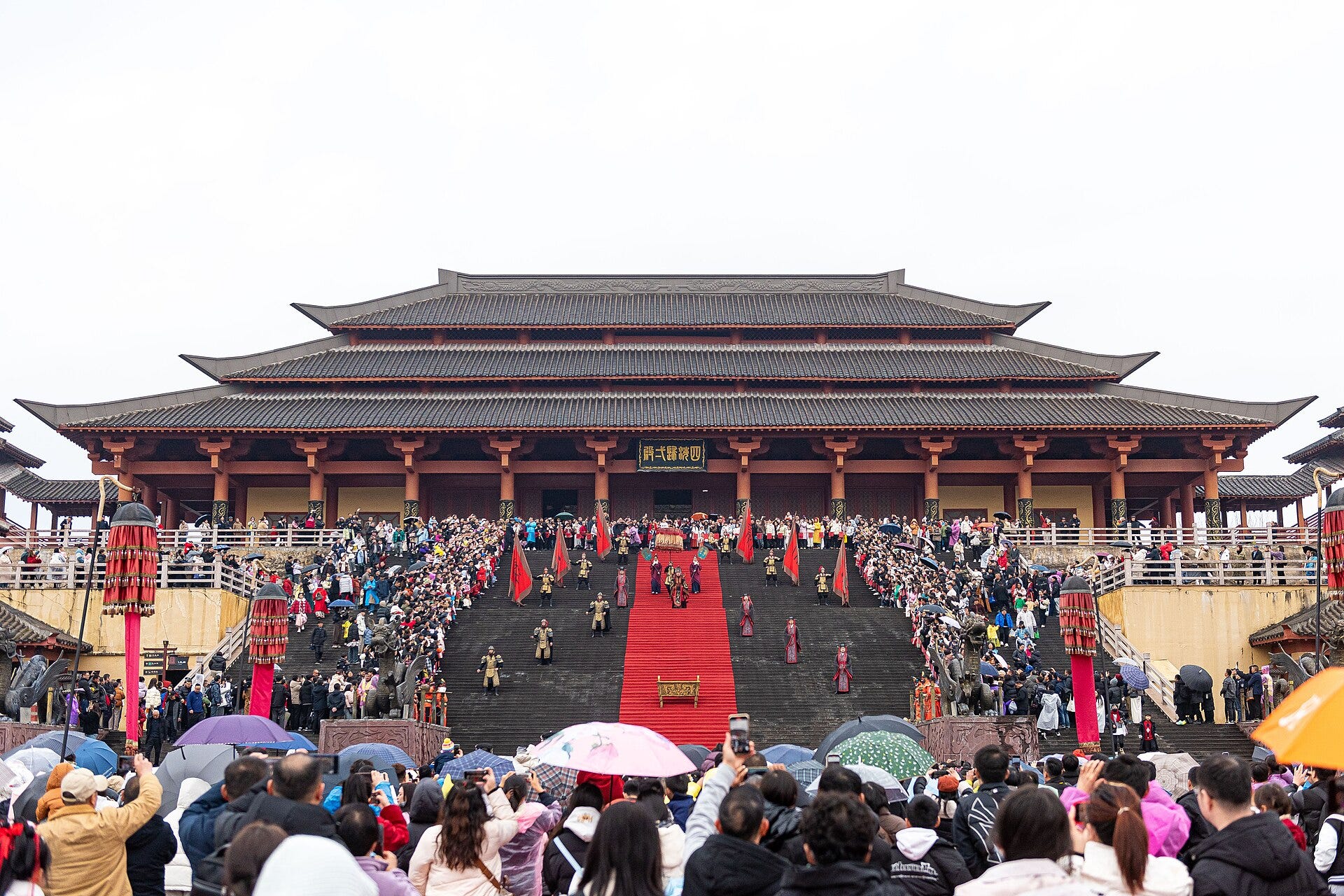
Hengdian did not begin with a film industry. It began with an industrial business and a founder willing to invest its resources in something the town had never done before.
By the early 1990s, Hengdian’s economy rested on manufacturing, including textiles and magnetic materials.1 Xu Wenrong, the founder of Hengdian Group, had built an industrial enterprise from a silk reeling mill acquired in 1975. The business gave him something the town’s geography and history could not, the capital to attempt a project on an entirely different scale.2
The opportunity came in late 1995, when director Xie Jin visited Dongyang looking for locations for The Opium War. The production needed a reconstruction of a nineteenth century Guangzhou street. Xu offered to build it himself, promising to complete the work in three months.3
The resulting set covered 21 hectares and contained around 150 buildings, with more than 60,000 square metres of construction. Completed in just over four months, it gave the production the location it needed. When The Opium War was released in 1997, Hengdian gained national attention.4
The significance of the project extended beyond a single film. Hengdian had demonstrated that a town without an established film production infrastructure could build a setting for a major production within a demanding timeframe.
Xu continued investing. A Qin dynasty palace followed the Guangzhou Street project, then other settings representing different periods and places, including Hong Kong Street and a recreation of Along the River During the Qingming Festival. By 2004, Hengdian had assembled thirteen filming bases, each adding another range of settings that a production could use.5
The investments were cumulative. A production that came for one historical setting could now find others nearby. Each new base expanded the range of projects Hengdian could accommodate, making the location useful for more than the film that had first brought it there.
But a collection of sets, however extensive, does not by itself create an industry. At this stage, Hengdian had built a growing inventory of production locations. The more consequential question was what would happen when productions began to organise their work around that inventory and when the town began to build for the needs of the industry beyond the sets themselves.
Discovery

The sets were not the product, the flow was the product.
Initially, Hengdian operated on a straightforward model; productions came to use its sets, paid location fees, filmed their scenes and left. The business was built around access to physical assets. More sets meant more locations to rent.
In 2000, Hengdian changed the model. From March 1, the town announced that filming crews could use its production bases without paying location fees.6 The decision removed a direct charge that had previously made each location part of a production’s cost calculation.
But the sets were only one part of what a production needed. Crews still required props, costumes, equipment, accommodation, food, transport and labour. By making access to its principal attraction free, Hengdian could draw productions into an environment where those other needs generated business.7
The logic was cumulative. More productions created demand for more services. More suppliers and workers made the next production easier to organise. As the supporting network grew, Hengdian became useful for reasons that extended beyond the sets themselves.
The early figures suggest how quickly activity accumulated. Between 1996 and the end of 2003, Hengdian reportedly hosted 143 production crews, responsible for more than 4,000 episodes of film and television. More than fifty productions a year were filming there on average, with over twenty crews sometimes working simultaneously.8
The important change was not simply the number of productions. It was the relationship between them and the environment in which they worked. Each crew could draw on resources that earlier productions had helped attract and sustain. Hengdian was becoming more than a collection of filming locations: it was becoming a concentration of production activity.
Later accounts of the town’s development describe the scale this model eventually reached. By 2019, Hengdian Group reported that more than two thirds of China’s costume dramas had been produced there.9 That later figure should not be confused with the position Hengdian occupied in the early 2000s, but it illustrates the scale of the concentration that followed.
The decision to make the sets free changed the economic logic of the enterprise. Hengdian no longer needed to treat every filming location as a product to be rented separately. The locations could instead attract the activity from which a wider network of businesses benefited.
The sets attracted the productions. The productions attracted the services. The services made the next production easier to bring in.
That was the beginning of gravity: not the accumulation of assets alone, but the accumulation of activity that made those assets more valuable to each successive user.
Activation
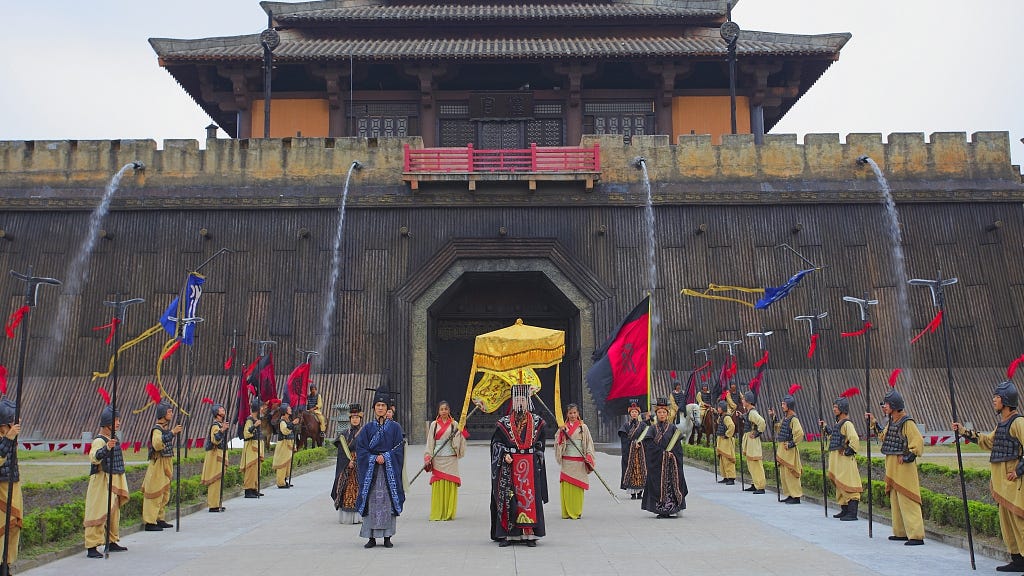
Hengdian had attracted productions by offering something they needed; places to film. But attracting a production and making a town capable of supporting an entire industry are two different achievements.
The next stage was to build around the work that happened between the scenes. The people needed to fill them, the institutions that could support the industry, the systems that could coordinate its demands and the infrastructure to accommodate new forms of production. These developments did more than increase Hengdian’s capacity. They made the town increasingly ready for the next production before it even arrived.
This required deliberate construction at every layer and each layer made the next one possible in a way the previous layer could not have achieved alone.
Institutionalising the Cluster
In 2004, Zhejiang introduced policy support for the Hengdian Film and Television Industry Experimental Zone.10 In April, national approval established it as China’s first national evel film and television industry experimental zone. The associated policies offered incentives including tax benefits, land-use priority, and fiscal support for qualifying enterprises.11
This gave Hengdian more than a collection of filming locations. It established a policy framework for developing the surrounding industry, encouraging enterprises to establish themselves within the cluster and strengthening the conditions for sustained production activity.
The significance was cumulative, the town was no longer relying on individual productions to justify individual investments. It was building an environment in which film related businesses had reasons to establish a continuing presence.
Building Labour Depth
In 2003, Hengdian established its Film and Television City Actors’ Guild, an organisation dedicated to serving background performers.12
The guild brought structure to a workforce that productions repeatedly needed. Registration, performer categories and assessment for specialised work helped make the labour pool more accessible to production teams.13 By 2024, reports put the guild’s registered extras at more than 130,000; a 2026 account placed the cumulative figure above 150,000.14
The advantage was not simply the size of the workforce. It was the concentration of people familiar with the demands of film production, including the routines of working on set and the requirements of different types of performance.
A production arriving in Hengdian could draw on an established labour pool rather than assemble every part of its workforce from scratch. Reproducing the sets elsewhere would not automatically reproduce that accumulated experience or the networks through which workers and productions found one another.
Making Density Coordinable
A large concentration of crews and suppliers creates another problem: coordination. Locations, schedules, equipment, transport and production requirements must fit together under tight deadlines.
Hengdian’s Film and Television Culture Industry Brain addressed this challenge through a digital platform that integrated production-related information and logistics. By December 2025, the platform had been developing for more than four years and had added a low altitude delivery service for crew supplies and equipment, using AI obstacle avoidance and BeiDou positioning technology.15
The strategic significance lies in the operational problem the platform addresses. A dense production cluster is valuable only if its resources can be accessed and coordinated efficiently. Digital systems can help make that concentration more usable, reducing the effort required to organise work across the ecosystem.
The platform’s accumulated operational experience may also be difficult to reproduce immediately. A competitor can develop comparable technology, but building an equally useful system requires relevant data, established workflows, and sustained use by the people and businesses it serves.
Absorbing New Formats
The clearest test of the cluster’s adaptability came with the growth of vertical micro-dramas.
In 2025, Hengdian reportedly received 4,016 vertical micro-drama crews, an increase of approximately 237% over the previous year.16 The figures indicate that the cluster could accommodate a rapidly expanding production format using infrastructure and services already developed around film and television work.
The importance of this development is not simply the volume. A production ecosystem tied to one format can become vulnerable when demand shifts. Hengdian’s ability to attract micro-drama production suggests that its underlying advantage extends beyond any single genre or production model.
The format changed, but many of the requirements remained familiar: locations, performers, equipment, crews, and coordination. Hengdian could absorb the new demand without having to create an entirely separate production environment.
The Accumulation Effect
These layers reinforced one another.
Policy support encouraged businesses to establish themselves in Hengdian. A deeper labour pool made productions easier to staff. Coordination systems helped crews access the cluster’s resources. New formats created additional demand for those same resources.
Each development strengthened the usefulness of the others and as the cluster grew, the decision facing a new production changed.
It was no longer simply a comparison between the cost of one set in Hengdian and the cost of a similar set elsewhere. It was a comparison between an established production environment and the effort required to assemble an alternative.
That is the threshold at which density begins to produce gravity.
Hengdian did not need to make every individual asset impossible to replicate. It needed to make the combined system increasingly difficult to match in practice.
The advantage was no longer just what Hengdian had built. It was what a production could do there without having to build it again.
The Shock
When the Default Stops Being Default

Hengdian had spent decades making live action production easier to organise in one place. Then, in 2026, a growing share of the market discovered it could produce a drama without assembling a physical crew, travelling to a location or building a set. The disruption was visible by the end of May. Hengdian World Studios had received 1,499 short drama crews, at least 50 percent fewer than in the same period of 2025.
Look at the image above. These are not just thumbnails; they are the future that arrived early. In the first quarter of 2026, China's online micro-drama industry released approximately 128,000 titles. Meanwhile, industry figures for the first quarter showed approximately 128,000 micro-dramas released in China, of which around 122,000 were AI-generated. The figures measure different parts of the industry, but together they revealed the scale of the shift underway.17
The economics helped explain why. A conventional live-action micro-drama could cost tens of thousands of yuan to produce and take two to three months, while a basic AI-generated drama could be produced at a reported cost of around 300 to 500 yuan per finished minute. These are not directly comparable cost measures, AI production could require repeated generations and substantial reworking to achieve acceptable footage. But for producers seeking to release large volumes of inexpensive content, the potential savings were compelling. The commercial logic of the low cost, high volume model was changing.18
As AI made an alternative production method increasingly viable, the rationale for financing large numbers of conventional volume dramas weakened. Reports from the period also identified changes in platform commissioning and the withdrawal of minimum guarantees that had helped make low budget live-action projects viable for smaller producers. The precise extent to which these decisions were driven by AI remains unclear. But the relationship is significant: as the economics of production shifted, the financing arrangements supporting the old model became less secure.
For Hengdian, the consequences travelled through the entire ecosystem. Fewer productions meant fewer bookings for studios, fewer calls for extras and less demand for the suppliers and services built around filming. One performer interviewed in 2026 described working fewer than ten days over two months. Another veteran actor, who had earned ten to twenty thousand yuan a month in 2025, reported earning seven to eight thousand in 2026 and finding it particularly difficult.19
The pressure reached the industry’s own production companies. Tinghuadao, one of the more prolific live action short drama producers, nearly paused live action shooting and redirected resources towards AI dramas for overseas markets.20 By October, reports put Hengdian’s production start rate at approximately 30 percent of the previous year’s level, with some estimates placing studio vacancy rates near 78 percent. These later figures suggest that the disruption extended beyond a brief post holiday slowdown, although the precise measurements vary by source.21
The shock exposed a vulnerability in the Default Gravity Principle: density can make a place the easiest choice within an established mode of production, but it cannot guarantee that the mode itself will endure.

Hengdian’s sets, labour pool, equipment suppliers and production services had accumulated around live action filmmaking. Their value came partly from their proximity to one another and from the ease with which a production could draw on them together. AI-generated content could bypass much of that physical system. The accumulated density had not disappeared; its relevance to a portion of the market had weakened.
This distinction matters. Hengdian had not necessarily lost its ability to serve live action productions. It had lost some of the demand that made that ability commercially valuable. Because the local ecosystem had grown around that demand, the consequences compounded: fewer crews meant less work for extras and suppliers, while reduced activity threatened to make the cluster less useful to the next production that arrived.
The gravity well was still there. The market was beginning to need something different.
Yet the shock did not establish that live action production was finished or that Hengdian’s advantage had become obsolete. AI offered a new route to volume, but it did not automatically solve the problems of performance, visual consistency, storytelling or creative judgement. Producers reported that generating satisfactory AI footage could require repeated attempts, sometimes eroding the apparent cost advantage. Meanwhile, Hengdian continued to receive live action productions. By June 2026, the base was reporting that new short drama starts in May and June had increased significantly compared with March and April. That was an early sign of recovery, not proof that activity had returned to its previous level.22
The emerging possibility was not a simple return to the old arrangement. It was a more differentiated production market: AI could serve projects where speed and volume mattered most, while live action remained valuable where physical performance, on set collaboration and the expressive detail of human actors mattered. Hengdian’s challenge was to make its accumulated capabilities relevant across that changing mix, rather than assume that the production model that built its position would continue to dominate.
This is where the shock becomes more than a story of technological disruption. Hengdian’s original advantage came from accumulating the assets, workers, services and coordination that made live action production easier to organise. But accumulation alone could not protect the town from a change in what producers needed. Its next advantage would depend on whether it could redirect those capabilities, develop new ones, and remain useful as production methods changed.
The shock therefore adds a necessary qualification to the Default Gravity Principle. Density creates gravity only while the activity around which it accumulated remains valuable. A cluster can become the default for a particular way of working without becoming the default for every future way of working. Its assets may persist even as demand shifts; its advantage depends on whether it can adapt those assets, skills and relationships to what the market needs next.
The default that survives is not necessarily the one that accumulated the most. It is the one that can change what its accumulated density is for.
The Default Gravity Principle
The Doctrine

Most advantages are won by comparison.
A city is cheaper, so production moves there. A company is faster, so customers switch. A product is better, so the market chooses it. The logic is competitive and legible: you win by being measurably superior on a dimension that matters. But comparison is also a vulnerability. Every advantage that can be measured can be matched. Every competitor who understands why you won can try to win the same way. The moment your advantage depends on being chosen, you have entered a contest you must keep winning.
The Default Gravity Principle describes a different kind of advantage, one that makes the comparison less necessary.
Irreplaceability can be manufactured by building density until you become the default answer. Not the best answer. Not the only answer. The answer that requires no deliberation.
The mechanism is not quality, cost or uniqueness alone. It is the removal of the choice from routine consideration. When the cost of evaluating alternatives exceeds the cost of using what already exists, the existing option becomes a centre of gravity. The decision does not disappear. It is made once, early, and then inherited by everyone who comes after.
This is why density can matter more than excellence when complexity is high and coordination is costly. A single superior asset can be copied. A dense system of interlocking assets, people, workflows and accumulated coordination cannot be reassembled quickly, because its value lies not in any one part but in the relationships between them. Density creates speed. Speed creates dependence. Dependence creates default status and default status reinforces the system: the more activity flows through it, the more experience and capacity it accumulates, and the harder it becomes to justify building an alternative.
The strategic implication is counterintuitive. Most actors try to become indispensable by being the best at one thing. The Default Gravity Principle says: become the place where the cost of leaving is higher than the cost of staying, not because leaving is impossible, but because leaving requires rebuilding the coordination already available. You do not need to be the only option. You need to be the option that makes searching for alternatives feel like unnecessary work.
This principle applies wherever complexity is high and coordination is costly. It applies to supply chains, where the density of suppliers can matter more than the price of any one. Applies also for talent clusters, where the concentration of skilled people makes relocation costly for employers and employees alike. Even for innovation ecosystems, where proximity among researchers, funders and infrastructure accelerates iteration in ways that cannot be replicated simply by assembling the same components elsewhere, this principle is relevant. For professional services, where concentrated expertise makes a firm the default choice for complex problems, it also applies. It applies even to careers: the person who becomes the default collaborator, the one whose involvement requires little deliberation because working with them is already the most effective route; has built a form of irreplaceability that does not depend on being the most talented.
But density is not permanence.

The gravity well depends on continued relevance. If the underlying mode of production shifts or the need that created the density disappears, accumulated coordination can lose its value. A default that no longer serves the need stops being the default. The advantage is not density alone; it is density applied to a need that persists.
This is the corollary the Default Gravity Principle requires: gravity must be continuously recalibrated to the mode of production it serves. The density that makes a place the default for one era can become the inertia that prevents it from adapting to the next. The default that survives is not necessarily the one that accumulated the most, but the one that can reconfigure its accumulated capabilities when the ground shifts beneath it.
The transferable insight is this: do not merely try to be chosen. Become the assumption. but never mistake the assumption for permanence. Build the density that makes deliberation expensive and the system complete enough that leaving feels like starting over. Then keep watching the ground, because the need that made you indispensable can change.
Excellence wins a comparison. A default makes the comparison unnecessary. Adaptation determines whether it stays that way.
Family XIII: The Fortress
Position in the Fortress
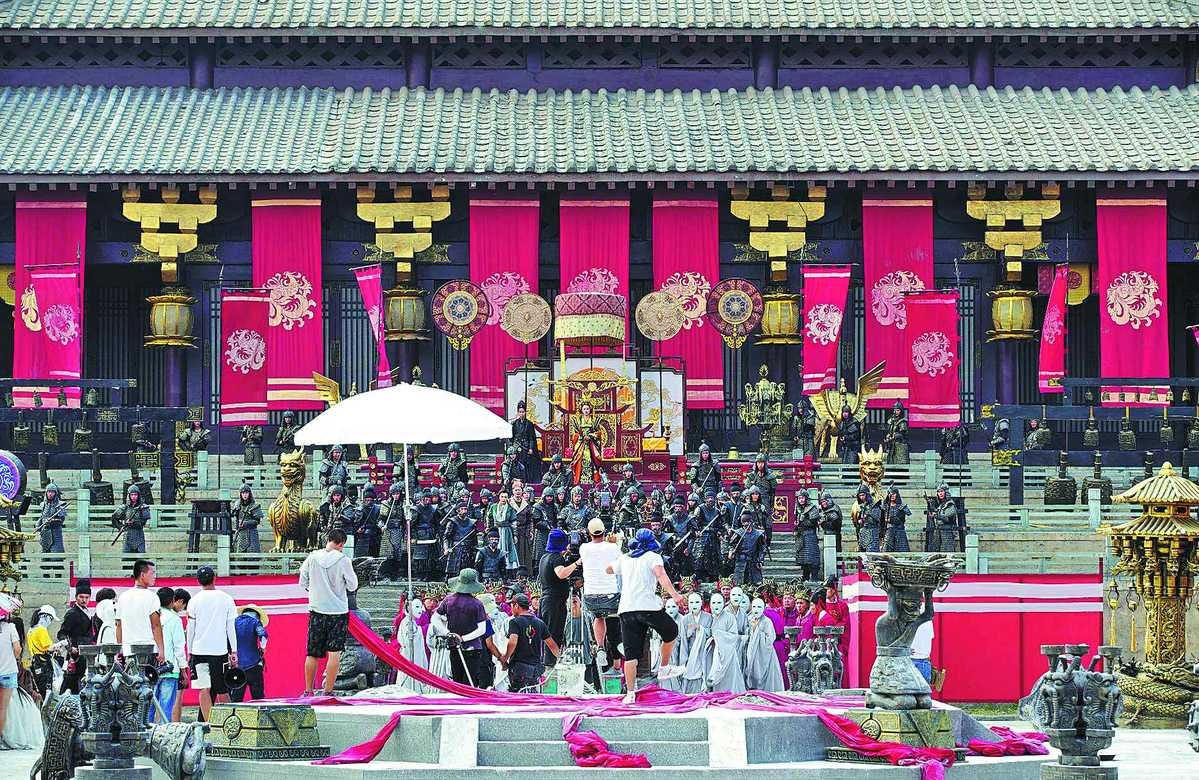
Core Principle: The Default Gravity Principle
Hengdian belongs in The Fortress because its advantage resides in a system of mutually reinforcing relationships rather than a single asset or point of control. Its particular mechanism is gravity through accumulated density: the system becomes difficult to replace because using it is easier than reconstructing its capabilities elsewhere.
Relationship to Previous Cities
Zunyi’s fortress is concentrated around a defining asset; Hengdian’s is distributed across a production ecosystem. One depends on the strength of its centre, the other on the density of its relationships.
Zhangjiajie derives its advantage from a distinctive visual asset; Hengdian from the production system built around its sets. One monetises the image, the other the coordination behind it.
Dongfang’s strength lies in an integrated system under central control. Hengdian’s lies in a distributed ecosystem whose participants reinforce one another through mutual demand.
Xinzhou’s advantage is accumulated embodied knowledge; Hengdian’s is the concentration of capabilities that makes knowledge accessible and deployable at scale.
Tainan (Family IX, Precedence): Tainan derives advantage from its established place in a sequence; Hengdian from becoming the assumed choice within a workflow. Precedence is positional; default status is operational.
Fangchenggang’s passage is constrained by geography; Hengdian’s by the practical difficulty of reproducing its accumulated coordination elsewhere.
New Contribution
Hengdian adds the gravity well to the Fortress taxonomy: a system that becomes difficult to replace not because it controls an indispensable asset, but because accumulated density makes its use the path of least resistance.
It also establishes a boundary condition absent from the principle alone: gravity depends on continued relevance. The 2026 shock demonstrated why that qualification matters. A system can retain its accumulated assets while losing demand for the mode of production those assets serve.
Irreplaceability is achieved by making the choice unnecessary. But gravity must be recalibrated when the mode of production shifts.
Hengdian in Five
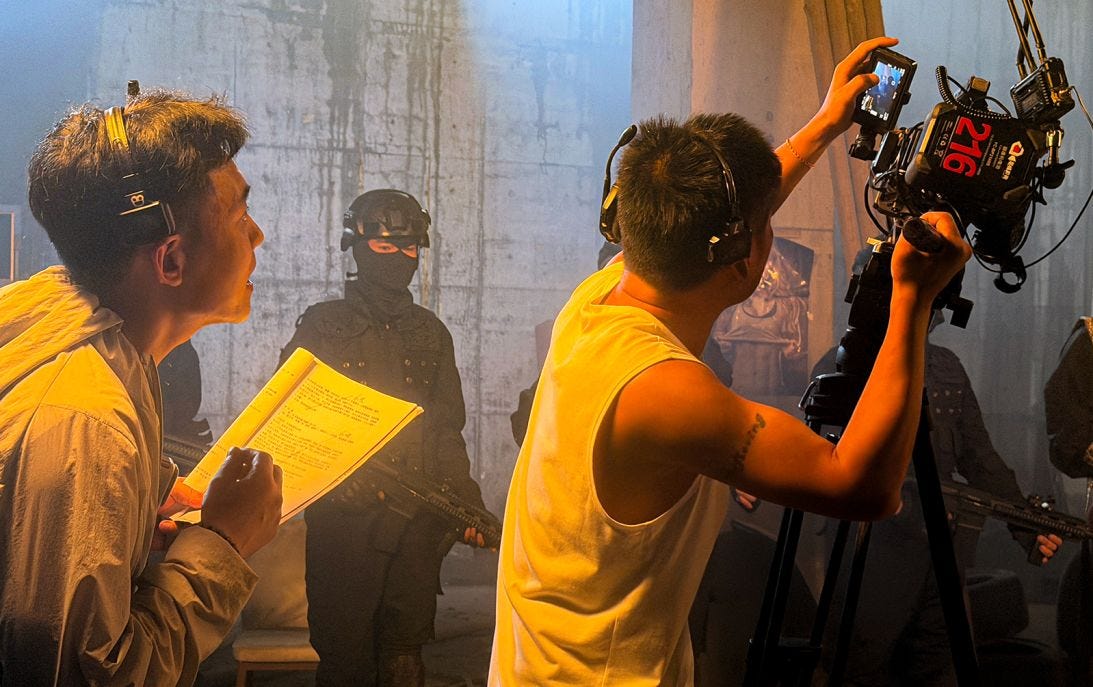
An industrial town became China’s film capital. Hengdian grew out of a business empire built from a silk reeling mill acquired in 1975, not from an established film industry.
Its streets belong to other worlds. From the Forbidden City to historic Guangzhou and old Shanghai, Hengdian recreates places across Chinese history, allowing productions to film different settings within one sprawling complex.
It turned film sets into an industrial cluster. Actors, extras, costume and prop suppliers, equipment providers, accommodation and production services accumulated around the studios, making Hengdian far more than a collection of backdrops.
Its business model made the sets free. From 2000, productions could use filming locations without location fees. Hengdian’s strategy was to attract the crews and capture the economic activity their presence generated.
Its greatest strength carries a vulnerability. The concentration of live action production made Hengdian a default destination, but the rise of AI generated micro-dramas in 2026 showed how quickly demand can change when content no longer needs the physical production system around which a city has built its advantage.
Reflection
Think about the last time you chose something without reconsidering the alternatives.
You returned not because you had proved it was the best, but because you already knew how it worked, what to expect and how to make it fit. Starting again would have meant rebuilding that familiarity from scratch.
At some point, a choice becomes an assumption. You stop asking whether to use it and start asking how to use it.
Now turn the question towards yourself.
Where are you the default?
Not necessarily the most talented or the only person capable of doing the work, but the person others instinctively turn to. Where have you built enough trust, reliability, knowledge and coordination that involving you feels easier than starting elsewhere?
It is tempting to pursue irreplaceability through excellence alone. But being excellent at something does not guarantee that people will keep choosing you. A deeper advantage emerges when your contribution becomes embedded in how things get done, when people rely not just on your individual ability, but on the relationships, understanding and continuity you bring.
Yet this creates a second question and it is the harder one.
What happens when the need you became indispensable for begins to disappear?
You can become the default within a system that is already changing. You can build your reputation around a skill that technology makes less necessary, or become essential to a process that no longer needs to exist in its current form. What once made you valuable can become the boundary of what you know how to do.
Hengdian’s lesson is not that accumulated advantage is futile. It is that the value of what you have built depends on whether it continues to serve a changing world.
So look at the places where others rely on you. What makes you their default: your expertise, your relationships, your ability to coordinate, or simply the fact that nobody has reconsidered the arrangement? If the work changed tomorrow, which parts of your value would travel with you, and which would be left behind?
Where are you the default today and what must you learn, build or become the default for tomorrow?
The answer is not a position to defend forever. It is a reason to keep paying attention.
Next Week | Bozhou
Hengdian showed us how a city can manufacture its own gravity and why that gravity must keep adapting to survive.
Next week, we turn to a city whose advantage was accumulating long before anyone thought to build a fortress around it.
Bozhou, in Anhui, has been associated with traditional Chinese medicine for centuries. Its identity is bound to the trade in medicinal herbs, the knowledge surrounding them and the networks through which that knowledge and those materials have passed from one generation to the next.
It is also traditionally identified as the hometown of Hua Tuo, the celebrated physician of ancient China. Its medicinal herb trade raises a different question for the Fortress: what happens when a city’s advantage is not deliberately assembled, but inherited through centuries of accumulated practice?
Hengdian built a system to attract an industry. Bozhou invites us to examine what happens when history itself becomes part of the infrastructure.
Next week: the difference between building a fortress and inheriting one.
SOURCES
China Daily, "China's 'Hollywood' shines in business," May 28, 2012.
Zhejiang Provincial Government, "Xu Wenrong," March 25, 2021.
China News Service, "浙江小镇'独霸'影视圈" (Zhejiang town dominates film industry), September 12, 2024.
Guangming Daily, "打造全球'梦工厂'" (Building a global dream factory), November 25, 2010.
Sina News, "中国影视业的新篇章" (A new chapter in Chinese film industry), July 28, 2004.
Xinhua Daily Telegraph, "When This Decision Was Made, Many Were in an Uproar: Hengdian's Transport Was Inconvenient, the Land Was Barren, There Was No FoundationBuilding a Film Studio Was a Fool's Dream," September 26, 2023. "
Sina News, "So That's Why Crews Go to Hengdian to Shoot for Free! The Business Logic Behind the Free Sets," March 1, 2017.
Hengdian Group Archival Records, "Development History of Hengdian World Studios," Zhejiang Provincial Archives
Hengdian Group, "China News Service: One City Leads an Era," July 23, 2019. "
"China's Hengdian: Twenty Years of Chasing Light and Shadow, How China's 'Hollywood' Took Off," July 10, 2024. Zhejiang Hengdian Film and Television Industry Experimental Zone."
Jinhua News, "Hengdian: Building a City Thirty Years Ago, Building Dreams Thirty Years Later," July 5, 2026.
Baidu Baike, “Hengdian Film and Television Culture Industry Cluster,” citing cluster data through 2025.
Overseas Net, "The People Who Tell Stories in Hengdian," December 26, 2024.
International Online, "Hengdian Film and Television Culture Industry Accelerates 'Culture + Technology' Deep Integration," December 24, 2025.
Guangming Net, "From 'Hengdian' to 'Vertical Store,'" March 21, 2026. "In the same period, newly started vertical micro-drama crews reached 4,016, a year-on-year increase of 237.48%."
Guangming Online, "Hengdian Film and Television Professionals Seek Coexistence with AI," June 30, 2026.
Sina Finance, “Scholar Observation: AI Short Dramas Are Fast and Cheap, But Live-Action Still Deserves Protection,” October 19, 2026.
Ifeng, “Jinhua: ‘At the Start of the Year It Felt Like the Sky Fell’ Hengdian’s Current Situation Exposed,” July 25, 2026.
CBNData, “Head Companies Stop Shooting, Ad Spending Halved: 6 Billion Yuan Cannot Save Live-Action Short Dramas?” July 9, 2026.
China Net Audio-Visual Association, “Hengdian World Studios Live-Action Production Projects Steadily Recovering,” July 2, 2026.