

The Province’s Lungs
Why Lishui Had to Become More Than a Sacrifice Zone

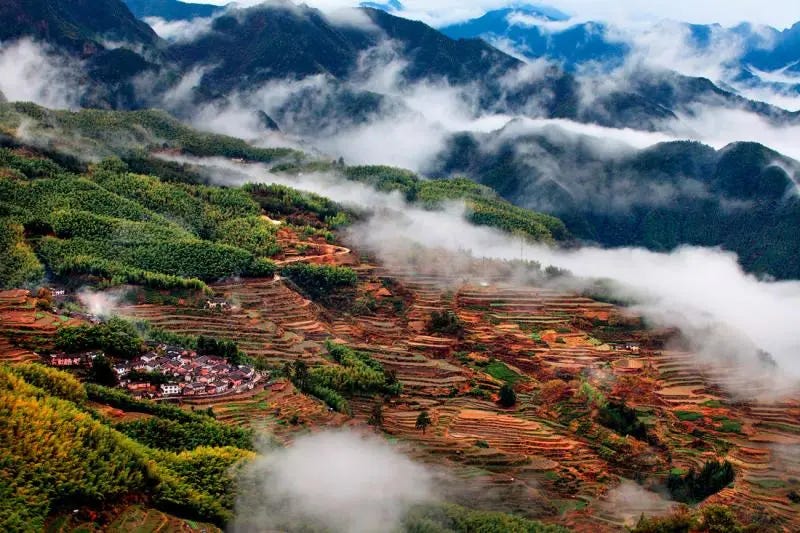
China’s periphery was never meant to compete. Mountain counties, watershed zones, ecological preserves; these were designed as supporting actors in a story written elsewhere. Their job: stay green, stay quiet, wait for transfers from the center, wait for remittances from children who left. Most will wait until nothing remains.
But a few places have stopped waiting. Lishui is one of them.
What Lishui attempted matters because it tests a premise at the heart of how China manages its vast hinterlands. The premise is that ecological preservation must be a cost; one Beijing bears, or one locals bear by accepting slower growth. Lishui asked whether preservation could instead become a revenue stream. Whether protected could mean priced higher. Whether a place told to wait could instead sell what only it possesses: air, water, silence, the fact of having waited at all.
This essay steps back from the operational details of our earlier deep dive. It asks what Lishui’s experiment says about China’s evolving approach to its peripheries; not as permanent dependents, but as assets with a different kind of value. How does Lishui connect to other cities we’ve studied? What does its timing tell us about how ecological transitions actually unfold? And what comes next for a place that stopped waiting, now that the waiting has ended?
For those who keep asking: what does any of this have to do with being told your whole life that your turn is coming; just not yet, just keep waiting, just keep making room for everyone else?
The deep dive tracked the mechanism.
This is about what the mechanism means and where it points.
The Place That Existed for Someone Else
Why This City Exists at All
Lishui exists because Zhejiang’s coast could not.
The coast could not keep its water clean while running factories. Could not maintain forest cover while building ports. Could not absorb its own ecological costs while maximizing growth. Someone had to.
That someone was Lishui.
Geography made the assignment obvious. Lishui’s mountains covered 88 percent of its territory. Flat land, the basic substrate of industrial development was scarce. Transport costs to markets were prohibitive. No amount of provincial policy could make this geography competitive for the kind of growth happening in Hangzhou, Ningbo, and Wenzhou.
So Lishui was designated what economists don’t like to name: a sacrifice zone.
The official term was ecological preservation area. The function was straightforward: keep the water clean for downstream users. Maintain forest cover for regional climate stability. Absorb the conservation mandates that would have slowed coastal growth. And supply the labor that coastal factories needed but didn’t want to raise themselves.
China’s coastal boom was not an accident. It was engineered through concentration; capital, policy, infrastructure all aimed at a narrow strip of land where returns would be highest. This was efficient for growth. But it created a legacy problem. The very concentration that made the coast rich left vast stretches of the interior with only one function: to absorb what the coast could not.
Water. Air. Ecological stability. Young people who would leave and not return.
Between 1990 and 2005, an estimated 400,000 people left Lishui for the coast. Remittances returned. People did not.
What remained was an economy of absence. No industry. No investment. Just subsistence agriculture, commodity pricing and fiscal transfers from the province; roughly 40 percent of local government expenditure by 2000.
This was not failure. This was function. Lishui existed to enable something elsewhere. Its poverty was not a bug. It was the point.
The arrangement was clear: the coast would grow and Lishui would wait. Wait for transfers. Wait for a turn that might never come. Wait because that’s what peripheries do.
For three decades, Lishui waited.
Then it stopped.
How This City Connects to Others We’ve Covered
If you’ve been following since Season 1, you’ll recognize Lishui’s face. You’ve seen it before.
Golog is the closest kin.
Both were designated peripheries. Both were told their job was to preserve; Golog at the headwaters of the Yellow River, Lishui in the mountains of Zhejiang. Both were paid to wait. Both watched their young leave.
Golog had something Lishui didn’t: the source of a river. Everyone downstream; farmers, cities, industries depends on what Golog does or doesn’t do. That monopoly on origin meant Golog didn’t need to build the elaborate certification machinery Lishui built.; it just had to guard. The leverage was built into the terrain.
Lishui had to engineer what Golog was born with. It had to make itself structurally necessary through architecture; brand stacks, verification loops, 15 million witnesses a year. Another mountain range could filter water for the coast. Another county could send young people to factories. Lishui had to become the only place that could certify what its mountains produced.
Daxinganling is the next closest. A logging ban stripped away its only industry, leaving nothing but forests and air. It asked the same question Lishui asked: What can only we certify? The answer was the air itself. Daxinganling now sells what it once gave away. Same move, different element.
Then there are the others, each a partial reflection:
Yancheng shows the certification mechanism from the other side; borrowing authority versus originating it. Together they bookend the spectrum.
Shigatse shows what it means to become the only entity with the right to define value in your territory. Lishui does it for ecological assets. Shigatse does it for cultural ones.
Chengmai shows how to build something from nothing; terroir from volcanic rock, standard from mandated preservation. Both turned absence into asset through deliberate construction.
Yongzhou shows the same instinct: recognizing that something ordinary, a mandarin grown in its soil was actually extraordinary because it couldn’t be grown anywhere else. The move was protecting it through GI, letting geography do the work of distinction. Lishui did the same with its mountains.
But Golog is the mirror. Same problem. Different starting position. One born with leverage. One who had to build it.
Lishui built. That’s the whole story.
The Invention They Didn’t Know They Had
The deep dive showed you the machinery: expressways that ended isolation, high speed rail that delivered visitors, a brand family covering 1,200 products, a government bureau that certifies what the mountains grow, 15 million annual visitors who become witnesses every time they buy Lishui goods back home.
But the machinery was never the point. The point was what the machinery made possible: a periphery that stopped being defined by what it lacked.
For decades, Lishui’s absence of industry was a problem to be compensated. The province sent transfers. The young sent remittances. Everyone waited for something to change. But change never arrives for places whose only function is to wait.
Then Lishui inverted the logic.
Instead of asking what it could produce; the mountains foreclosed that it asked what it could verify. Instead of seeking certification from UNESCO or some global body unlikely to arrive, it asked what certification only it could issue. The answer was the mountains themselves. Not as scenery. As proof.
A mushroom grown in Lishui’s mist carries evidence no lab can replicate: that the air was clean, the water was untouched, the grower was there. A tea leaf from its terraces contains a story no factory can claim: that the slope was tended, that nothing was forced, that the slowness was intentional. The brand became the mechanism for translating that proof into price.
This is what made Lishui different. It stopped waiting to be certified by others. It became the certifier instead. And in doing so, it turned its constraint; the absence of industry into the very thing industry could not reproduce.
The machinery built a standard. The standard built a new kind of periphery: one that no longer needed permission to matter.
The Designated Periphery
Why This City Matters to China
Before Lishui, the standard answer to ecological peripheries was simple: pay them to wait.
Lishui’s question: what can only we certify? Was never just about mushrooms and tea.
It was about what any of us do when the role we were assigned stops fitting. When we realize the waiting was never going to end unless we ended it ourselves. When the thing we thought was absence turns out to be the only thing no one else can replicate.
The rest of this article covers how Lishui answered that question. What you do with the answer is up to you.
