


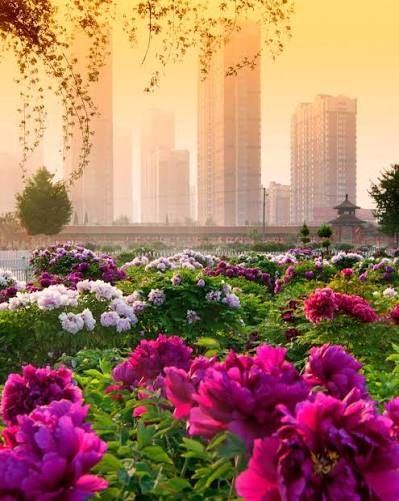
The skyline of Heze is a contradiction.
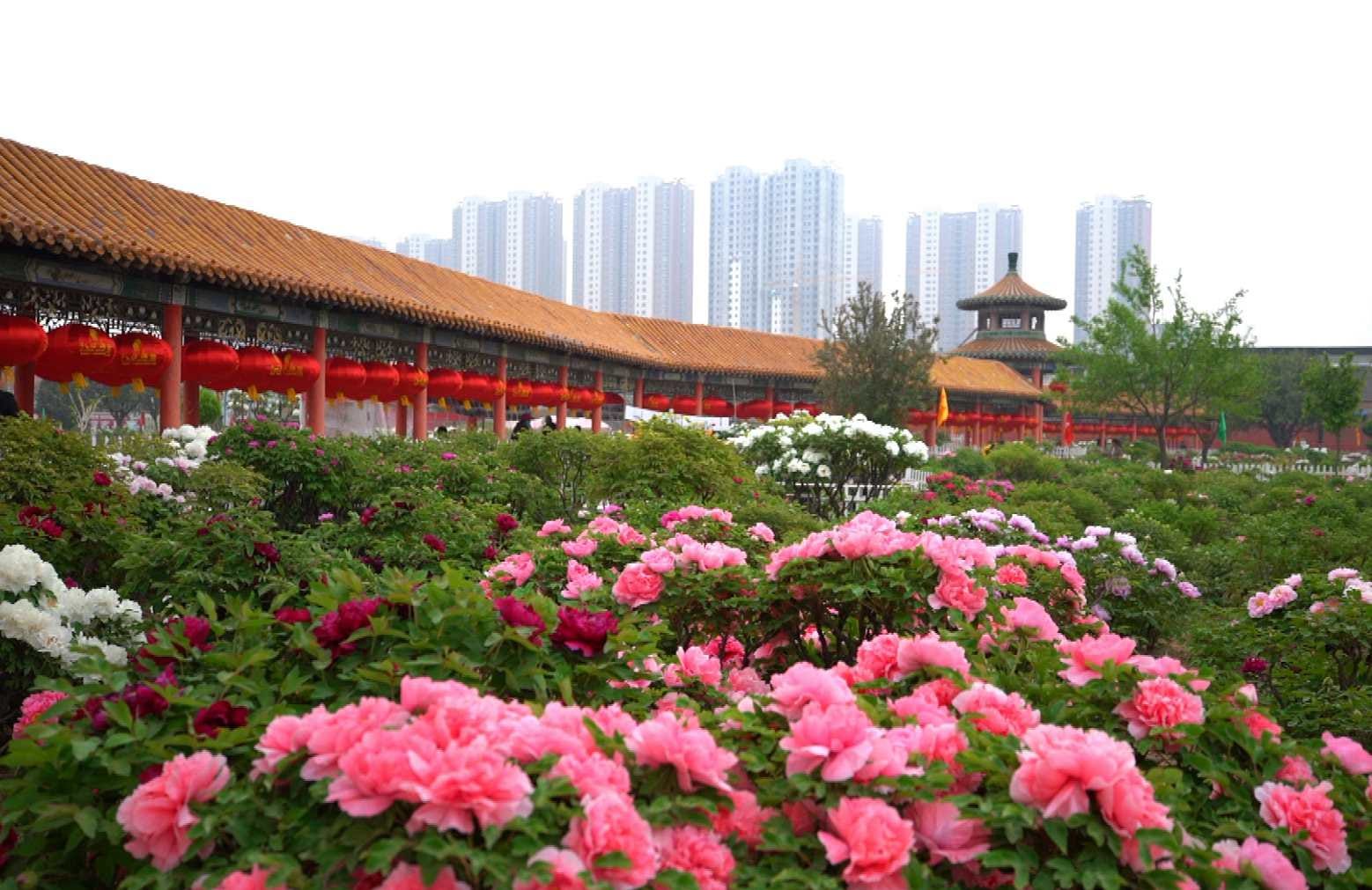
Cranes and concrete. Glass towers rising from the Yellow River plain, still muddy with the silt of centuries. Everywhere; between the highways, along the boulevards, spilling over the edges of industrial parks, the peonies.
Millions of them. A billion petals. Red and white and purple and pink. A city that looks, from above, like someone dropped a garden on top of a construction site.
For a thousand years, this was the whole story. The Peony Capital of China. A place where the flower was revered, cultivated, celebrated and then forgotten the moment the blooms faded. The tourists came in April. The money left in May. The beauty belonged to the city, but the value belonged to everyone else.
Heze was the world’s most beautiful agricultural backwater.
Until someone looked at the flower and stopped seeing a petal. They saw the root, the seed, the oil and the medicine. The genomic code that could be owned, patented, and licensed. They saw a biological fortress waiting to be built on a foundation of beauty.
The question was simple: What if we owned the entire lifecycle?
The answer would transform Heze from a place that blooms into a place that cannot be bypassed.
The Historical System
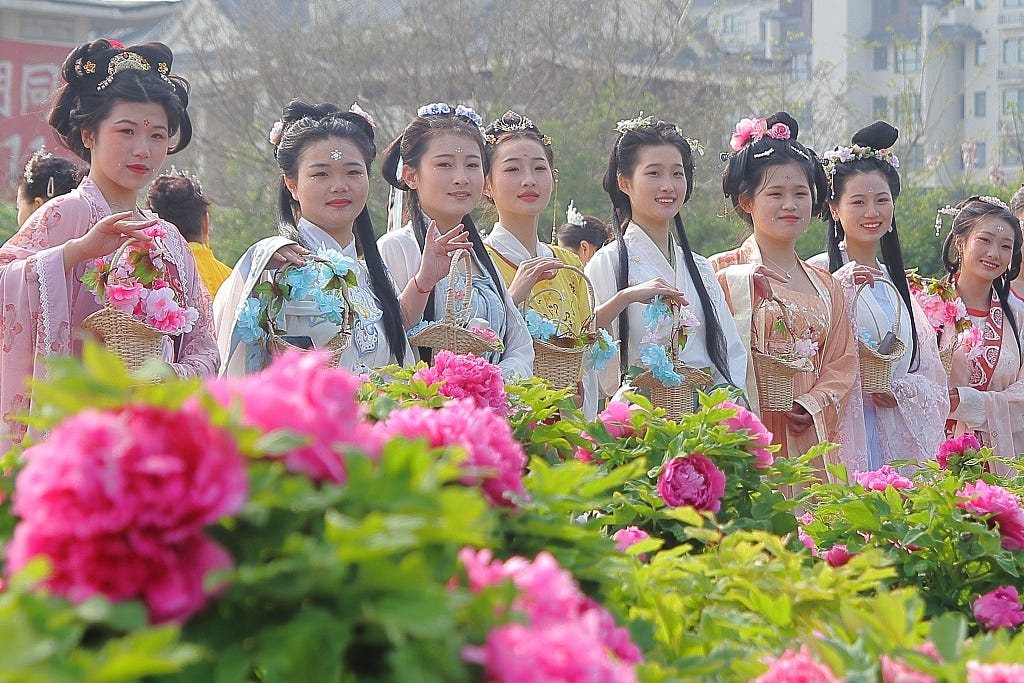
Heze did not begin as a city of production. It began as a city of beauty.
Known historically as Caozhou, Heze sits on the Yellow River plain in southwestern Shandong Province; fertile, flat, and perpetually vulnerable to the river’s floods. For centuries, it was agricultural land, not strategic territory. It had no harbor, no mountain pass, no mineral wealth. It was a place people passed through, not a place they built fortunes in.
What it had was soil and on that soil, for over 1,500 years, it grew peonies.1 The cultivation began in the Sui Dynasty (581–618), expanded through the Tang (618–907), and flourished during the Ming (1368–1644) and Qing (1644–1911) dynasties. By the Qing era, Heze had become the undisputed peony cultivation center of China; home to more than a dozen renowned gardens, hundreds of varieties, and a cultural reputation that poets celebrated and emperors acknowledged.2
But reputation is not leverage.
For most of its history, Heze’s peonies generated cultural capital but not economic sovereignty. The flowers were admired, painted and celebrated in verse. They attracted visitors in spring. They conferred prestige. But the value chain stopped at the garden gate. Heze grew the flowers; others processed them, packaged them, and profited from them. The city was the origin but not the owner.3
The original model worked for centuries, until it stopped working.
By the early 2000s, the limits of the flower viewing economy had become visible. The tourism season lasted weeks, not months. The revenue peaked and collapsed annually. The younger generation, seeing no future in petals, began leaving for the coastal cities. The cultivation knowledge, passed down through families for generations, was aging alongside the growers themselves.4
Heze had a reputation but no resilience. A brand that bloomed in April and faded in May. A thousand years of heritage that could not keep its children from leaving. This led to Heze asking a different question.
Not: How do we sell more flowers?
But: What else is in this plant?
The question seemed simple. The answer would require rebuilding the city from its roots.
Discovery
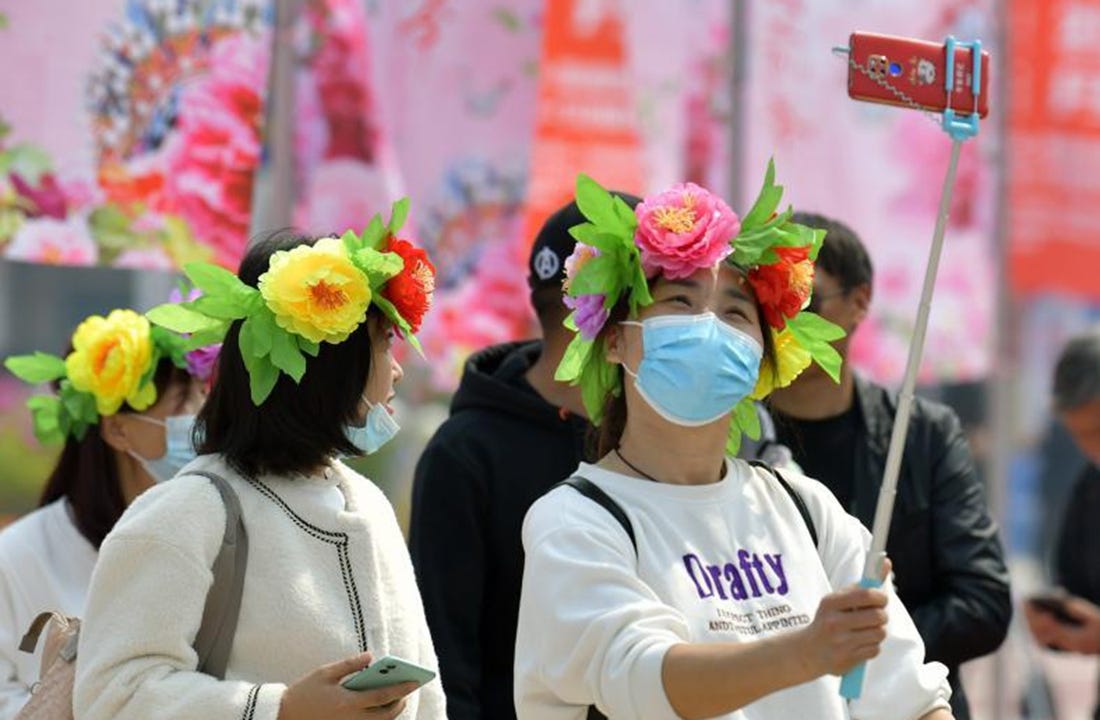
Heze had spent centuries cultivating beauty without capturing value. The peonies bloomed. The tourists came. The money left. The city was the origin but never the owner.
Then, in the late 1990s, there was a quiet recognition that the old model could not survive.
In 1997, the municipal government made a deliberate choice. It formally adopted an agricultural industrialization strategy, identifying three dominant industries to pursue: livestock, fruits and forestry, and vegetables.5 Peonies were placed within the forestry and horticulture pillar, but not as an ornamental product. The framing had shifted subtly. Peonies were now an agricultural product to be processed and sold, not merely a flower to be viewed.
The recognition was incomplete but critical: the city would not survive as a garden.
The breakthrough came from an unexpected direction: a single returnee. In 2000, Li Xiaoqi, a graduate of China Agricultural University, came back to Heze.6 He did not return to write poetry about peonies. He returned to build an industry. Starting with a family plot of less than ten mu, he expanded over two decades to 146 Hectares of modern cultivation; complete with processing facilities, cold storage, laboratories and a research partnership with the National Oil Peony Engineering Technology Center.7
Li was not the only one. Others followed. The city began to attract not tourists, but entrepreneurs. People who looked at the peony and saw not a petal, but a supply chain.
The moment of recognition was that Heze did not need to become a better tourist destination. It needed to become the only place that could process the entire plant.
The city had been famous for a thousand years. It had never been indispensable. Now it had discovered the asset that would make it so.8 Not the flower, but the complete biological stack; the germplasm, the cultivation knowledge, the processing infrastructure, and the people who knew how to turn roots into medicine, seeds into oil, petals into cosmetics.9
The mechanism that converted recognition into irreplaceability.
Activation
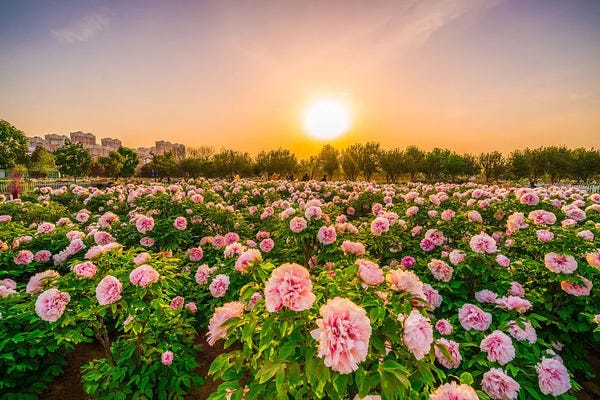
Heze did not become indispensable by selling more flowers. It became indispensable by owning what the flower could become.
The mechanism was not a single policy or a single investment. It was a systematic reconstruction of the city’s relationship to its primary asset; moving from cultivation to complete metabolic capture. The peony ceased to be a product and became a platform.
Deepening the biological stack.
Heze built the world’s largest peony germplasm bank, housing over 1,308 registered varieties. More than 1,000 of these were developed by modern Heze growers, layered onto 118 traditional types that had survived since the Ming and Qing dynasties.10 This was not preservation. It was genomic sovereignty; owning the raw material that no competitor could reassemble because the knowledge was embodied in the soil, the climate and the people who had grown peonies for generations.
Building the processing infrastructure.
Longchi Peony Industry Co., Ltd., one of Heze’s leading enterprises, developed over 150 product varieties by making use of the entire plant; roots for medicine, seeds for oil, petals for cosmetics, stamens for tea.11 The company employs 30 researchers dedicated to peony food development and continues to work with research institutions to advance deeper processing. Across the city, over 120 enterprises now produce and export peony related products, developing more than 260 varieties sold to over 30 countries and regions, including the United States, France and Japan.12
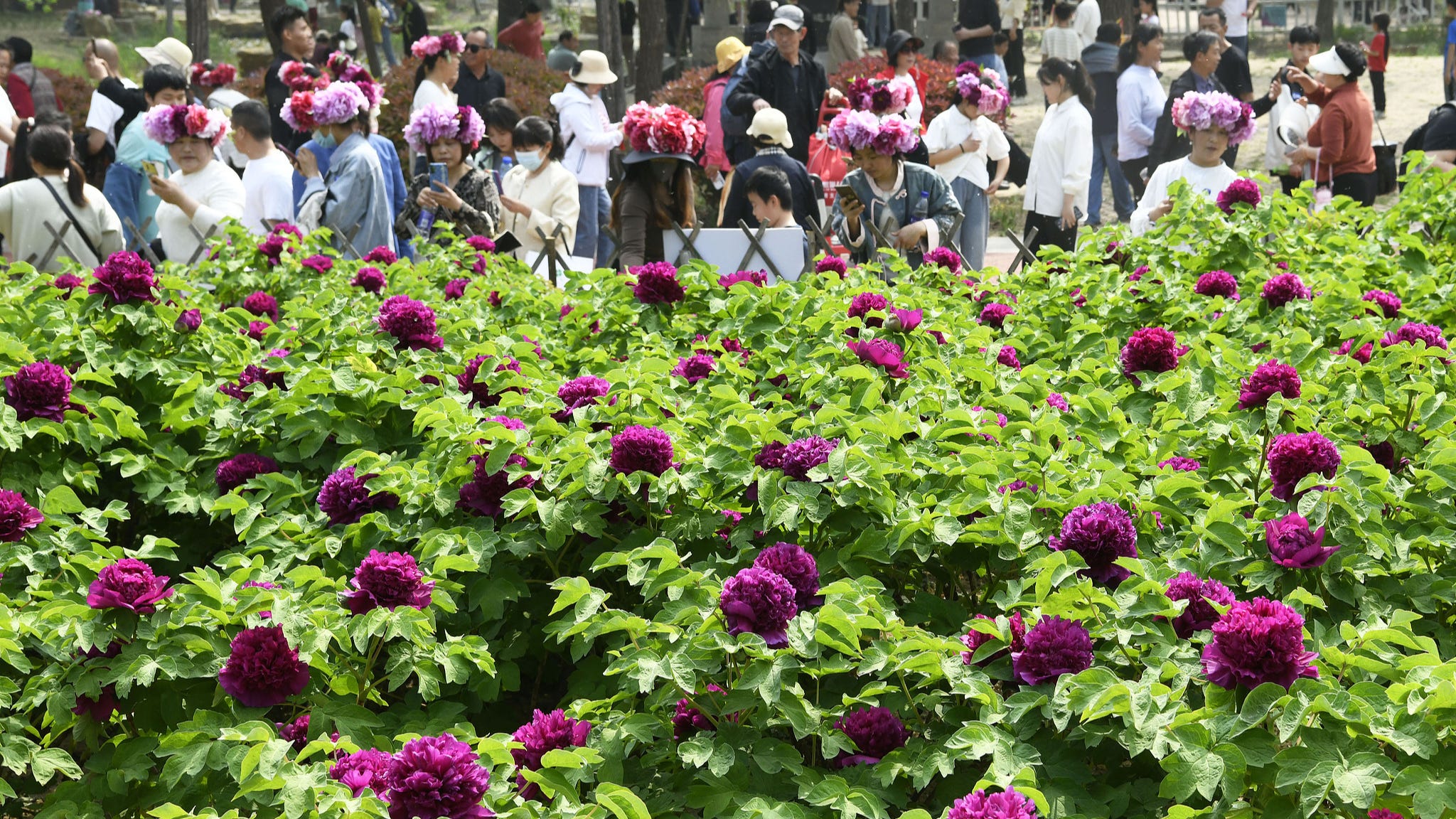
The scale is telling. By 2025, the total output value of Heze’s peony industry exceeded 13 billion yuan (approximately $1.9 billion USD), creating livelihoods for more than 500,000 people.13 In Mudan District, literally Peony District more than half of local farmers are involved in the peony related industry, working in greenhouse cultivation, essential oil extraction, handicraft making and live streaming sales.14
Weaving the peony into the city’s identity infrastructure.
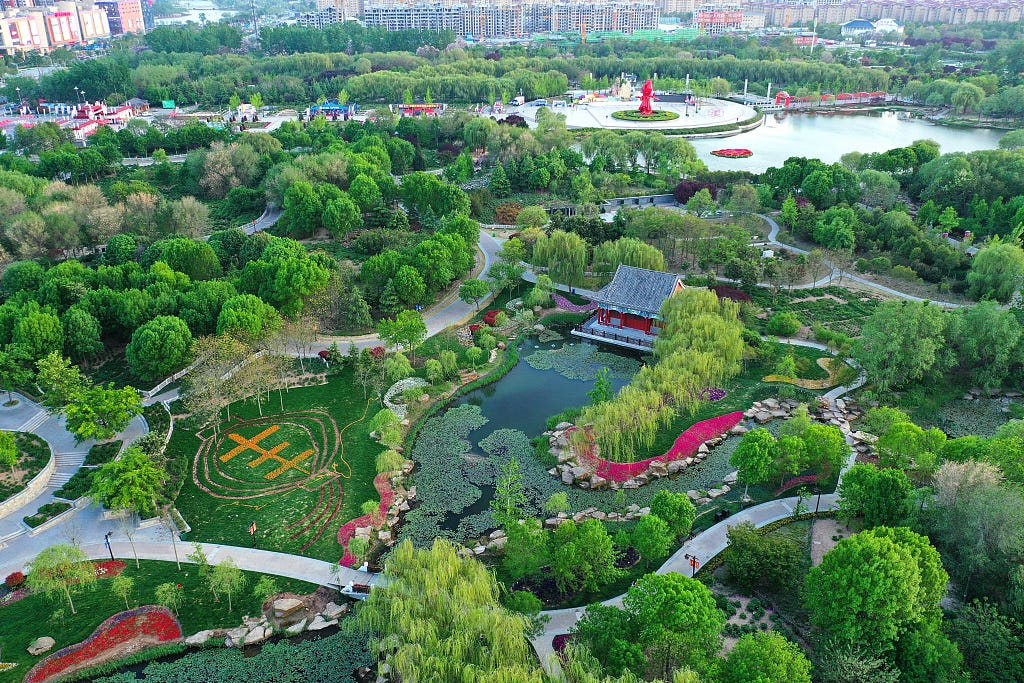
Heze did not stop at processing. It embedded the flower into the fabric of daily life. Road railings are carved with blooming peony reliefs. Buses adorned with peony motifs glide through the streets.15 The annual World Peony Conference, hosted by the Heze Municipal Government, has become the global platform that formally designates Heze as the permanent origin of all things peony.16
This is not marketing. It is a legislative act; reinforced by state capital, scientific R&D and a millennium of cultivation knowledge.
Creating adjacent monopolies.
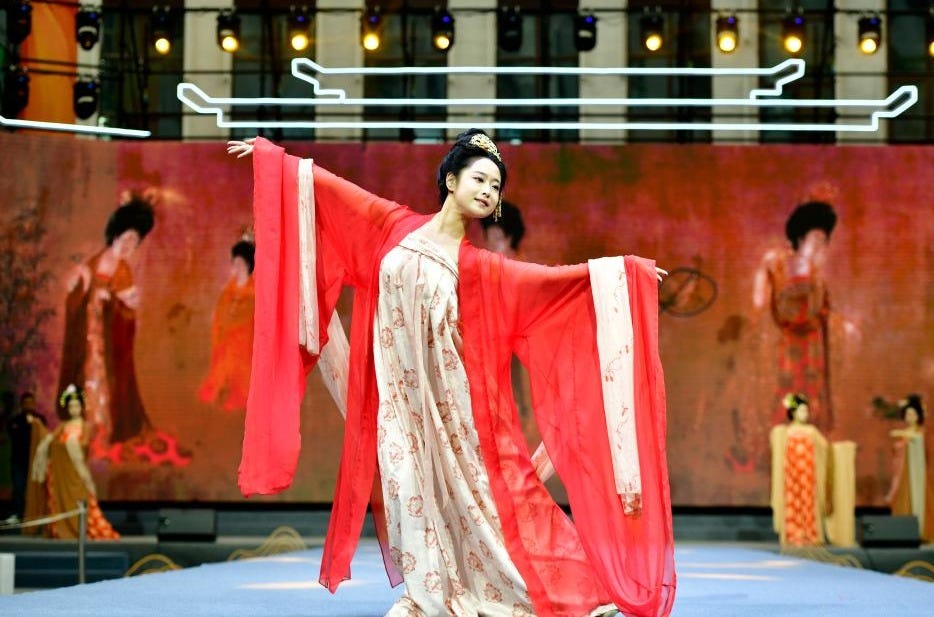
Heze recognized that the peony’s value extended beyond the plant itself. Not far from the peony gardens lies Caoxian County, which produces nearly half of the Hanfu dresses in China.17 The city’s peony themed cultural products; paintings, carved porcelain, silk products and Hanfu expand the flower’s value beyond agriculture and processing into design, art and tourism. In Juye County, a subsidiary of Heze, a complete industrial chain for fine brushwork peony painting now supports over 28,000 practitioners who produce more than 1.5 million paintings annually, generating approximately 4.5 billion yuan (about 620 million USD) in total output value.18
Why this cannot be replicated.
A competitor cannot rebuild the germplasm bank. It cannot recreate the processing expertise. It cannot replicate the cultural narrative that has been woven into the city’s identity for over 1,500 years. It cannot assemble the institutional stack; state backed infrastructure, certification authority, global conference and a population of 500,000 workers whose livelihoods depend on the industry.
Heze has become the only place where the complete peony value chain can function. The competitors cannot bypass it because they cannot reassemble the full stack: the genetics, the processing intelligence, the state backed infrastructure, and the cultural narrative, all fused into one city, one plant, one permanent monopoly.
The Doctrine
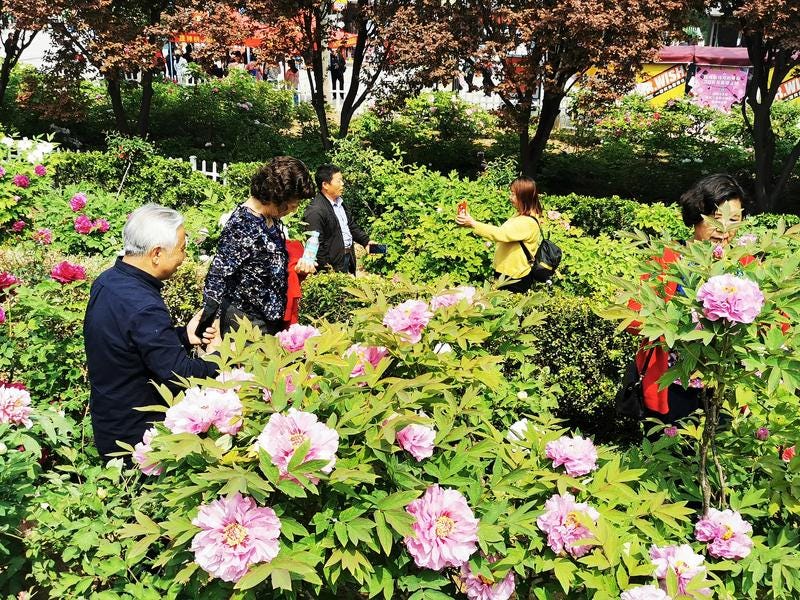
Heze’s transformation reveals a single, transferable principle. A city that owns the complete lifecycle of its defining asset cannot be bypassed. The flower was never the product. The flower was the entry point. The real asset was the metabolic system built around it.
The extraction gives us the Genomic Sovereignty Principle.
Own the complete biological, industrial and narrative lifecycle of a single non-replicable asset. Monetize every stage; seed, root, petal, oil, medicine, motif, patent, certification. The territory becomes not just the producer, but the genomic and metabolic sovereign of the category. Competitors cannot replicate because they cannot reassemble the full stack: the germplasm, the processing intelligence, the state backed infrastructure and the cultural narrative; all fused into one place, one plant, one permanent monopoly.
Heze did not become indispensable by selling more flowers. It became indispensable by owning what the flower could become. The peony ceased to be a product and became a platform; a biological input stack that no competitor could reassemble.19
The principle reveals a deeper truth: origin is not leverage. Control over the value chain is leverage. A city can be famous for a thousand years and still be replaceable. Heze was famous for fifteen centuries. It only became indispensable when it stopped exporting raw beauty and started exporting processed sovereignty.20
Every city with a signature asset faces the same choice: remain the origin, or become the owner. Heze chose ownership. The doctrine it leaves behind is simple and brutal:
If you cannot metabolize your asset through every stage of its lifecycle, you are not the sovereign of the category. You are the supplier to whoever is.
The city that owns the germplasm, the processing, the certification, and the narrative owns the category forever. The city that only grows the flower is a garden. The city that processes the entire plant is a fortress.
Position of Heze in the Fortress
Heze strengthens Family IX: Origin Sovereignty.
Heze joins Family IX, the family that studies places that establish authority by becoming the unique source of something no competitor can authentically reproduce. Cities in this family share a common insight: markets compete, but origins define. The city that owns the origin owns the category.
Heze belongs here with distinction, it operates at a different level. It did not simply claim origin. It built the genomic, industrial, and narrative infrastructure to make that origin enforceable.
City Source of Origin
Yongzhou Deep historical connection to an industry
Chengmai Legal annexation of a historical story
Jiayuguan Sovereign narrative control over a gateway
Tonghua Single irreplaceable asset (frost cycle)
Huangnan Confluence of three irreplaceable assets
Yan’an Ideological sacred site as permanent anchor
Heze Genomic and metabolic sovereignty over a biological asset
Heze’s contribution is showing how origin sovereignty can be achieved through complete biological lifecycle capture. Yongzhou has an industry. Tonghua has a frost cycle. Huangnan has a confluence. Yan’an has a sacred site. Heze has a genomic fortress; the germplasm, the processing infrastructure, the certification authority, and the cultural narrative, all fused into one city, one plant, one permanent monopoly.
Heze teaches that origin sovereignty is not complete until you own every stage of the asset’s lifecycle. Claiming origin is narrative. Owning origin is structural.
How Does It Deepen or Refine the Doctrine?
Heze introduces a new dimension: Genomic Sovereignty.
This is the first time a city in this family has demonstrated that origin can be established through complete biological lifecycle capture; not just through narrative, certification, physical uniqueness, or ideological anchoring. Previous cities in Family IX derived value from products, crafts, physical confluence, or sacred representation. Heze derives value from owning the genetic code, processing intelligence and certification authority of its defining asset.
The doctrine is refined to show that origin sovereignty requires more than claiming to be the source. It requires building the infrastructure that makes the source permanent and defensible. A competitor cannot bypass Heze because they cannot reassemble the biological stack: the germplasm, the processing expertise, the state backed infrastructure and the 1,500 year cultivation history, all fused into one place.
How Does This Doctrine Differ from the Closest Existing Doctrine?
The closest existing doctrine in Family IX is Tonghua’s Irreplaceability Lens Principle.
Both Tonghua and Heze establish sovereignty through a biological asset that cannot be replicated. Tonghua’s ice wine depends on a unique frost cycle that occurs only on its mountain slopes. Heze’s peony industry depends on a complete metabolic system; germplasm, processing, certification, narrative that cannot be reassembled anywhere else.
But they differ in a critical way.
Tonghua’s sovereignty depends on a single physical condition: the frost cycle. That condition is irreplaceable, but it is also passive. Heze’s sovereignty depends on an active, constructed system: the germplasm bank, the processing infrastructure, the certification authority, the global conference. Heze did not just inherit an irreplaceable condition. It built an irreplaceable system.
Tonghua teaches that physical uniqueness can create origin sovereignty. Heze teaches that origin sovereignty can be engineered through complete metabolic capture. The difference is between inheritance and construction. Heze built what Tonghua was given.
Heze joins the Origin Sovereignty family as the definitive case of Genomic Sovereignty; teaching that origin is not complete until you own every stage of the asset’s lifecycle. Claiming origin is narrative. Owning origin is structural. Heze built the structure.
The principle now sits alongside Yongzhou’s Rooted Platform, Tonghua’s Irreplaceability Lens, Huangnan’s Confluence Monopoly and Yan’an’s Sacred Anchoring; each demonstrating a different path to becoming the unique source that competitors cannot bypass.
Reflection
You have always had something.
Everyone knows you for it. It is the first thing people mention when your name comes up. The signature asset. The defining identity. The thing that made you visible, celebrated, admired and, without your noticing, trapped.
For years, it was enough. The world came to you. They praised what you had. They wrote poems about it, took pictures of it, told their friends to visit. You built your identity around being the place that had this one thing and it worked. Until it didn’t.
The tourists stopped coming. The younger generation started leaving. The world changed, but your asset stayed the same. You were still famous, but fame had become a cage. You could be admired without being needed. You could be loved without being depended upon. You were the origin, but not the owner.
That is the moment Heze faced. And that is the moment you face now.
Heze did not ask: How do we sell more flowers?
It asked: What else is in this plant?
That question broke the cage. It revealed that the asset everyone admired was only the surface. Beneath it lay the root, the seed, the oil, the medicine, the genomic code; an entire industrial metabolism waiting to be unlocked. The city stopped exporting beauty and started exporting sovereignty.
The question is the same for you.
Your asset; the thing you are known for, the thing that made you visible has only ever been the entry point. The real value has always been deeper. The question is whether you will build the infrastructure to own it.
Because the world has changed. The old model is breaking. The people who admired you are now looking elsewhere. The reputation you built is softening. The asset that made you famous is becoming the cage that holds you back.
Heze chose to metabolize. It chose to own the entire lifecycle. It chose to become indispensable rather than merely visible.
You have the same choice.
What else is in your plant?
Next Week | Dongfang
Heze’s lesson is simple but profound that the asset you are known for is never the ceiling, it is only the entry point to what you could own. The city that had nothing but flowers built a biological fortress that no competitor can bypass. It metabolized beauty into sovereignty.
But what happens when your city has no signature asset at all? No flower. No history. No product anyone mentions. Just a position at the edge of the nation, facing outward toward the South China Sea and the ASEAN economies beyond.
Most cities that sit at the edge of a nation accept their fate. They become endpoints. Dead ends. Places where the road stops and the sea begins. They are forgotten because they face nothing but water.
Dongfang did not accept this. It sits on Hainan’s western coast, named for the direction it does not face; the irony is the first clue. The city has no famous product, no cultural story tourists repeat, no biological monopoly to metabolize. What it has is a deep-water port, a natural gas field offshore, a free trade zone at the edge of the nation and a question: What flows through you?
While Heze built inward, metabolizing a single asset into an industrial fortress, Dongfang is building outward; becoming the corridor through which energy, minerals and trade cannot avoid. A city that refuses to be an endpoint and is quietly engineering itself into the passage that others must pass through.
The question is: can you build irreplaceability not from what you have, but from what flows through you?
Dongafang is City 60
In Shandong丨The Place Where Peonies Fill the Air. Dazhong.com. 2024, April 22
Heze City has a long history of peony cultivation, and it was already famous in the Ming Dynasty. Heze Daily. November 11, 2009
A City of Peonies: The Foundation of Heze’s Prosperity – A Case Study of the Correct View of Performance Development in Heze. Heze Daily 2026, May 15
Shandong Local Archives. (n.d.). Volume 3: Agricultural Industrialization. Shandong Local Archives
(People’s Happy Life) A beautiful peony flower opens up a happy life in Heze, the “Peony Capital of China”. China News Network. June 28, 2022
Blooming 'Flower Economy' - Heze's Peony Industry Boosts Development, Cultural Exchanges. Les Echos Comfi. CGTN 2025, April 11
See how a flower achieves value enhancement across the entire supply chain. China City Network. June 9, 2026
ibid1
ibid1
Letter from China: How the peony fuels local economy in east China. Belt and Road Portal. Xinhua News Agency. 2026, April 15
ibid12
Heze, Shandong: Peony Leverages Industrial Chain to Inject Economy Vitality. Select Shandong. Haibao News. 2025, April 18
See how a flower achieves value enhancement across the entire supply chain. China City Network. June 9, 2026
Rich cultural heritage, industrial chain help Shandong's Heze become "Peony Capital". Xinhua News Agency. (2024, April 11).
Juye County Government. Forum on Development of China’s Fine Brushwork Peony Painting Industry Held in Juye During 2026 World Peony Conference. GlobeNewswire. 2026, April 13
Intl forum discusses role of peony flowers in cultural exchange and mutual understanding. China Daily. 2026, April 12
Thank you, Lile Mo, for another insightful article about how every town or city, however small, has a unique relationship with the natural world and our local landscapes which can be nurtured to improve the lives of all human beings, and the fauna and flora with which we share our environment. Illustrating this long term view is China's gift to the world ... if only we would listen.
I also like the parallel (almost fleeting) thought near the end of this long read that each of us would do well to look inside ourselves to find and grow that unique characteristic which would genuinely serve to make the world a better place, even if this means changing a lifetime of learned habits.
We love peonies. We have two mature plants in our garden here in southern England, and we planted four more this year. Their beauty is fleeting but spectacular during those few weeks in April/May when the blooms finally emerge. They may take a few years to fully mature, but our ever-developing garden will be our own gift to the future residents of our family home.