

The Command City
How a military garrison turned itself into a municipality, replaced persuasion with execution and grew faster than any market economy could


Tiemenguan does not fit.
It has no famous product. No cultural story tourists repeat. No natural harbor or river confluence. No elite university spinning out startups. No private champion firm with a national brand. No diaspora sending remittances home.
By the standard logic of economic development, Tiemenguan should be irrelevant.
Most cities that lack these assets accept the logic. They apply for heritage status. They build a tourism bureau. They wait for investment that never comes. They become administrative backwaters with a plaque on a wall.
Tiemenguan did not accept this.
It did not invent a premium product. It did not discover a hidden narrative. It did not wait for a private champion. It used something no civilian city could use: a military command hierarchy converted into a municipal government, with the power to assign labor by decree, seize land without litigation, and enforce industrial targets through the discipline of a standing army.
This is not a story about markets. It is a story about governance as a factor of production.
And if you have ever wondered why some places build industrial capacity in years while identical neighbors take decades, the mechanism behind Tiemenguan’s 29.6% growth is the answer.
Tiemenguan’s economic velocity is not a function of geography, policy incentives, or market discovery. It is a function of governance structure. The XPCC Second Division operates with powers no civilian city possesses: command labor allocation, direct land seizure/reclamation, internal security integration and KPI based military discipline applied to industrial output.
WHAT TIEMENGUAN WAS BEFORE THE INTERVENTION
Before it was a city, Tiemenguan was not a place. It was a function.
The Second Division of the Xinjiang Production and Construction Corps was the entity that occupied this territory. The Corps itself was established in 1954; a hybrid institution, part agricultural enterprise, part military garrison, part internal colonization apparatus. Its mandate was not economic optimization. Its mandate was permanent presence. The land was secondary.1
What Existed
The Second Division’s territory was not a city. It was a dispersed network of regiment stations; the 28th, the 29th, the 30th scattered across what would later become 590.27 square kilometers of Gobi desert and reclaimed cropland. Fourteen agricultural regiments in total, each a cluster of barracks, fields and state owned farm infrastructure.2
The division grew cotton. It grew wheat. It grew sugar beets and oilseeds. Later, orchards; Korla fragrant pears, red dates because the soil, against all odds, tolerated them.
But it did not process what it grew.
Raw cotton was baled and shipped to coastal mills. Fresh tomatoes were trucked to canneries in Urumqi or beyond. The value was extracted elsewhere. The division kept the weight and the labor; the margin flowed to factories it would never own.
By 2010, the division’s population was approximately 200,000. Most were Corps members or their descendants. They lived in regiment housing, worked regiment land, sent their children to regiment schools. The economy was not a market. It was an allocation.
What It Was Not
Tiemenguan was not a logistics node. It was located 50 kilometers west of Korla and 500 kilometers southwest of Ürümqi; close enough to be overshadowed, far enough to be ignored. The nearest rail line was not on its territory. Highways were two lane roads that baked and cracked under the Gobi sun. Goods moved slowly, if they moved at all.
It was not a processing center. No canneries. No textile mills. No cold storage worth the name. The division produced raw materials for other people’s factories.
It was not a destination. No one went to the Second Division unless they were assigned there. Tourism was a word for other places.
It was not economically necessary. The cotton could be grown elsewhere. The tomatoes could be grown elsewhere. The only thing the Second Division produced that could not be replaced was the loyalty of its population. That was not an economic asset. That was a strategic subsidy.
The Trap
By the late 2000s, the division was trapped.
It could not attract private investment because land rights were fuzzy; Corps land, not municipal land, not collective land, a legal category that made bankers nervous.
It could not retain its young. Corps children with ambition left for Urumqi, for Beijing, for the coast. The division was a place to leave.
It could not upgrade its economy because it had no density. Dispersed regiments could not form a labor market. A factory needs workers who can walk to work. The division had farmers who drove an hour to a field.
It could not die. Beijing would not allow it. The Second Division was a demographic anchor in a sensitive region. It would be subsidized forever, kept alive like a patient on permanent life support.
This was the low-value equilibrium: stable, marginal, replaceable.
The Asset That Was Not an Asset
But the division had one thing.
It had command.
The Corps was not a civilian government. It did not hold hearings. It did not negotiate with village collectives. It did not wait for the People’s Congress to approve its budget. It issued orders.
The Second Division’s commander was not a mayor. He was a political commissar; dual hatted, military | civilian, answerable upward, not sideways. The land was not private. It was allocated. The labor was not a market. It was a roster.
This command structure was the division’s only non-replaceable asset. Not the soil. Not the crops. Not the location. The ability to move people and land without asking permission.
That asset was invisible in the pre-2012 baseline because it had no economic expression. The division used its command powers to grow cotton; the same cotton grown everywhere else. The power existed, but it was deployed toward commodity outcomes.
The question that 2012 would answer: what happens when you point command power at something other than subsistence?
The constraint that would be removed first: Administrative invisibility.
The command structure existed. The land existed. The labor existed. What the division lacked was a legal vehicle to convert these into municipal economic activity. The 2012 city decree would provide that vehicle; without changing the command structure underneath.3
WHAT CHANGED AND HOW
THE CATALYST
The trajectory bent not from market discovery or infrastructure breakthrough. It bent from a policy cascade: a central directive, followed by a legal reclassification, followed by state financed access.
The Central Directive: 2010
On May 17–19, 2010, the Central Xinjiang Work Conference convened in Beijing. All nine members of the Politburo Standing Committee attended.4
This was not a routine meeting. It was the highest level policy intervention in Xinjiang since the 1990s, explicitly modeled on the Tibet Work Conference framework.5 The conference produced a strategic shift: economic development and social stability would be pursued in parallel, with the former financing the latter.6
The mechanism was a package of fiscal transfers, tax holidays, resource tax reform, and crucially for Tiemenguan; accelerated infrastructure construction across the region.7
This was the mandate. The vehicle would follow.
The Legal Reclassification: December 2012
On December 17, 2012, the State Council of China issued Document No. 206 (国函〔2012〕206号), formally approving the establishment of Tiemenguan as a county level city.8
Seven days later, on December 24, the Xinjiang Autonomous Region government issued its own implementing directive, Document No. 104 (新政发〔2012〕104号).
The timing was not incidental. The approval came exactly two and a half years after the Central Xinjiang Work Conference, a deliberate synchronization with the five-year planning cycle.
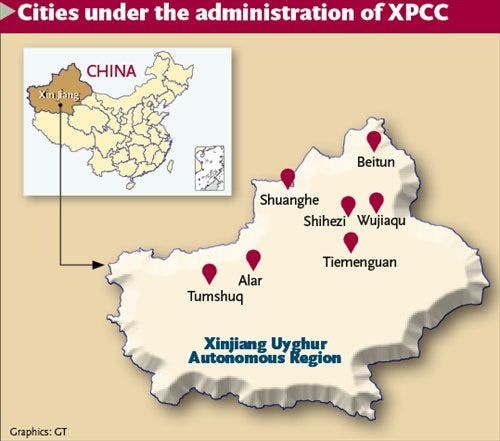
What was created? A hybrid entity. Tiemenguan was the sixth city in Xinjiang converted from XPCC land, following Shihezi, Aral, Tumxuk, Wujiaqu, and Beitun.9 Like its predecessors, it was designated a county level city directly administered by the Autonomous Region; no intervening prefectural government, meaning direct access to provincial and central budgets.
Unlike a standard city, however, Tiemenguan retained the Corps governance structure underneath. The Second Division commander became the mayor. The political commissar became the Party secretary. The regiments became townships. The command hierarchy was repurposed, not replaced.
The seat of the new city was placed at the 29th Regiment settlement. The 28th Regiment was renamed Boguqi Town; the 30th Regiment, Shuangfeng Town. The territorial claim was 590.27 square kilometers.
The Access Unlock: Infrastructure After Policy
The 2012 decree did not, by itself, create economic velocity. It created the vehicle for velocity. The actual movement required physical access and that access was state financed on a multi year timeline.
The Three Unlocks, Sequenced
Note the sequence. Policy came first; two and a half years before legal status. Legal status came second eleven years before the desert highway opened. The physical infrastructure lagged because it required capital, and capital required a legal entity to receive it.
The Corps did not wait for infrastructure. It used the legal reclassification to begin industrial construction on land it already controlled, with labor it already commanded, while the roads and rails were still being approved.
This is the inversion of normal development logic. Most cities get infrastructure first, then growth. Tiemenguan got the right to grow first, then demanded the infrastructure to service it.
The Constraint Removed First
Administrative invisibility.
Before December 2012, the Second Division could not receive direct central infrastructure funding as a municipal entity. It could not issue municipal land titles. It could not enter into contracts with private firms as a city government. It could not rename its railway station, because the railway system did not recognize it.
The 2012 decree removed all of these invisibilities simultaneously. The physical constraints; bad roads, distant rail remained. But the legal constraint that prevented the Corps from solving the physical constraints was gone.
The Corps could now act. The budget followed. The roads followed. The rail service followed. But the first unlock was the piece of paper signed in Beijing.
GOVERNANCE ARCHITECTURE
The Shi-Tuan Integration Mechanism
Tiemenguan operates under a governance model called division and city integration.10
This is not a metaphor. It is a legal-administrative fusion. The city shares the exact same leadership group as the Second Division of the XPCC. The Corps commander is the mayor. The political commissar is the Party secretary. The regiments became towns.
The model has precedent. Tiemenguan is the sixth city in Xinjiang converted from XPCC land, following Shihezi, Aral, Tumxuk, Wujiaqu, and Beitun.11 But precedent does not diminish distinctiveness. A city governed by a military chain of command is not a city; it is a garrison that files municipal paperwork.
The Dual Mandate
The XPCC’s official responsibilities are economic development and social stability.12 This is not a balanced portfolio. “Stability” in the Xinjiang context means internal security, demographic engineering and the prevention of ethnic unrest. The XPCC maintains its own armed police and militia. It is a state within a state.
For an enterprise or a city under the XPCC, this dual mandate has a measurable effect. Research on XPCC enterprises shows that their unique organizational structure and heavy policy reliance make their investment behavior more vulnerable to policy fluctuations than standard state owned enterprises. The same logic applies to the city. Tiemenguan’s economic decisions are not optimized for return on investment. They are optimized for stability and growth, in that order.
The Tax Authority Unlock
Before city status, the Second Division had no authority to collect taxes. Industrial and service enterprises affiliated with the XPCC paid taxes to local civilian governments. The XPCC received fiscal transfers from Beijing, but its own revenue base was constrained.13
City status changed this. As a county level municipality, Tiemenguan now has the authority to collect taxes on its territory.14 The significance is not the absolute amount, Tiemenguan remains a small economy: but the autonomy. The city government can now fund its own industrial policy without routing every yuan through Beijing’s transfer payment system.
Pan Xingang, head of the Institute of Economic Research with the XPCC, stated the logic directly: “A lack of tax revenues has limited the XPCC’s development momentum. By setting up cities or townships, they could have the authority to collect taxes and achieve faster development.”
The Leadership Dual Hat
“The city implemented the ‘division and city integration’ management system; it shares the same leader group with the 2nd Division.”15
Fan Wenming is listed as CCP Secretary of Tiemenguan and Political Commissar of the Second Division. Wang Lei is listed as Mayor and Commander of the Second Division.16
This is not a personnel rotation. This is a structural identity. The same individual who commands a military unit capable of armed force also approves industrial zone zoning. The same individual who manages agricultural output targets also oversees police functions.
The Command Hierarchy Preserved
The regiments did not disappear when they became towns. The 29th Regiment became the city seat. The 28th Regiment became Boghux Town. The 30th Regiment became Shuangfeng Town. The organizational chart remained; the labels changed.
The Corps command hierarchy has capabilities no civilian government possesses. Here is what the fusion enables that a civilian city cannot do:
Land. A civilian government wants to build a factory. It must negotiate with village collectives, compensate farmers, settle disputes in court. Years pass. Tiemenguan wants to build a factory. The Corps Commander says: “Regiment 29, your southern fields are now an industrial zone.” The regiment moves. Months pass.
Labor. A civilian city needs workers. It posts wages, hopes people come, negotiates with unions if they exist. Tiemenguan needs workers. It assigns them. Five hundred forty-four people work in the textile factory in Tiemenguan’s economic zone. Two hundred seventy of them come from poor rural areas of southern Xinjiang. They did not apply. They were sent.
Security. A civilian city faces a strike at a factory. It calls the police. The police are civilians. They negotiate. Tiemenguan faces a strike. The same chain of command that runs the factory runs the armed police. The strike ends.
This is not governance. This is a military operation with a spreadsheet.
The Orchestrator
Who governs Tiemenguan?
Not a mayor in the civilian sense. Not a private sector “chain master.” Not an industry association.
The orchestrator is the XPCC Second Division Party Committee, operating through the dual hat leadership. The city is the civilian facing shell; the Corps is the operational core.
Is coordination emergent or imposed?
Imposed. Entirely. Tiemenguan has no history of emergent market coordination. The Corps command hierarchy pre-existed the city and was preserved through the 2012 transition. Every economic outcome in Tiemenguan is the result of a directive, not a discovery.
ECONOMIC VELOCITY

Every city wants to grow. Most grow in increments. A factory opens. A road finishes. A harvest comes in. The line moves up. Slowly. Predictably.
Tiemenguan does not grow in increments. It grows in spikes.
In September 2025, after seven consecutive months of flat or declining industrial output, Tiemenguan’s industrial value added jumped 20.2% in a single month.17
Not a season. Not a year. A month.
What caused the spike? Eleven newly registered scale up enterprises began operations simultaneously. These eleven firms alone accounted for 9% of all industrial value added and contributed 9 percentage points to the growth rate.
In a civilian city, eleven new factories do not open in the same month. Permitting staggers them. Construction delays stagger them. Labor shortages stagger them. Market uncertainty staggers them.
In Tiemenguan, they open together because they were ordered to open together.
This is the signature of command growth: lumpy, project driven, indifferent to business cycles. The Corps does not wait for demand to appear. It builds capacity. Then it finds a use for the capacity.
The Industrial Stack
Tiemenguan’s economy is organized around three processing verticals. Notice the pattern: nothing is sold raw.
First: The Two Reds.
The Yanqi Basin, under Tiemenguan’s control, produces industrial tomatoes and pigment rich chilies. These are not grocery store products. They are inputs: tomatoes for paste and sauce; chilies for natural red pigment (capsanthin) the stuff that makes sausage red and lipstick redder.
Tiemenguan now hosts 65 chili processing enterprises. Annual processing capacity: 200,000 tons of raw chili. Industrial output value: 3 billion yuan.
The city claims the world’s largest capsanthin production capacity and the world’s second largest tomato processing capacity. The claim may be inflated. The concentration is not. Sixty five processors in one jurisdiction, all supplied by Corps controlled farms, all feeding into a supply chain whose parameters are set by the Corps leadership.18
This is not an industrial cluster in the normal sense. It is a directed cluster. The Corps decides how much chili to plant. It decides where it is processed. It decides which enterprises get the raw material.
Second: Chemicals and New Materials.
The largest single investment in Tiemenguan’s pipeline is an 8 billion yuan facility to produce 200,000 tons of industrial silicon and 100,000 tons of polysilicon. Polysilicon is the foundation of solar panels.
Tiemenguan does not mine silicon. The raw material comes from elsewhere. But the Corps can offer what civilian cities cannot: subsidized energy, land seized without litigation, labor assigned by decree. The margin is captured not at extraction, but at processing.
Third: Textiles.
Tiemenguan is one of Xinjiang’s three designated textile bases. The region produces 700,000 tons of raw cotton annually. Before 2012, that cotton left raw. Now it stays. Existing capacity: 600,000 spindles of cotton yarn, 3 million towels, 800,000 garments.
Again, the pattern: captive raw material (Corps grown cotton), directed processing investment (state financed mills), local value capture.
The Growth Pattern
In the first three quarters of 2025, Tiemenguan's GDP reached 12.034 billion yuan, up 6.6% year on year. Slightly above the national average. Nothing dramatic.
But the headline number hides the shape.
Industrial value added grew 17% in the first quarter of 2024. Then it cooled. Then, in September 2025, the 20.2% spike.
This is not a smooth growth curve. It is a staircase. Periods of flat output followed by sharp jumps when new capacity comes online. The jumps are not demand driven. They are supply driven. The Corps finishes a batch of projects. The batch opens. The line jumps.
In a market economy, this pattern would be a warning sign. Overcapacity. Misallocation. But Tiemenguan is not a market economy. It is a command economy with a municipal shell. Overcapacity is not a bug. It is the mechanism. Build first. Ask questions later.
Could a civilian city of 200,000 people in the Gobi Desert replicate this?
No civilian city could force eleven enterprises to open in the same quarter. No civilian city could compel farmers to sell to designated processors. No civilian city could redirect coal mine output to subsidize a polysilicon plant.
Civilian cities negotiate. Civilian cities incentivize. Civilian cities hope.
Tiemenguan orders.
The velocity is not a function of smarter strategy. It is a function of a governance structure that removed the word no from the approval process. Not no from regulators. Not no from neighbors. Not no from labor. The Corps does not hear no because the Corps does not ask.
The mechanism: Directed investment, coordinated project commissioning, captive supply chains and the absence of civilian friction.
Producing growth not as a smooth trend, but as a series of command executed jumps.
What this is not: Market driven industrial development.
What this is: A military quartermaster's approach to GDP.
THE UNIQUE ENABLERS
Every city has police. Every city has courts. Every city has a population policy.
Tiemenguan has an army.
The XPCC is not a normal government agency. It is a hybrid institution with its own armed forces, its own judicial system, and its own demographic mandate . When the State Council turned the Second Division into a city, it did not dissolve these powers. It preserved them.
This is what makes Tiemenguan’s governance structure not just different, but unreplicable by a civilian city. Three enablers, each unavailable to a normal mayor.
The Armed Police
The XPCC’s official white paper states it plainly: the Corps maintains strong militia and armed police forces whose members are capable of both combat and production.
In a civilian city, if a factory has a labor dispute, the manager calls the local police. The police are civilians. They negotiate. They mediate. They may take hours or days. The factory stops.
In Tiemenguan, the factory manager and the police commander report to the same person: the Corps Commander, who is also the mayor. The armed police are not external responders. They are internal assets. The line between economic management and security enforcement does not exist.
The white paper records specific instances: the 1990 riot in Barin Township, the 1997 Yining incident. In both cases, XPCC militias struck swiftly alongside armed police. The Corps is not a passive observer of stability. It is the instrument of stability.19
For economic velocity, this means one thing: no friction from below. Strikes do not escalate. Supply chains are not blockaded. Labor does not organize against management because management and security are the same chain of comman
The Parallel State
The XPCC administers its own judicial system. It runs its own courts. It manages its own public services .
In practical terms, this means Tiemenguan does not need to wait for the regional government in Urumqi to resolve a land dispute, process a business license, or adjudicate a contract. The Corps has its own legal apparatus, embedded in the same command structure.
Dr. Yajun Bao, a researcher who spent a year inside the XPCC, described it as “a hybrid of state-owned enterprise and bureaucracy” with “its own administration and judicial systems” . He also noted a crucial constraint: before city status, the XPCC “had no authority to collect taxes” and “survives only through massive central government subsidies”.20
City status solved the tax problem. The judicial powers were already in place.
For economic velocity, this means: no waiting for external approvals. The Corps decides. The Corps enforces. The Corps does not file cross jurisdictional paperwork.
The Demographic Mandate
The XPCC was founded for one reason above all others: to plant Han Chinese bodies on contested ground.
The original members were decommissioned soldiers from the 1950s, later joined by young people, professionals, and peasant farmers sent from all over China. The intention, explicitly, was “to ensure a permanent population of Han Chinese in this ethnically diverse region” .
Tiemenguan inherited this mandate. The Second Division’s regiments were not just farms. They were demographic anchors.
For economic velocity, this means: labor supply is not a market variable. When Tiemenguan needs workers, it does not post job ads and hope. It activates the same apparatus that has been moving Han settlers to Xinjiang for seventy years.
The textile factory cited in Chapter 3; 544 employees, 270 from poor rural areas of southern Xinjiang is not a labor market outcome. It is demographic engineering repurposed for industrial production. The same pipeline that brought settlers brings factory hands. The machinery does not care why they came.
The Synergy
These three enablers are not separate. They are the same thing viewed from different angles.
The armed police guarantee that economic commands are obeyed. The parallel state guarantees that legal approvals take days, not years. The demographic mandate guarantees that labor arrives when ordered.
Together, they produce what no civilian city can produce: frictionless execution.
The Corps does not negotiate with labor unions because there are no independent labor unions. It does not wait for court rulings because it runs the courts. It does not compete for workers because it produces workers.
This is not efficiency. Efficiency implies doing the same thing with fewer resources. This is immunity. Tiemenguan does not have fewer constraints. It has different constraints and those constraints are optimized for speed, not consent.
A military-security-demographic apparatus, preserved through municipal reclassification, that eliminates the friction points labor, legal, population that slow down civilian administered economic development.
What this is not: Rule of law. Labor rights. Administrative due process.
What this is: Command economics with a security guarantee
NEGATIVE SPACE
Every city we have covered has something it sells.
Heihe sells certified passage through friction. Cangzhou sells embedded martial arts infrastructure. Lingao sells narrative repetition. Xiahe sells purity as a story.
Tiemenguan sells nothing you can name.
No product carries the city’s brand. No tourist repeats its name. No certification seal bears its mark. The chili pigment leaves as a commodity. The polysilicon leaves as a component. The textiles leave as bales. The city is invisible in its own output.
What Tiemenguan Does Not Have
No brand. You cannot buy a “Tiemenguan” tomato paste can. The paste is packaged under other labels. The city does not appear on the final product. The consumer does not know where the pigment came from. The city has chosen to remain a B2B ghost.
No tourism. There are no “Iron Gate Pass” souvenirs. No Instagram pavilions. No festival calendar. The city does not want you to visit. It wants you to ship through it. The hospitality sector in Tiemenguan is an afterthought.
No private champion. There is no Tiemenguan equivalent of a Moutai or a Huawei. The largest enterprises are state owned or Corps directed. The 65 chili processors are not independent entrepreneurs. They are executing a plan written elsewhere.
No university. No research institute of national significance. No talent pipeline producing indigenous innovation. Tiemenguan does not invent. It adopts. It scales. It executes.
No diaspora. No Tiemenguan network in Shanghai or Beijing sending remittances home. The city’s best talent does not leave to make fortunes elsewhere and return. The city’s best talent is assigned there.
The Inversion
Most cities that lack these assets are poor. They are the marginal, replaceable zones.
Tiemenguan is not poor.
It has 6.6% GDP growth. It has a 3 billion yuan chili processing cluster. It has an 8 billion yuan polysilicon project in the pipeline. It has double digit industrial spikes.
The standard development playbook says: build a brand, attract tourism, nurture a champion, found a university, mobilize a diaspora. Tiemenguan has done none of these things. It has grown anyway.
This is the negative space. The absence of the expected tells you what is actually doing the work.
What the Absence Proves
The work is being done by governance structure, not market assets.
A brand requires consumer trust. Tiemenguan does not need consumer trust. It sells to other businesses under state coordinated contracts.
Tourism requires a narrative. Tiemenguan does not need a narrative. It needs throughput.
A private champion requires risk taking entrepreneurs. Tiemenguan does not need entrepreneurs. It needs obedient project managers.
A university requires long term intellectual investment. Tiemenguan does not need to invent. It needs to copy and scale.
A diaspora requires voluntary movement. Tiemenguan does not need volunteers. It has assignees.
The negative space reveals the positive mechanism. Tiemenguan succeeds not because it has the assets of a premium economy. It succeeds because it does not need them. It has replaced every soft asset with a hard command.
The Risk
This is not a stable equilibrium.
Cities that lack brands, tourism, private champions, universities and diasporas are vulnerable. They have no cushion. If the command structure falters; if Beijing redirects subsidies, if the Corps leadership loses discipline, if the demographic pipeline slows there is no organic economy underneath.
Tiemenguan is not a forest. It is a greenhouse. The glass is the command structure. Break the glass, and the plants die.
But while the glass holds, the plants grow. And they grow faster than any forest.
Tiemenguan substitutes governance for every soft asset a normal city requires.
No brand? Command compels B2B buyers.
No tourism? Command does not need visitation.
No private champion? Command directs state enterprises.
No university? Command imports technology.
No diaspora? Command assigns labor..
It is not a resilient, diversified, organic economy..
It is a command economy stripped for speed, with all the fragility that implies.
CONCLUSION
Tiemenguan did not build a brand. It built a chain of command.
Every other city we have covered won by discovering or inventing something the market wanted. Tiemenguan won by removing the need for the market to want anything at all. The Corps orders. The Corps builds. The Corps grows. The market follows or does not follow. It does not matter.
Tiemenguan does not persuade.
It commands.
The question this case leaves on the table is not "how did Tiemenguan do it?" That question has been answered.
The question is: what else can a command structure build, once it learns to file municipal paperwork?
Because if an army can become a city and grow faster than any civilian competitor then the boundary between security and economic development was never real. It was just a line on an org chart. And org charts can be redrawn.
Next Week: Jingzhou
Tiemenguan proved that a command structure can outrun any market. But speed without narrative is brittle. The garrison grows fast, but it does not grow loved. It does not generate loyalty. It does not produce a story that outlives the generals who issued the orders. The question Tiemenguan leaves unanswered is not about velocity. It is about endurance. What happens when the command structure ages? What replaces it?
Jingzhou may hold an answer. Not because it is fast. Jingzhou is not fast. It has been slow for a very long time; two thousand years of slow, layered, sedimentary accumulation. Jingzhou is not a garrison that became a city. It is a city that never stopped being a kingdom. Before Qin unification, before the Three Kingdoms, before the Sui-Tang canal system made other cities rich, Jingzhou was already the capital of Chu. It did not earn its status. It inherited it. And it never left.
The question Jingzhou poses is the mirror of Tiemenguan's: not how to build velocity from command, but how to sustain gravity without it. Not speed, but sediment. Not orders, but stories that survive the people who told them.
SOURCES
Shao Wei, “Robust economic growth in XPCC for 2010,” China Daily, November 29, 2010.
Wikipedia, "Tiemenguan City," accessed 2026, established December 2012, CCP Secretary Fan Wenming (Political Commissar of the 2nd Division).
State Council’s Approval of the Establishment of Tiemenguan City (County-level) in Xinjiang Uygur Autonomous Region Xinzhengfa [2012] No. 104
People’s Daily, “Central Xinjiang Work Conference Held; Hu Jintao and Wen Jiabao Deliver Important Speeches,” May 21, 2010
China Newsweek, “Central Government’s Strategy for Governing Xinjiang: Low-key Adjustments, High profile Prosperity for the People; Professional Forces for Counter-Terrorism,” CCTV.com, May 27, 2010
Xinhua News Agency, “A Look Inside Xinjiang’s New Development Policies: New Ideas, New Goals, New Policies, New Mechanisms,” CCTV.com, May 21, 2010
China News Network, “Central Committee Holds Symposium on Xinjiang Work, Emphasizing Efforts to Guarantee and Improve People’s Livelihoods,” May 20, 2010
State Council, “Reply of the State Council on Agreeing to the Establishment of Tiemenguan City at the County Level in Xinjiang Uygur Autonomous Region” (Guo Han [2012] No. 206), December 17, 2012
Wikipedia, “Tiemenguan City,” established December 2012, sixth city converted from XPCC land.
Wikipedia, “Tiemenguan City,” seat at 29th Regiment, 28th Regiment as Boghux Town, 30th Regiment as Shuangfeng Town.
Global Times, “Divisions of XPCC contribute to social stability, promote residents’ income,” September 23, 2020,
ibid11
Global Times, “Xinjiang to build cities from scratch,” July 3, 2014, tax authority unlock.
Wikipedia, “Tiemenguan City,” seat at 29th Regiment, 28th Regiment as Boghux Town, 30th Regiment as Shuangfeng Town.
Wikipedia, “Tiemenguan City,” accessed 2026
ibid14
Jing Wang, Yinan Li, “The Impact of EPU on Corporate Investment in China: Insights for State-Owned Enterprises and the XPCC Enterprises,” Atlantis Press, September 2025,
Tiemenguan Government, "1–9月铁门关市经济运行平稳 政策效应持续显现," December 31, 2025
State Council Information Office, “The History and Development of the Xinjiang Production and Construction Corps” (White Paper), 2014
Dr Yajun Bao, “The Xinjiang Production and Construction Corps: An Insider’s Perspective,” Blavatnik School of Government, University of Oxford, 2018
It struck me that the city functions more like a single business, producing something that the market wants (capsaicin, silicone) through decree by fiat over its own infrastructure and workers. So it gets the tax revenue of a municipality plus the C-suite autonomy of a privately held corporation. What do you think of that analogy?