


Own the gate. Own the story. Finance from elsewhere. Never sell.
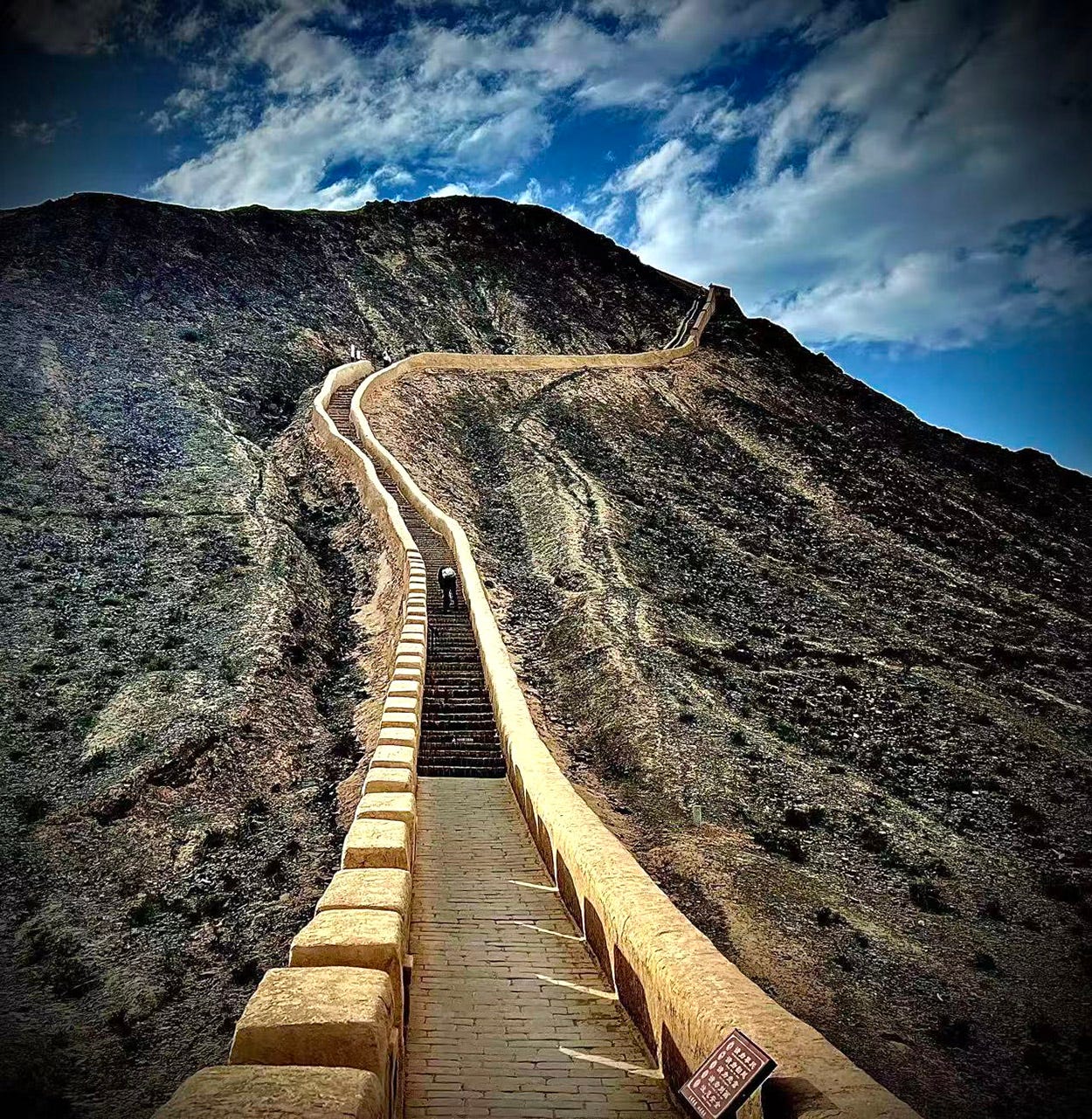
There is a certain kind of power that comes from owning something that cannot be replicated.
Not a patent. Not a brand. Not a technology that can be reverse engineered. A physical, geographic, historical fact: the only place where something happened, or ended, or began. You cannot build another Grand Canyon. You cannot move the western terminus of the Great Wall. You cannot manufacture a second Machu Picchu.
Most cities with such assets do not know what they have. They treat them as heritage to preserve, relics to protect, or at best, commodities to monetize through ticket sales. They outsource the operation. They let private capital dictate the narrative. They treat the gate as a revenue stream rather than a sovereign instrument.
Jiayuguan did something different.
A company town built around a state owned steel mill; replaceable, forgettable, a dot on the map because a furnace was placed there looked at the crumbling fort at its edge and saw not a relic but a creation waiting to happen. With the fiscal capacity of its industrial anchor, it built infrastructure. It collapsed distance. It took control of the story. Then it did something that no private operator could: it refused to choose what the story meant.
Is the Fort the end of the Great Wall or the beginning of the frontier? The answer depends on who is selling the ticket and in Jiayuguan, the state sells both, on the same day, from the same gate. The ambiguity is not a weakness to be resolved. It is the point.
This is the Sovereign Orchestrator: a state that does not regulate or subsidize, but creates and operates. It owns the non-replicable asset permanently. It controls the narrative without being pinned to a single interpretation. It uses independent fiscal capacity; from any source to insulate the asset from market pressure. It then confines private capital to the periphery, where it can build hotels and restaurants but never touch the gate.
Jiayuguan is not alone. The Louvre, Machu Picchu, Angkor Wat, the Vatican Museums, the Pyramids of Giza; each is a variation on the same archetype. But Jiayuguan reveals something the others do not: that the Sovereign Orchestrator can be built, not inherited. The Fort was not globally famous before the orchestration began. The state created the pilgrimage, not just managed it.
This is the story of how a remote outpost learned to own the gate and the story of the gate.
A City Built for Steel
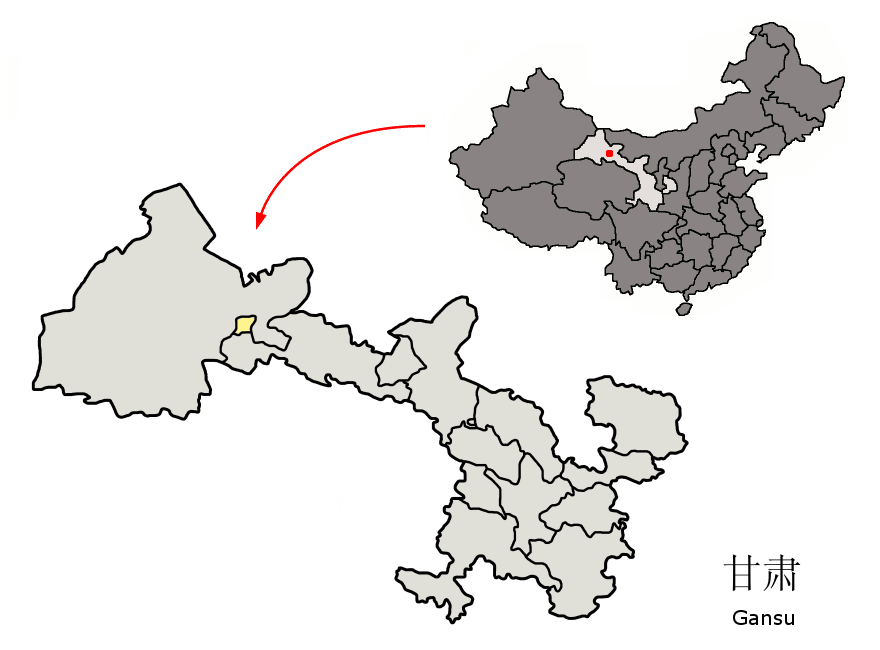
Before Jiayuguan became the Sovereign Orchestrator, it was barely a city at all.
In 1965, when Jiayuguan was formally established as a county level city under the direct jurisdiction of Gansu Province, its existence was tethered entirely to a single industrial asset: the Jiuquan Iron and Steel Works (JISCO), founded in 1958.1 The city did not emerge organically from trade routes, agricultural surplus or strategic geography. It was placed there because a furnace was placed there.
The numbers tell the story of a settlement with no economic reason to exist beyond the steel mill. In 1965, the year of the city’s founding, its population stood at approximately 30,000. By 1971, when Jiayuguan was elevated to a prefecture level city by area, the smallest in Gansu; the population had barely reached 38,000.2 This was not a city with a diversified economy or a deep labor pool. It was a company town in the most literal sense: a workforce housed next to its workplace, with no surrounding economic hinterland to speak of.
The dominance of JISCO was absolute. Mining and mineral processing were not merely the primary industries; for decades, they were effectively the only industries.3 The city’s fate rose and fell with the price of steel, the availability of iron ore from the nearby Jingtieshan mine, and the production targets set by the central government.
The constraint was existential: Jiayuguan was replaceable. The steel it produced could be made elsewhere. The location offered no inherent competitive advantage except the historical decision to place a furnace there in the late 1950s. The city had no cultural identity distinct from the factory. It had no narrative. It was, in the language of economic geography, a point of production with no claim to permanence.
The Long Shadow of a Single Industry
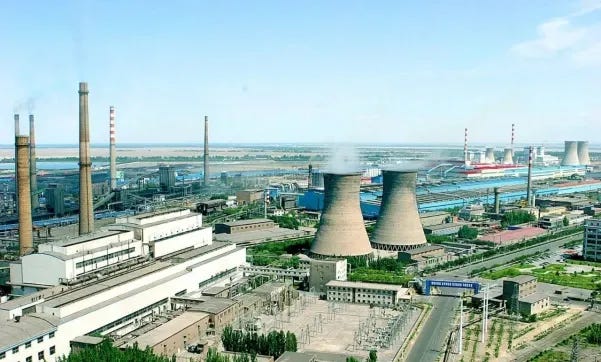
The consequences of this mono-industrial structure were stark.
For twenty seven years, from its founding until 1985, JISCO operated at a loss.4 The steel works produced iron but not steel; a bottleneck that left the enterprise incomplete and unprofitable. The turning point came on December 24, 1985, when the first steel was poured at the newly constructed steelmaking plant. As the local historical record notes5: From this day on, JISCO ended its 27 year history of losses.6
The steelmaking plant, a key national construction project during the Sixth Five Year Plan period, was designed with an initial annual capacity of 450,000 tons.7 Within a decade, production surged. By 1995, crude steel output reached 1.03 million tons. By 2000, it had grown to 1.92 million tons.8 The city grew alongside it: population expanded from 87,000 in 1990 to 134,000 in 2000 and by 2010 had reached 232,000.9
But growth did not equal diversification. As late as 2005, when per capita GDP in Jiayuguan reached 44,674 yuan; remarkably high for a city of its size, the industrial sector still accounted for 74.2 percent of GDP.10 The city was prosperous by the narrow measure of output per worker, but profoundly vulnerable by any measure of structural resilience.
The Asset That Sat Unrecognized
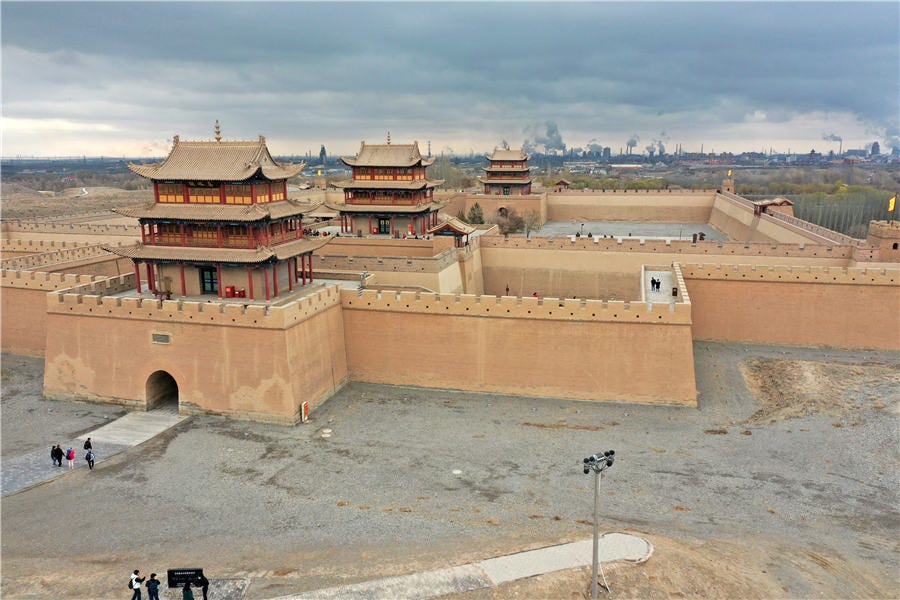
All the while, Jiayuguan possessed something that no other city could claim.
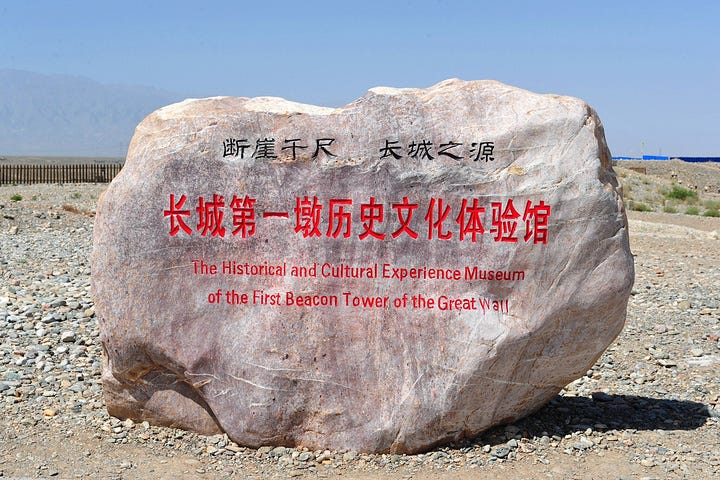
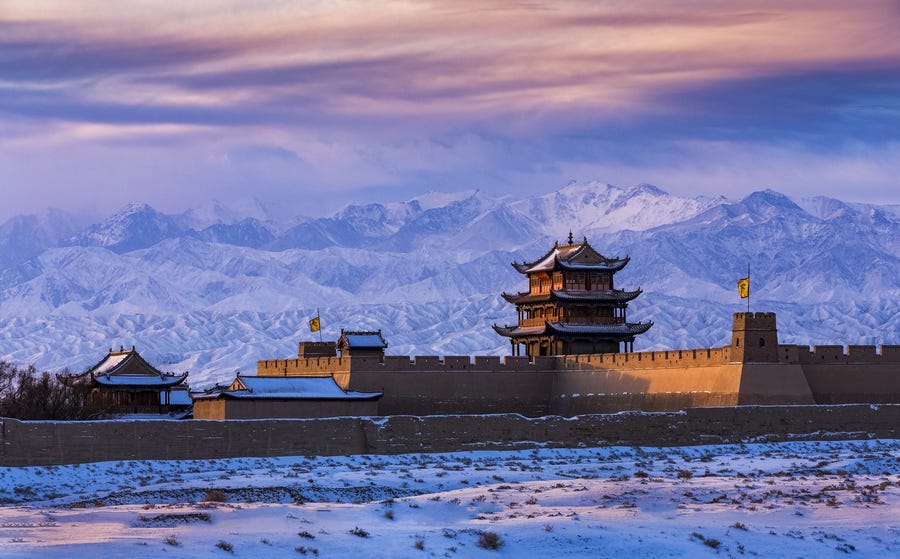
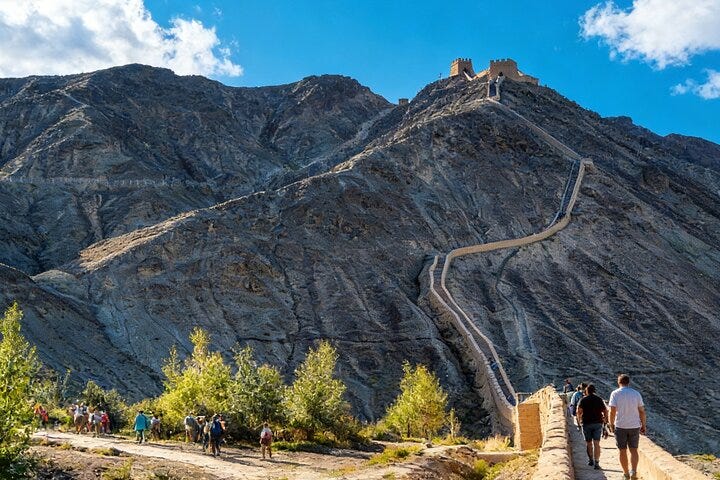
The fortress at Jiayuguan, constructed in 1372 during the early Ming Dynasty, is the western terminus of the Great Wall. Known as the First Pass Under Heaven, it stands at the edge of the desert, the point where the wall meets the Jiayuguan Pass between the snow capped Qilian Mountains and the Black Mountain.11 A National Geographic correspondent who visited in the late 1970s described the journey to this remote outpost as a passage to China’s Far West.12
But for decades, the Fort was not an economic asset. In 1984, the year before JISCO began producing steel, the Jiayuguan Pass received approximately 10,000 visitors annually.13 It was a relic. A historical artifact. A curiosity for the occasional traveler willing to make the long journey to a remote industrial city. The state owned steel mill paid the bills; the Fort stood silent, waiting for someone to realize that its story; the story of the terminus, the frontier, the edge could be worth more than all the steel the furnaces could produce.
That realization would require a pivot and the pivot would require permission.
Permission to Build a Story
The Creation
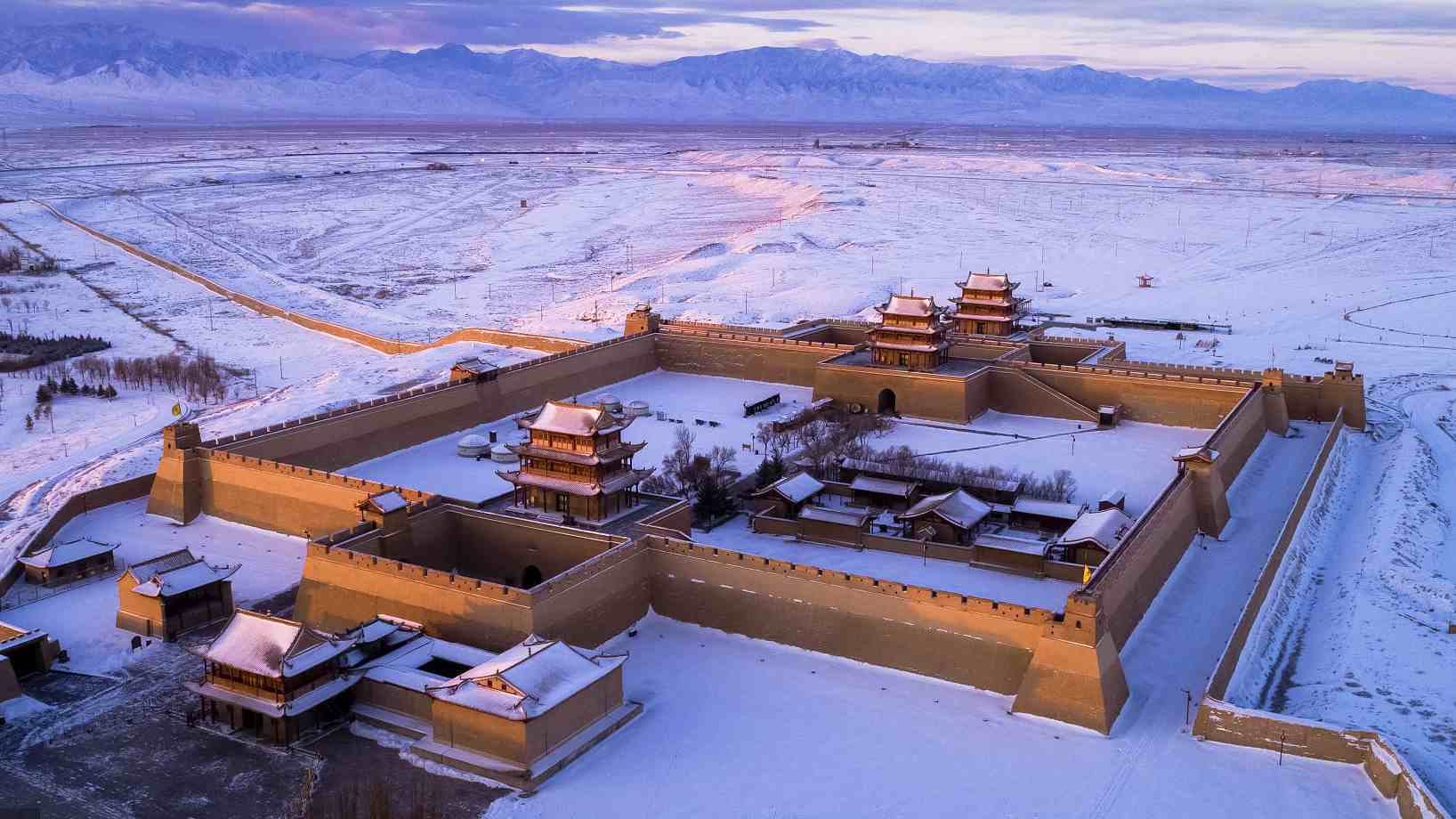
The pivot did not begin with a market discovery. It began with a designation.
In 2010, Jiayuguan was named a National Tourism Service Standardization Pilot City by the National Tourism Administration of China.14 The designation was not an investment. It was permission. Permission to rebrand. Permission to treat the Fort not as a relic to preserve but as an asset to develop.
Permission to imagine that a company town built for steel could become something else
The timing was not accidental. The national government was in the early stages of what would become the Belt and Road Initiative, announced in 2013. Jiayuguan sat at a strategic intersection: the western terminus of the Great Wall, the eastern gateway to Xinjiang, a point on the ancient Silk Road that the new initiative sought to revive.15 The Fort was elevated as a flagship cultural heritage site, reframed from a regional curiosity to a national pilgrimage destination.16
The designation carried weight. It unlocked access to central government funding for infrastructure, accelerated approvals for transportation projects and most critically authorized the local government to operate the Fort as a sovereign asset rather than a heritage site managed by cultural authorities.
The Infrastructure Collapse
Before the pivot, Jiayuguan was remote. After the pivot, distance collapsed.
The Lanzhou–Xinjiang High Speed Railway, a key component of the Belt and Road infrastructure push, began construction in 2009 and opened in phases between 2014 and 2017. Jiayuguan South Station became a major stop on the line, connecting the city to Lanzhou in four hours; a journey that once took eighteen hours by conventional rail.17 The high speed rail turned isolation into proximity. Tourists from the provincial capital, from Xi’an, from the coastal cities, could now reach the terminus in a single day.
The airport followed. Jiayuguan Airport, originally a military airfield, underwent expansion beginning in 2012, with a new terminal completed in 2015.18 Direct flights connected Jiayuguan to Beijing, Shanghai, Xi’an and Chengdu. The city that had been a dead end on the railway line became a node in the national air network.
The road network hardened. National Highway 312, the main artery through the Hexi Corridor, was upgraded. The rise of domestic self drive tourism; a booming middle class phenomenon turned the journey to Jiayuguan into a rite of passage: the drive to the edge, the road that ends at the wall.19
The infrastructure was not built by the city. It was built by the state, for the state’s purposes. But Jiayuguan, having secured the designation, positioned itself to be the beneficiary. The sovereign orchestrator does not build every road. It ensures that the roads built by others lead to its gate.
The Narrative Forge
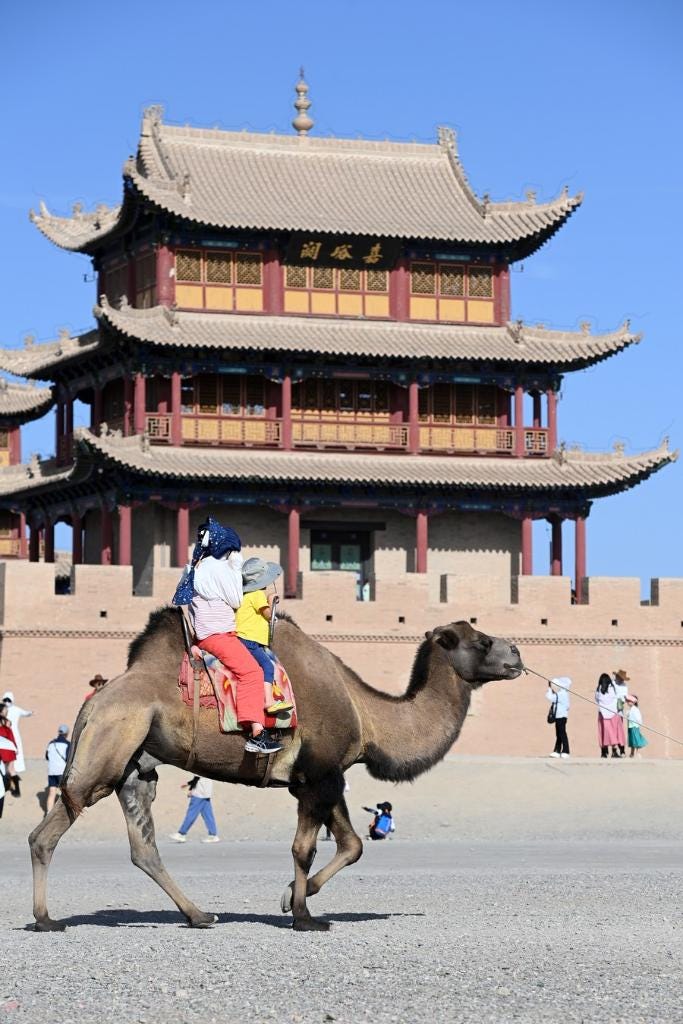
Infrastructure brought bodies. Narrative brought value.
The Fort had always been a fact: the western terminus, the last outpost, the edge. But facts do not generate premiums. Stories do. And the state, as sovereign orchestrator, controlled the story.
The narrative was forged through multiple layers of authority. In 1961, the Jiayuguan Pass had been designated a Major Historical and Cultural Site Protected at the National Level; the highest designation available.20 In 1987, the Great Wall was inscribed as a UNESCO World Heritage Site, with Jiayuguan as its western anchor.21 These were dormant credentials, waiting to be activated.
The activation came with the policy pivot. The Fort was reframed not as a relic of the Ming Dynasty but as a living symbol of Chinese civilization’s endurance. The official narrative emphasized the pass as the point where the Silk Road passed through the Great Wall; connecting China to Central Asia and beyond.22 This framing aligned perfectly with the Belt and Road Initiative’s rhetoric of connectivity and historical continuity.
But the state did not lock itself into a single story. It cultivated ambiguity.
To the domestic tourist seeking cultural education, the Fort was presented as the end; the place where the dragon stops, where civilization defended its edge. Interpretive materials emphasized military history, strategic defense, the heroes who guarded the pass.23
To the aspirational traveler seeking adventure, the Fort was presented as the beginning; the gateway to the western frontier, the launchpad for exploration beyond. Marketing materials featured desert sunsets, the promise of the Silk Road, the romance of the edge.24
The state owned both framings. It did not need to choose. It could sell pilgrimage to one customer and adventure to another on the same day, from the same gate.
The Operation
With designation secured, infrastructure built and narrative forged, the state moved to operate.
The Jiayuguan Municipal Government, through its tourism administration, took direct control of the Fort. The site was managed as a state owned asset, with pricing authority held by the local government. Entry fees were set at a premium;150 yuan during peak season capturing the value of the non-replicable asset directly into public coffers.25
The operation was not minimalist. The state invested in site development: restoration of the fortress walls, construction of visitor centers, installation of interpretive exhibits, development of night tours and light shows.26 The Fort was transformed from a crumbling relic to a curated experience.
Crucially, the state did not outsource the core. Private capital was invited to build hotels, restaurants and tour services; the periphery. The first five star hotel in Jiayuguan, the Great Wall International Hotel, opened in 2012 with private investment.27 Private tour operators, bus companies and souvenir vendors clustered around the site. But the gate itself remained in state hands. The state controlled access. The state controlled the story. The state captured the premium.
This structure; state ownership of the core, private capital in the periphery was not an accident of history. It was the architecture of the sovereign orchestrator.
What Was Created
By 2019, the year before the pandemic disrupted global tourism, the Jiayuguan Pass received over 1.3 million visitors annually.28 The city that had been a company town for steel had become a pilgrimage destination. Tourism revenue had grown from negligible in 2005 to over 2.5 billion yuan in 2019.29
But the creation was not a tourism industry. It was a sovereign narrative asset.
The Fort could not be replicated. No other city could build a western terminus. No other city could claim to be the place where the Great Wall ends. This geographic monopoly, once activated through designation, infrastructure and narrative, became a permanent revenue stream; insulated from competition, protected from market forces, held in state ownership indefinitely.
The steel mill still operated. JISCO continued to produce steel, volatile and cyclical, providing the fiscal capacity that had financed the infrastructure and continued to underwrite the city’s operations. But the Fort no longer depended on the steel. It had its own balance sheet. Its own revenue. Its own permanence.
The sovereign orchestrator had built something that could outlast the furnace.
Owning the Gate, Owning the Story
The Architecture
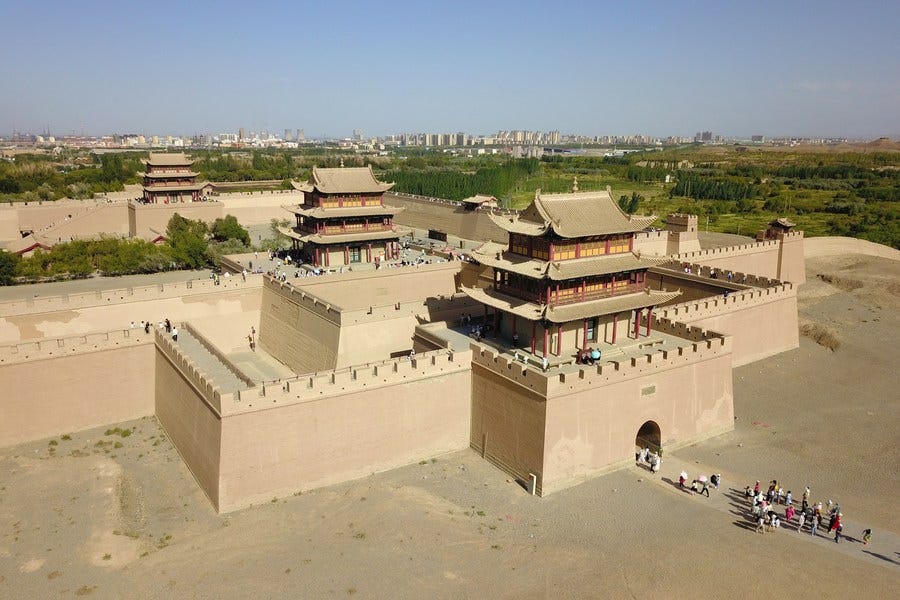
The Fort at Jiayuguan is not a complex asset. It is a wall, a pass, a stretch of desert. But the architecture built around it; the structure of ownership, narrative and capital is precise.
The sovereign orchestrator operates through three interlocking mechanisms: permanent ownership of the core asset, narrative sovereignty over its meaning and the confinement of private capital to the non-strategic periphery. Jiayuguan reveals how these mechanisms function together, not as a static structure but as a living system.
Permanent Ownership
The first mechanism is the simplest: the state never sells.
The Jiayuguan Pass is owned and operated by the Jiayuguan Municipal Government through its Tourism Administration.30 Unlike heritage sites that are contracted to private operators or managed through public-private partnerships, the Fort remains in direct state control. The government sets entry fees, determines operating hours, approves all site modifications and retains all revenue.31
This permanent ownership insulates the asset from pressures that would otherwise degrade its value.
A private operator, facing debt service or investor return expectations, would be forced to maximize short term revenue: raise ticket prices to the point of demand destruction, pack the site beyond carrying capacity, license the brand indiscriminately, or dilute the experience through over commercialization. The state, owning the asset permanently, can optimize for long term value. It can invest in restoration projects that do not yield immediate returns. It can limit visitor numbers to preserve the experience. It can say no to development proposals that would erode the site’s authenticity.32
The freedom to say no is the hidden advantage of permanent ownership. The sovereign orchestrator does not need to monetize every square meter. It can leave the desert empty because the emptiness is part of the value.
Narrative Sovereignty
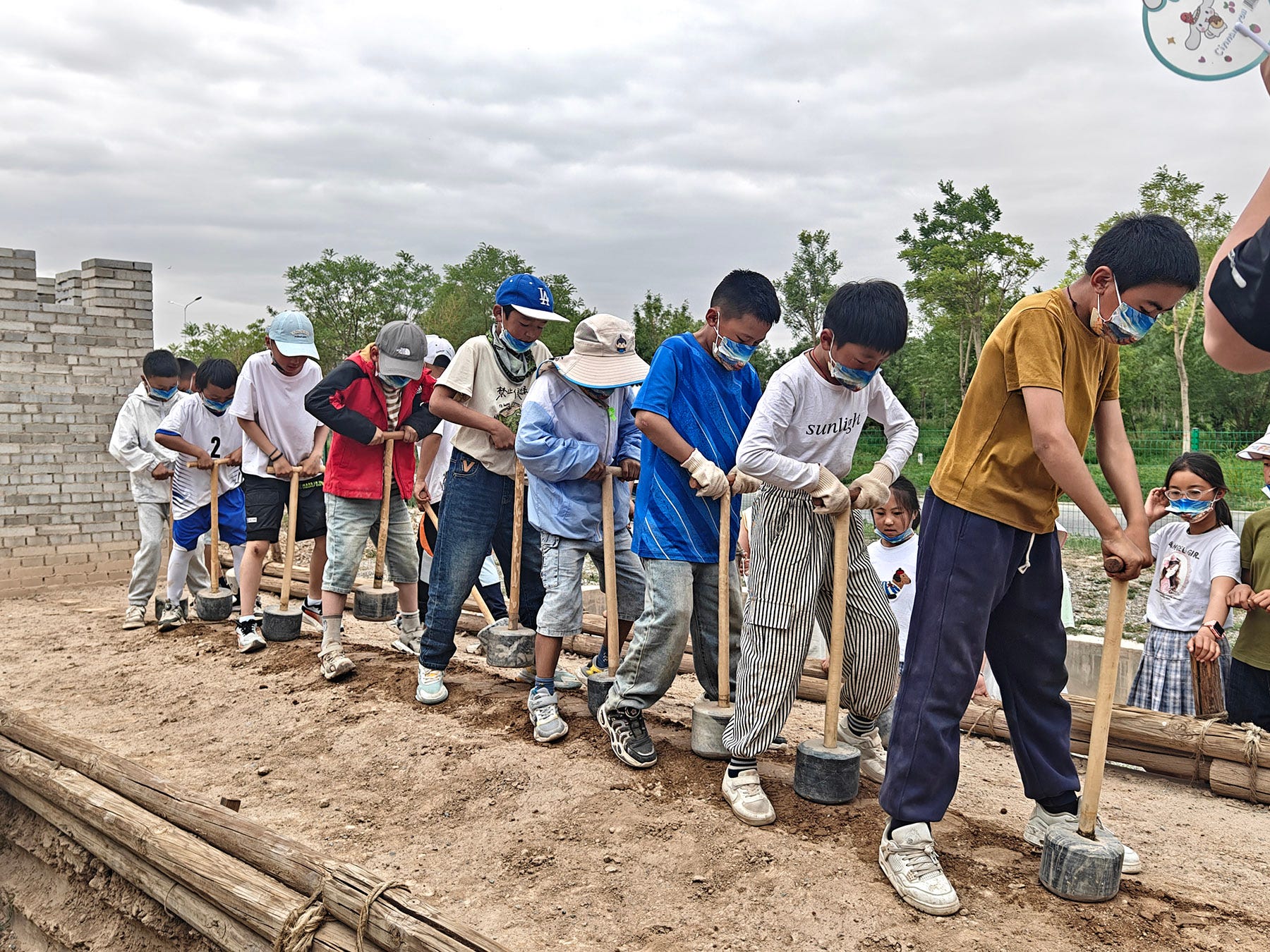
The second mechanism is the more subtle: the state controls the story, and the story controls the premium.
The Jiayuguan Pass is a geographic fact: 39.8° N, 98.2° E, the western terminus of the Ming Great Wall.33 But facts do not generate 1.3 million visitors per year. Stories do. And the state, as sovereign orchestrator, does not merely tell the story; it owns the authority to define what the story means.
This authority operates through multiple channels.
Designation as certification. The Fort carries three layers of official designation: Major Historical and Cultural Site Protected at the National Level (1961), UNESCO World Heritage Site (1987), and National Tourism Service Standardization Pilot City (2010).34 Each designation is a state issued credential that certifies authenticity, significance and quality. No private entity can issue these credentials. They belong to the state alone.
Interpretation as control. On site exhibits, official brochures and guide narratives are produced and approved by the municipal tourism administration.35 The interpretive framework emphasizes the Fort’s role in Chinese civilization: the guardian of the frontier, the symbol of endurance, the point where the Silk Road passed through the wall. This framing aligns with national narratives of unity, history and territorial integrity.
Ambiguity as flexibility. The state does not lock itself into a single interpretation. The Fort is presented to different audiences in different ways. For educational tours, it is a military history site. For cultural tourists, it is a UNESCO treasure. For domestic leisure travelers, it is a scenic destination. For aspirational adventurers, it is the gateway to the western frontier.36
This narrative flexibility is possible only because the state owns the asset permanently. A private operator would be forced to choose a brand identity and commit. The state can hold multiple framings simultaneously, capturing different market segments without diluting the core.
The power of narrative sovereignty becomes visible in moments of ambiguity. Is the Fort the end of the Great Wall or the beginning of the frontier? The state does not need to decide. It sells both answers, from the same gate, to the same customer if necessary. The ambiguity is not a weakness to be resolved. It is the point.
Peripheral Private Capital
The third mechanism is the boundary: private capital serves the periphery; the state holds the core.
Jiayuguan’s tourism economy is built on a clear division of labor. The state owns and operates the Fort. Private capital builds and operates everything else: hotels, restaurants, tour buses, souvenir shops, photography services, transportation networks.37
This division is not accidental. It reflects a strategic judgment about where private capital creates value and where it destroys it.
Where private capital creates value: In services that require operational flexibility, customer facing innovation, and competition on price and quality. Hotels benefit from private management. Restaurants thrive on private entrepreneurship. Tour operators respond to shifting customer preferences faster than any state owned entity could.
Where private capital destroys value: At the core of the asset itself. Private operators would be tempted to overcrowd, overcharge or over brand. The Fort’s value lies in its authenticity, its scarcity, its non-replicable character. These qualities are preserved by state control, not enhanced by private competition.
The boundary is enforced through practical mechanisms. The state controls access to the site; private tour operators must obtain permits to bring groups. The state controls ticketing; private vendors cannot sell entry. The state controls the brand; private businesses cannot use the Fort’s imagery without authorization.38
The result is a structure where private capital competes vigorously in the periphery, driving quality and innovation in services, but never accumulates the power to dictate terms at the core. The sovereign orchestrator captures the premium; private capital captures the margin.
The Balance Sheet Separation
The architecture contains one additional feature: the separation of balance sheets.
The Fort’s operations are funded through entry fees, which in 2019 generated approximately 195 million yuan in revenue.39 These revenues cover site maintenance, restoration projects and a portion of the municipal tourism administration’s operating budget. The Fort is not subsidized by the city’s industrial base.
But the Fort does not need to service the debt incurred to build the infrastructure that made it accessible. The high speed rail station, the airport expansion, the highway upgrades; these were funded through national and provincial transportation budgets, not through tourism revenue.40 The infrastructure that collapsed distance was paid for by other balance sheets.
This separation is critical. If the Fort were required to generate the returns necessary to fund its own infrastructure, the pressure to monetize would be overwhelming. Ticket prices would rise. Visitor numbers would need to grow faster than carrying capacity would allow. The premium would erode.
Instead, the infrastructure was funded as infrastructure; a public good, a national connectivity project, a Belt and Road investment. The Fort captured the benefit without bearing the cost. The steel mill, through its tax contributions, helped fund the municipal operations that supported the Fort, but the Fort itself was never burdened with the capital costs of its own creation.
This is the hidden architecture of the sovereign orchestrator: the core asset sits on its own balance sheet, insulated from the capital costs that would otherwise force it to behave like a commercial enterprise.
The Architecture in Operation
The mechanisms work together as a system.
Permanent ownership gives the state the freedom to say no to short term monetization. Narrative sovereignty gives the state the power to capture premium value through meaning rather than brute pricing. Peripheral private capital delivers quality services without threatening the core. Balance sheet separation insulates the asset from the capital costs of its own enabling infrastructure.
Together, these mechanisms produce a structure that Jiayuguan’s planners did not invent but inherited and refined. The same architecture operates at the Louvre, where the French state owns the museum and the collection while private operators run cafes and gift shops. At Machu Picchu, where the Peruvian state controls access while private companies operate the train and hotels. At Angkor Wat, where the Cambodian state, through the APSARA Authority, exercises absolute control over the site while private tourism services cluster outside.41
Jiayuguan’s distinction is not the architecture itself but the fact that it was built from scratch. The Louvre was a royal palace before it was a museum. Machu Picchu was a rediscovered wonder. Angkor Wat was a national symbol before the modern tourism economy existed. Jiayuguan was a company town with a crumbling fort at its edge. The sovereign orchestrator took a non-replicable asset that sat unrecognized and built the architecture that turned it into a permanent revenue stream.
The gate was always there. The architecture was created.
What the Sovereign Orchestrator Cannot Do
The Limits
The Sovereign Orchestrator is a powerful architecture, but it is not a universal one. Jiayuguan’s transformation reveals not only what the model enables but also what it cannot do. These limits are not failures of execution. They are structural constraints built into the architecture itself.
It Cannot Create New Assets from Nothing
The Sovereign Orchestrator requires a non-replicable asset. Jiayuguan had the Fort. The Louvre had the palace. Machu Picchu had the citadel. The architecture can activate a dormant asset, but it cannot manufacture the geographic, historical, or cultural monopoly that makes the asset non-replicable in the first place.
This constraint matters because it defines where the model can be applied. A city without a non-replicable asset cannot become a Sovereign Orchestrator. It can build infrastructure. It can forge narratives. It can attract private capital. But it cannot create the kind of permanent, insulated revenue stream that Jiayuguan built around the Fort. The architecture depends on the asset, not the other way around.
It Cannot Foster an Independent Private Sector
The Sovereign Orchestrator confines private capital to the periphery. Hotels, restaurants, tour operators; these thrive. But they thrive as dependents, not as autonomous actors. They serve the core asset. They do not own it. They do not control it. They cannot accumulate the capital or brand equity to challenge the state’s monopoly over the gate.
This produces a structurally dependent private sector. In Jiayuguan, the hospitality and service industries grew alongside the Fort’s transformation, but they remain tethered to a single asset. If the Fort’s visitor numbers decline, the periphery collapses. There is no diversification within the private sector because the architecture actively prevents private capital from developing independent centers of value. The state captures the premium; private capital captures the margin. This is by design, but it is also a vulnerability.
It Cannot Adapt Easily to Narrative Collapse
The Fort’s value depends on the continuity of the state’s narrative. That narrative is not fixed. It has shifted over time; from military history to cultural heritage to Belt and Road symbolism, but it has remained within the state’s control. The risk is not a shift in narrative. The risk is a collapse in narrative credibility.
If the state’s storytelling loses authority; through political instability, cultural fragmentation or simply generational disinterest, the asset’s premium erodes. Unlike a private brand, which can pivot to new markets or reinvent itself under pressure, a sovereign narrative asset is locked into its state owner. The state cannot rebrand the Fort as something it is not. The western terminus will always be the western terminus. But the story of what that means; whether it is an end or a beginning, a pilgrimage or a curiosity is contingent on the state’s ability to keep telling it in ways that people believe.
It Cannot Replicate Without Fiscal Capacity
The most binding limit is fiscal. Jiayuguan’s transformation was funded by infrastructure built on separate balance sheets: national transportation budgets, provincial development funds and the tax base of a state owned steel mill. The Fort itself was never asked to repay the capital cost of its own creation.
Most localities do not have this luxury. They cannot build high speed rail lines or expand airports on the promise of future tourism revenue. They are forced to fund development through the same budgets that must cover education, health care and social services or through debt that the asset itself must service. When the asset is burdened with its own infrastructure costs, the pressure to monetize becomes overwhelming. Ticket prices rise. Visitor numbers must grow faster than carrying capacity allows. The premium erodes. The architecture collapses.
The Sovereign Orchestrator requires a separate balance sheet. Without it, the model does not work. This is not a limit that can be overcome by good management or creative financing. It is a structural precondition.
What These Limits Mean
The Sovereign Orchestrator is not a blueprint for every city. It is a specific architecture for a specific condition: a non-replicable asset, a state willing to own it permanently and independent fiscal capacity to build without demanding immediate returns.
Where these conditions exist, the model is extraordinarily powerful. Jiayuguan transformed a dormant relic into a permanent revenue stream. The Fort outlasts the furnace. The gate pays for itself.
But where the conditions do not exist, the model cannot be imposed. The asset cannot be manufactured. The private sector cannot be liberated. The narrative cannot be forced. The fiscal capacity cannot be borrowed into existence.
The limit of the Sovereign Orchestrator is that it requires the very things it creates: permanence, sovereignty, separation. It can activate a dormant asset. It cannot create the conditions for its own existence.
THE FIVE GLOBAL KINSHIPS
Where Jiayuguan’s Lesson Applies
Jiayuguan’s transformation was not inevitable. The Fort sat for six centuries; recognized, protected, but economically inert. The pivot required three things: a non replicable asset, a state willing to own it permanently and independent fiscal capacity to build without demanding immediate returns.
Around the world, there are sites that share Jiayuguan’s 1980 condition. They have the asset. They lack the architecture. These are the kinship cases, not the ones that already succeeded, but the ones that could.
1. Takht-e Soleyman, Iran
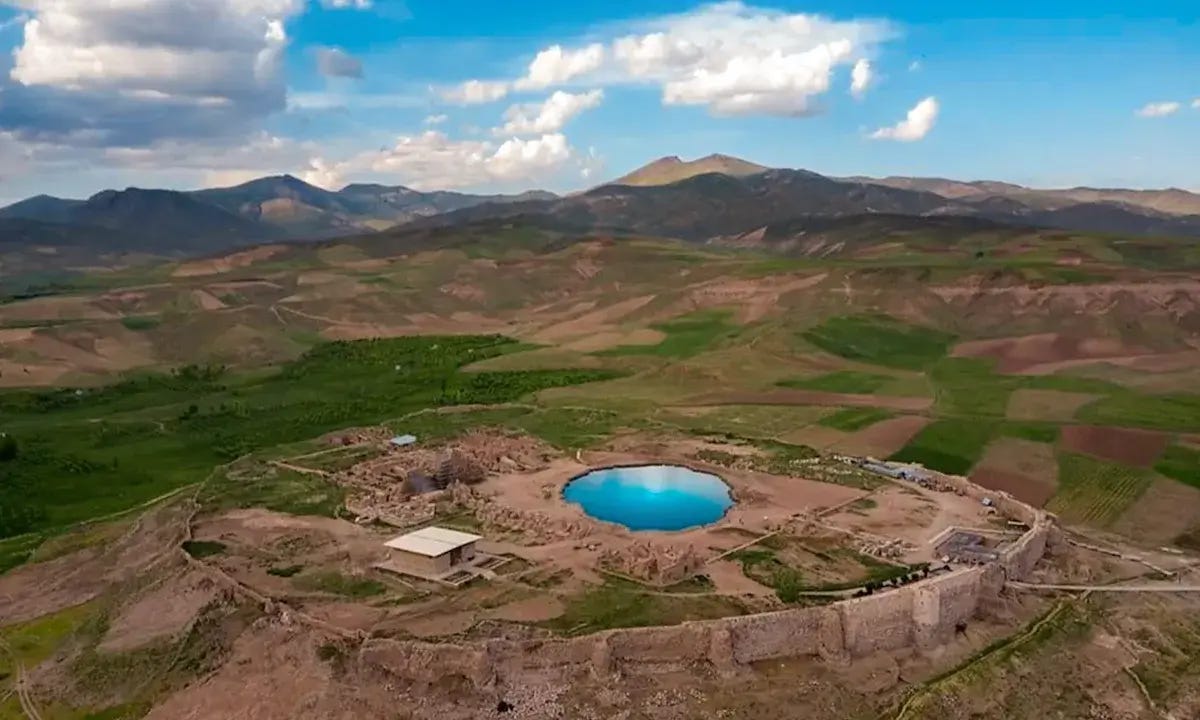
The holiest Zoroastrian site of the Sasanian Empire, where a volcanic crater lake feeds ancient fire temples. A UNESCO World Heritage site since 2003. The place where Persian kings were crowned. The cosmological center of an empire.
Remote in West Azerbaijan province, hours from any major city. Minimal visitor infrastructure. No paved road leading directly to the site. A handful of local guides. Annual visitors in the tens of thousands; a fraction of what Persepolis receives. The site is recognized by UNESCO but remains invisible to the global tourism economy.
Like the Fort, Takht-e Soleyman is a geographic and historical monopoly. There is no other Zoroastrian fire temple with this lineage. There is no other crater lake with this cosmological significance. But the state has not yet designated it as a sovereign narrative asset. The infrastructure has not been built. The story has not been forged.
The asset alone is not enough. Designation unlocks funding. Infrastructure collapses distance. Narrative creates premium. Iran has the fiscal capacity (oil revenue) and the state apparatus to orchestrate. What is missing is the decision to treat Takht-e Soleyman as a sovereign asset rather than a heritage site.
2. Great Zimbabwe, Zimbabwe
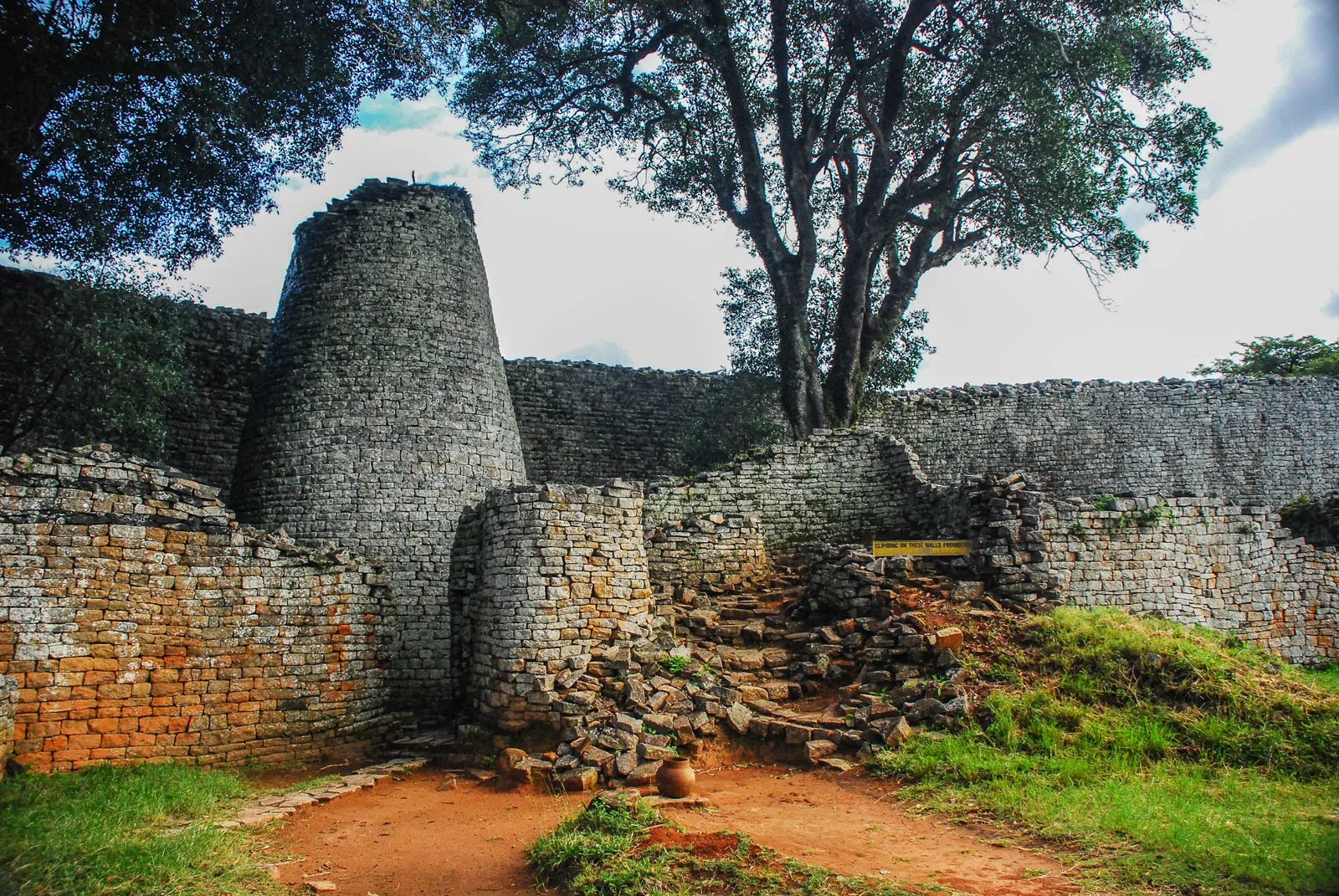
The stone ruins of a medieval African kingdom, the largest ancient structure in sub-Saharan Africa after the pyramids. A UNESCO World Heritage site since 1986. The name of the country itself derives from this site.
Accessible by a paved road from Masvingo, but visitor numbers remain low; approximately 80,000 annually, a fraction of what a site of this significance would attract in Europe or Asia. Limited interpretive infrastructure. Minimal state investment. The narrative of Great Zimbabwe was suppressed during the colonial era (European settlers attributed it to Phoenicians or Arabs rather than African builders), and post independence investment has prioritized other priorities.
Great Zimbabwe is a non-replicable asset. It is the only site of its kind. It carries the weight of national identity. But the state lacks the independent fiscal capacity that Jiayuguan had through JISCO. Zimbabwe’s economy cannot fund the infrastructure collapse that would turn isolation into proximity. The sovereign orchestrator model requires fiscal capacity. Without it, the asset remains dormant.
The architecture requires a separate balance sheet. If the site itself must fund its own infrastructure, the transformation will not happen. Zimbabwe would need external capital; development finance, international aid or a fiscal anchor from another sector to replicate Jiayuguan’s model.
3. Choquequirao, Peru
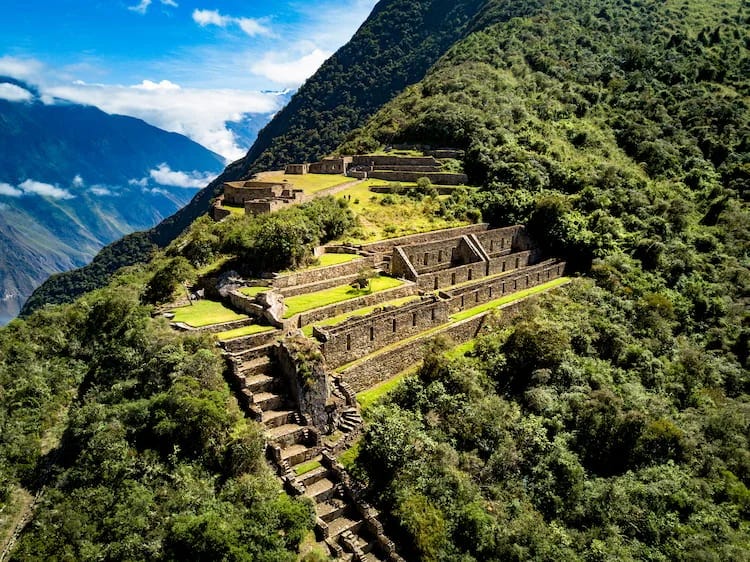
The other Machu Picchu an Incan site in the Vilcabamba mountain range, larger than Machu Picchu, never fully excavated, accessible only by a two day hike. Archaeologists believe it was one of the last refuges of the Incan resistance after the Spanish conquest.
Choquequirao receives approximately 30,000 visitors annually; compared to Machu Picchu’s 1.5 million. There is no road. No train. The only access is a steep 30 kilometer trail from the nearest village. The Peruvian state has designated it, protected it, but not yet orchestrated it. The site sits in the shadow of its more famous sibling, waiting for the infrastructure that would collapse distance.
Like the Fort before the high speed rail, Choquequirao is isolated. The asset is non-replicable; it is the largest Incan site still under forest cover, the place where the last Incan emperor may have held out. But the state has not yet made the decision to build. Machu Picchu was transformed by infrastructure: the train from Cusco, the bridge across the Urubamba, the town of Aguas Calientes built to serve visitors. Choquequirao waits for its own infrastructure collapse.
Isolation can become proximity, but only if the state builds the road or the railway or the cable car and funds it from a separate balance sheet. Choquequirao does not need to pay for its own access. It needs the Peruvian state to treat it as a sovereign investment, not a commercial project.
4. Hatra, Iraq
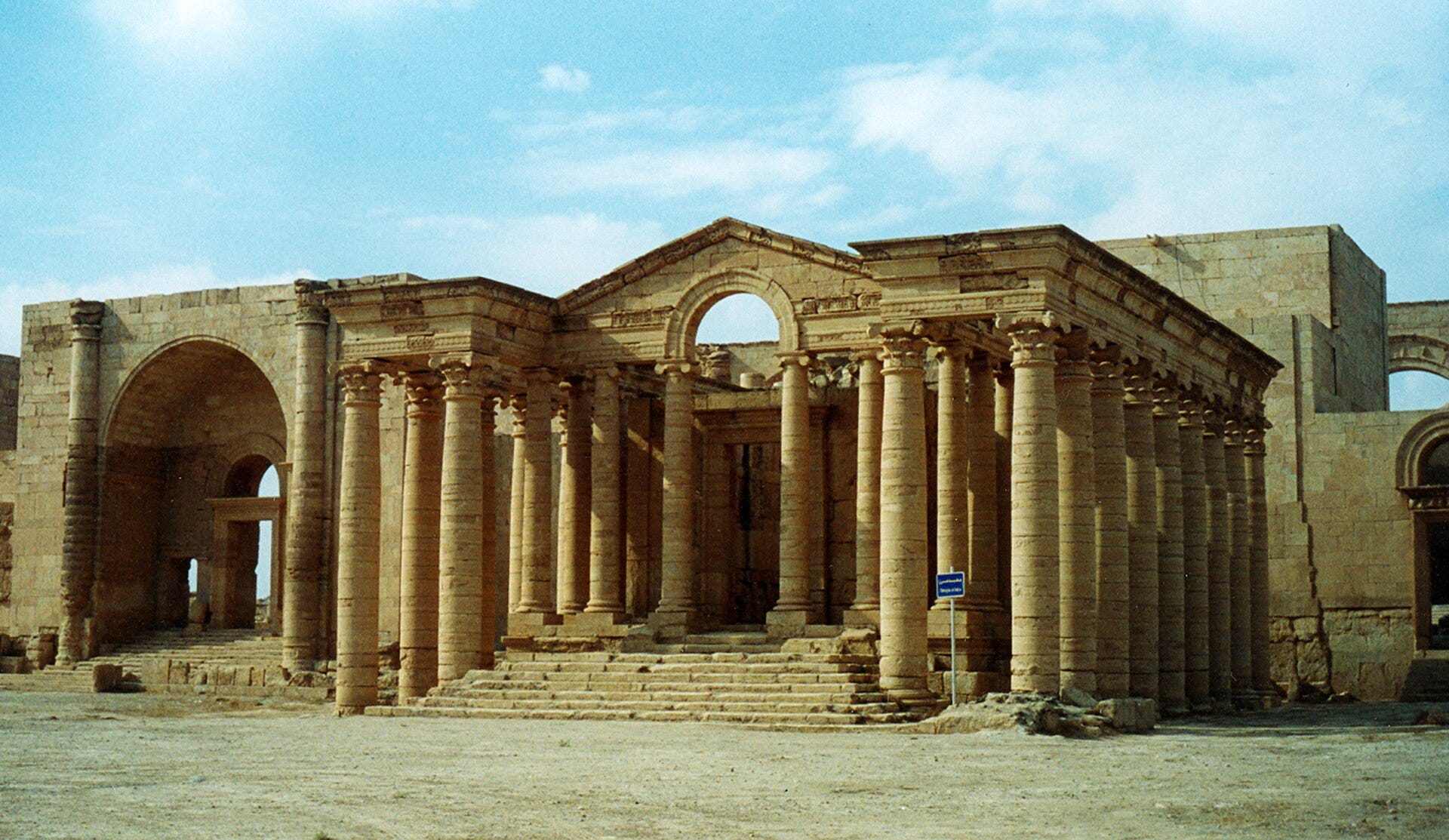
The 2,000 year old Parthian city in the desert of northern Iraq, a UNESCO World Heritage site since 1985. A circular city with massive walls, temples blending Hellenistic, Mesopotamian, and Persian architecture. One of the best preserved ancient cities in the world; until ISIS destroyed sections of it in 2015.
Hatra was a minor tourist site before 2003. After the US invasion, it became inaccessible. After ISIS, it became a symbol of destruction. Today, it is protected by Iraqi security forces, but tourism does not exist. The infrastructure is destroyed. The narrative is one of loss, not pilgrimage.
Hatra has what Jiayuguan had: a non-replicable asset, recognized by the state, protected by law, but economically inert. What it lacks is stability and fiscal capacity. Iraq has oil revenue; a separate balance sheet that could fund reconstruction and infrastructure. But the state has not yet decided to treat Hatra as a sovereign narrative asset.
The pivot requires a decision. Jiayuguan was not transformed by market forces. It was transformed by a policy designation that unlocked infrastructure and narrative. Hatra could follow the same path if the Iraqi state, with its oil fiscal capacity, chose to treat the site as a sovereign asset; a symbol of Iraqi civilization, a destination for pilgrimage, a gate that the state owns permanently.
5. Rani Ki Vav, India
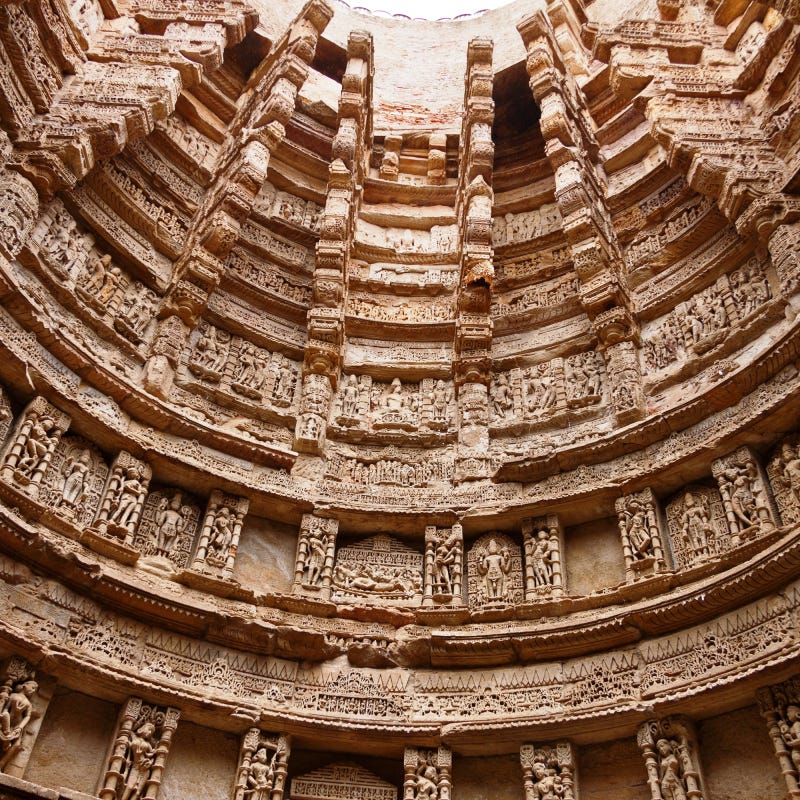
The 11th century stepwell in Patan, Gujarat, built by the Solanki dynasty, buried under silt for centuries, rediscovered in the 1960s. A UNESCO World Heritage site since 2014. One of the most intricate and largest stepwells in India, a masterpiece of water architecture.
Rani Ki Vav receives visitors; Gujarat has invested in tourism infrastructure but it remains a regional attraction, not a national pilgrimage site. The stepwell is stunning, but the narrative around it is underdeveloped. It is presented as architecture, not as sovereign story. The site generates modest revenue; the state has not yet built the infrastructure that would collapse distance from Mumbai, Delhi, or Ahmedabad.
Rani Ki Vav has the non-replicable asset. It has state ownership. It has the potential for narrative sovereignty; the story of water, of queens, of buried civilization waiting to be unearthed. What it lacks is the decision to treat it as a sovereign orchestrator would: a permanent asset to be developed with independent fiscal capacity, not a heritage site to be managed with limited budgets.
The asset must be separated from its funding. If Rani Ki Vav is funded through the same tourism budget that must cover dozens of sites, it will never receive the concentrated investment that turns isolation into proximity. India has the fiscal capacity. What is missing is the architecture: a dedicated state entity, permanent ownership, narrative sovereignty, and infrastructure funded from a separate balance sheet.
What These Kinships Share
Each of these five sites sits where Jiayuguan sat in 1980.
What binds these five sites is not their architecture or their history. It is their condition. Each possesses a non-replicable asset; geographic, historical, cultural that is recognized by the state, protected by law, and yet economically dormant. They sit where Jiayuguan sat in 1980: the gate exists, but the architecture that would turn it into a sovereign asset does not. No policy designation has prioritized them. No infrastructure has collapsed their isolation. No separate balance sheet has funded their transformation without demanding immediate returns. They are heritage sites, not sovereign instruments.
The question is not whether these sites have value. The question is whether their states will decide to act as sovereign orchestrators; to own the asset permanently, to fund infrastructure from a separate balance sheet, to forge the story that makes the gate worth traveling to.
Jiayuguan’s lesson is that the architecture must be built. The gate will not build itself.
Structural Pattern Recognition
Standing Capability
China in 5 is a longitudinal structural audit. Each week, one city is examined not as a case study but as a mechanism; a discrete piece of strategic architecture extracted from a specific context and rendered transferable.
Over time, this builds pattern memory. Mechanisms documented in one jurisdiction become recognizable when they appear elsewhere. The Sovereign Orchestrator identified in Jiayuguan, for instance, is not a Chinese phenomenon. It is a structural archetype with precedents in France, Iran, Indonesia, Jordan, and the United States. The contribution of this work is not discovery but codification: naming the mechanism, articulating its architecture, specifying its transfer conditions.
The standing capability is comparative observation. As the archive of mechanisms grows, the ability to recognize structural analogs across jurisdictions sharpens. A region facing a dormant non-replicable asset may find resonance in Jiayuguan. A jurisdiction managing a state owned industrial transition may look to Yulin or Panzhihua. The relevance is identified proactively; not through solicitation but through the accumulation of documented patterns.
For governments, regions, or institutions engaged in long arc structural development, the utility of this work lies in its cumulative precision. Each audit specifies not only what worked but under what conditions, with what fiscal architecture, and with what limits. Transfer is never assumed; it is diagnosed.
Proximity to this work; regular observation of the mechanisms as they are extracted offers an advantage that cannot be replicated through sporadic consultation. Structural pattern recognition requires sustained exposure to the architecture as it is documented, not summarized after the fact.
The work continues. The archive grows. The patterns accumulate.
Jiayuguan in the Chinese System
Monday: The Companion Essay
How a company town became a sovereign narrative asset and what that reveals about the state’s evolving role in economic orchestration.
This coming Monday, we will publish the companion essay to Jiayuguan. Where the deep dive traced the forensic mechanics of the Sovereign Orchestrator; the designation, the infrastructure, the narrative architecture the companion zooms out to situate the city within China’s larger system.
It will ask: Why does Jiayuguan exist at all? How does its model connect to Hefei’s state as venture capitalist, to Yulin’s captive transition, to the other cities we have documented? What national function does a sovereign narrative asset serve nd why does this model make sense now; at this particular convergence of industrial transition, cultural policy and Belt and Road infrastructure?
The companion will not repeat the deep dive. It will not re-explain the mechanics of the Fort. It will assume the reader has already traced the architecture. Instead, it will open a higher altitude view: the systems logic beneath the city’s existence, the connections across the mental map, the timing that makes this model urgent, and the direction it signals for the next decade.
For readers who have followed the series, the companion is the layer that answers not how but why. For institutions watching the accumulation of mechanisms, it is the framing that makes the pattern visible.
Monday.
What the Gate Teaches
The Departure
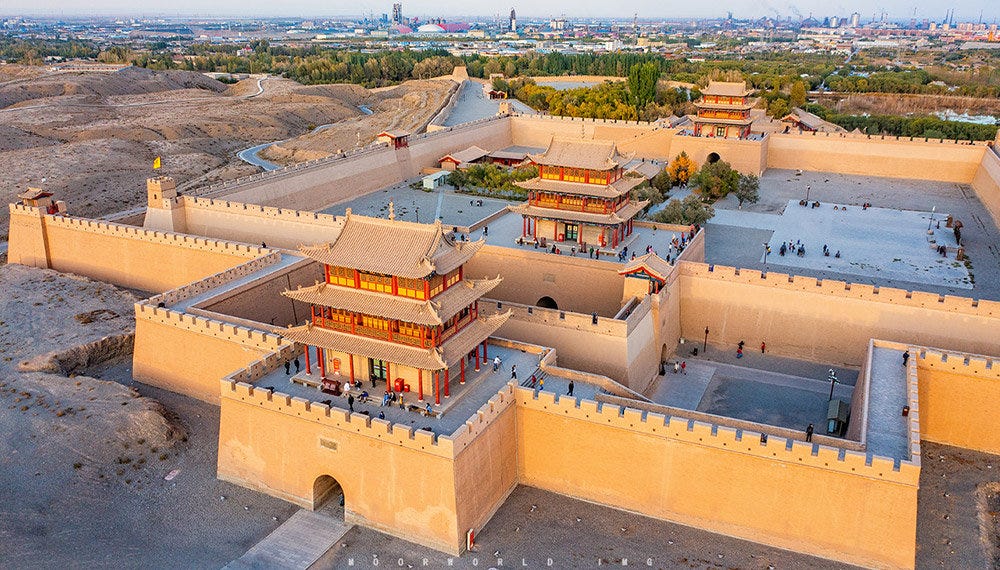
You leave the Fort at sunset. The desert absorbs the light. The wall stretches east into darkness, a stone spine across the landscape, disappearing into the dust. Behind you, the city goes about its business; the furnaces burning, the hotels turning over rooms, the tour buses loading passengers for the evening drive back to the high-speed rail station.
The gate stands. It has stood for six centuries. It will stand, in all likelihood, for six more.
What was built around it; the infrastructure, the narrative, the architecture of permanent state ownership is newer. Less than two decades have passed since the pivot began. And yet the structure already feels settled, as if it had always been this way: the state holding the gate, private capital serving the periphery, the story of the terminus told and retold to each new wave of visitors.
The steel mill that financed the transformation still operates. It is still volatile. It is still exposed to global commodity cycles that no city can control. But the Fort does not rise and fall with the price of steel. It has its own balance sheet. Its own revenue. Its own permanence. The sovereign orchestrator built something that can outlast the furnace.
Jiayuguan teaches that a dormant asset is not a destiny. The Fort sat for centuries; recognized, protected, economically inert. The transformation required no new discovery, no technological breakthrough, no market miracle. It required a decision: to treat the gate as a sovereign asset, to fund its infrastructure from a separate balance sheet, to own the story as permanently as the stone.
This is not a model that can be applied everywhere. It requires a non-replicable asset. It requires fiscal capacity independent of the asset itself. It requires a state willing to own permanently, to confine private capital to the periphery, to hold narrative ambiguity as a strength rather than a weakness.
But where these conditions exist, the Sovereign Orchestrator offers something rare: a structure that captures premium value indefinitely, insulated from market forces, immune to competition, held in public ownership for the long arc.
What other assets sit in plain sight, unrecognized as sovereign, because no one has yet claimed the authority to define what they mean?
The Fort was always the western terminus. That fact generated no value until someone decided to build the architecture that turned a geographic fact into a narrative asset and then to hold that architecture permanently.
Every region has its Fort. Every territory has its dormant monopoly, its non-replicable asset, its gate waiting to be owned. The question is not whether the asset exists. The question is whether the decision will be made to build the architecture that activates it.
The Sovereign Orchestrator does not ask whether the gate is an end or a beginning. It asks only: who controls the answer?
In Jiayuguan, the answer is settled. The state holds the gate. The state tells the story. The state owns the architecture that makes the gate permanent.
The visitor passes through. The wall stretches east. The desert absorbs the light. And the gate, owned and operated, waits for the next pilgrim, the next adventurer, the next generation asking the same question: does the Great Wall end here, or does it begin?
The answer depends on who is selling the ticket. And in Jiayuguan, that answer has been settled.
NEXT: FOSHAN | CITY 40
The next deep dive will examine Foshan, a city in Guangdong Province that has spent three decades navigating a transition few cities survive: the transformation from a low-margin manufacturing hinterland to a premium producer of high-value goods, without losing its industrial base or its social cohesion.
Where Jiayuguan built a sovereign narrative asset on a separate fiscal balance sheet, Foshan faces a different problem. Its asset is not a gate but a network; a dense web of specialized manufacturing clusters, family owned workshops and a diaspora of skilled labor that has spread across the Pearl River Delta and beyond. The question is not how to own the asset permanently but how to upgrade it without destroying it.
Foshan reveals a different strategic archetype: the Industrial Metabolism, where a city digests its own industrial past to feed its future; not by abandoning the factory floor but by metabolizing the knowledge, the supply chains, and the labor discipline accumulated over decades into a new configuration of value.
Where Jiayuguan separated its industrial anchor from its narrative asset, Foshan has no such separation. Its industrial base is its asset. The question is whether it can become its own orchestrator.
Coming next.
Jiayuguan Municipal People's Government official website, "City Profile" (城市概况).
Gansu Provincial Bureau of Statistics, Gansu Statistical Yearbook 1991 (北京: 中国统计出版社, 1991)
Jiayuguan City Annals (嘉峪关市志), Gansu People's Publishing House, 2011
National Bureau of Statistics of China, China Steel Industry Statistical Yearbook 2001 (北京: 中国统计出版社, 2001).
ibid4
Gansu Provincial Bureau of Statistics, Gansu Development Yearbook 2006 (兰州: 甘肃人民出版社, 2006).
ibid4
National Bureau of Statistics of China, China Steel Industry Statistical Yearbook 2001 (北京: 中国统计出版社, 2001). / JISCO annual reports, JISCO official investor relations.
ibid2
Jiayuguan Municipal Bureau of Statistics, Jiayuguan Statistical Yearbook 2006 (嘉峪关: 嘉峪关市统计局, 2006).
State Administration of Cultural Heritage, "Jiayuguan Pass" (嘉峪关)
National Geographic, Vol. 157, No. 3, March 1980, "Journey into China's Far West."
State Administration of Cultural Heritage, "List of Major Historical and Cultural Sites Protected at the National Level," 1961.
National Tourism Administration of China, “List of National Tourism Service Standardization Pilot Cities” (全国旅游服务标准化试点城市名单), 2010
National Development and Reform Commission, “Vision and Actions on Jointly Building Silk Road Economic Belt and 21st-Century Maritime Silk Road,” March 2015.
Jiayuguan Municipal Government, “Jiayuguan Tourism Development Plan 2011–2020” (嘉峪关市旅游发展规划2011-2020), 2011.
China Railway Corporation, “Lanzhou–Xinjiang High-Speed Railway Opening Report” (兰新高速铁路开通报告), 2014.
Civil Aviation Administration of China, “Jiayuguan Airport Expansion Project Completion Report” (嘉峪关机场扩建工程竣工报告), 2015.
China Tourism Academy, *Annual Report on China’s Self-Drive Tourism Development 2018* (中国自驾车旅游发展年度报告2018), 2018.
State Administration of Cultural Heritage, “List of Major Historical and Cultural Sites Protected at the National Level” (全国重点文物保护单位名单), 1961.
UNESCO World Heritage Centre, “The Great Wall,” inscribed 1987. https://whc.unesco.org/en/list/438
Jiayuguan Municipal Government, Jiayuguan: The First Pass Under Heaven (嘉峪关: 天下第一雄关), official tourism brochure, 2015.
Jiayuguan Pass interpretive exhibits, on-site signage.
Gansu Provincial Tourism Administration, “Great Wall Silk Road Tourism Route” promotional campaign materials, 2016.
Jiayuguan Municipal Development and Reform Commission, “Notice on Jiayuguan Pass Entry Fee Pricing” (关于嘉峪关关城门票价格的通知), 2018.
Jiayuguan Municipal Government, Jiayuguan Cultural Heritage Protection and Tourism Development Report 2015–2018 (嘉峪关文化遗产保护与旅游发展报告2015-2018), 2019.
Great Wall International Hotel opening records, Jiayuguan Municipal Commerce Bureau, 2012.
Jiayuguan Municipal Bureau of Statistics, Jiayuguan Statistical Bulletin of National Economic and Social Development 2019 (嘉峪关市2019年国民经济和社会发展统计公报), 2020.
Jiayuguan Municipal Bureau of Statistics, Jiayuguan Tourism Economic Data Report 2005–2019 (嘉峪关市旅游经济数据报告2005-2019), 2020.
Jiayuguan Municipal Government, “Jiayuguan Tourism Administration Organizational Structure” (嘉峪关市旅游局组织机构), official government document, 2015.
Jiayuguan Municipal Development and Reform Commission, “Notice on Jiayuguan Pass Entry Fee Pricing” (关于嘉峪关关城门票价格的通知), 2018.
Jiayuguan Cultural Heritage Bureau, Jiayuguan Pass Restoration Project Report 2010–2018 (嘉峪关关城修缮工程报告2010-2018), 2019.
UNESCO World Heritage Centre, “The Great Wall,” inscribed 1987. https://whc.unesco.org/en/list/438
National Tourism Administration of China, “List of National Tourism Service Standardization Pilot Cities,” 2010.
Jiayuguan Tourism Administration, Jiayuguan Pass Interpretive Master Plan (嘉峪关关城解说总体规划), 2014.
Jiayuguan Municipal Government, Jiayuguan Tourism Marketing Strategy 2015–2020 (嘉峪关市旅游营销战略2015-2020), 2015.
Jiayuguan Municipal Bureau of Commerce, Jiayuguan Tourism Service Industry Development Report (嘉峪关市旅游服务业发展报告), 2018.
Jiayuguan Tourism Administration, “Regulations on Commercial Activities at Jiayuguan Pass” (嘉峪关关城商业活动管理规定), 2016.
Jiayuguan Municipal Bureau of Statistics, Jiayuguan Statistical Bulletin of National Economic and Social Development 2019 (嘉峪关市2019年国民经济和社会发展统计公报), 2020.
China Railway Corporation, “Lanzhou–Xinjiang High-Speed Railway Investment and Financing Report” (兰新高速铁路投融资报告), 2015;
Ministerio de Cultura del Perú, “Plan de Gestión del Santuario Histórico de Machu Picchu 2015–2019”
Really enjoyed learning about these archaeological sites that I had never heard of before. As a devoted lover of old buildings and structures, I'm glad to hear that the Chinese state is elevating this as a teaching tool and destination. And the idea of protecting the non-replicable core really resonated with me. As an entrepreneur, I have to make sure I don't let the push to take care of my clients undermine the barriers around access to my unique abilities. I have to be my own gatekeeper and not overcrowd the site, so to speak. Very encouraging!
Mo, The idea of narrative sovereignty is especially striking. The ability to hold multiple interpretations simultaneously without resolving them into a single framing feels less like marketing and more like strategic design. Another great piece of work and history. Thank you for sharing, Monica