

How a Replaceable Periphery Made Itself Indispensable

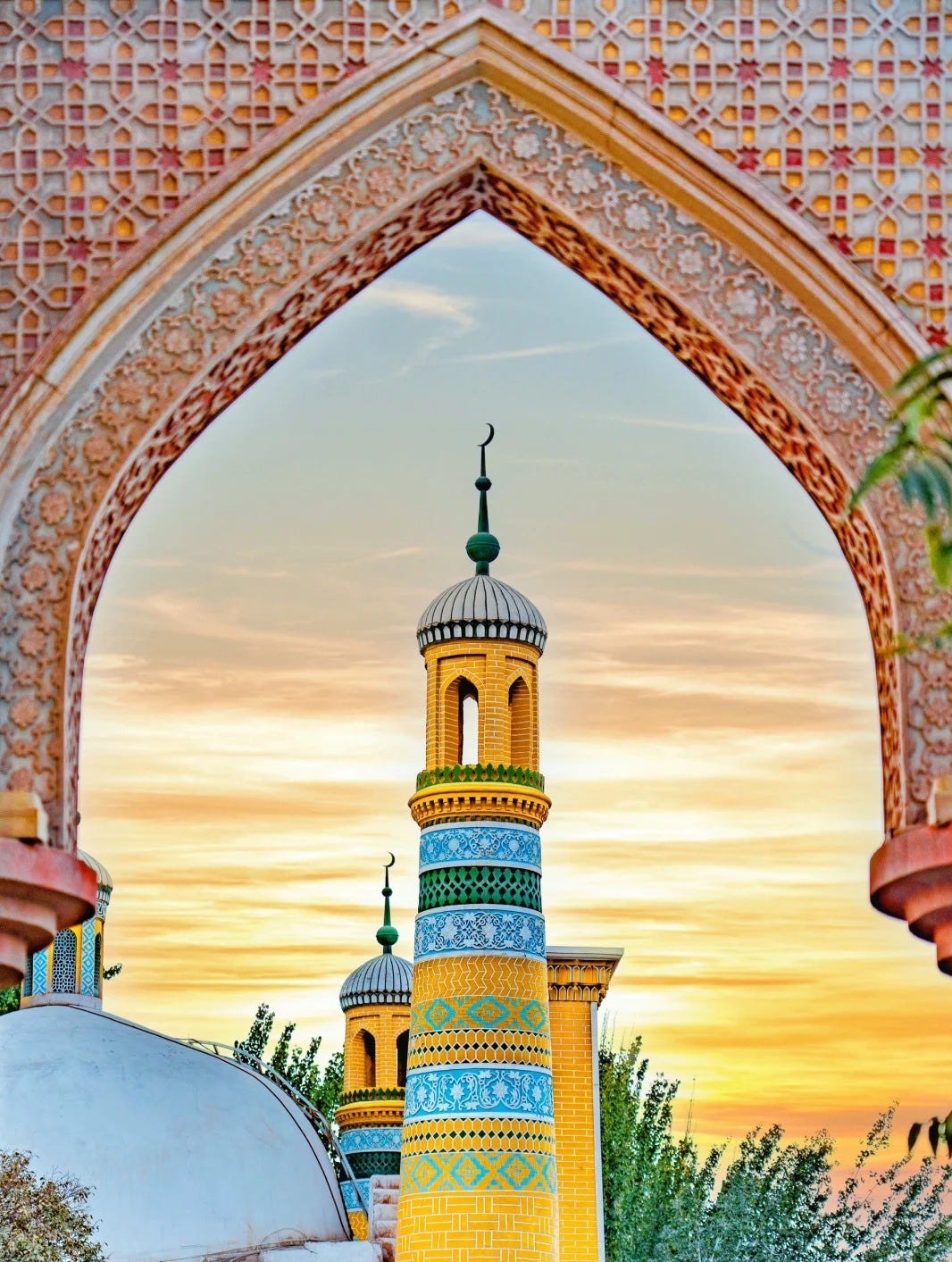
Most cities become important because of what they possess; harbors, minerals, factories, universities, the accumulated capital of generations. They sit atop something the world wants, and the world comes to them.
Kashgar possesses nothing.
No coastline. No oil. No fertile soil beyond what irrigation can coax from the desert. No industrial inheritance. For most of its history, it was defined entirely by absence; the farthest point from every center that mattered, a place you reached only when you had nowhere left to go.
And yet.
Today, every truck bound for Pakistan, Central Asia, and the Middle East must cross what was once a dead end. Every ambition China holds for overland trade depends on this single chokepoint. The city that owned nothing but the path now owns the path itself and charges tolls on everything that moves along it.
This is not a story about development. It is a story about inversion: how a periphery made itself central, how a liability became a lock, how a city with no assets turned the accident of location into leverage.
The Deep Dive: Kashgar: The Tollgate Frontier laid out the mechanics; the sequence, the architecture, the lock in. This Companion zooms out. It asks the higher altitude questions: Why does this city exist at all? How does it fit into China’s broader system? Why now? And where is it headed next?
Because Kashgar is not an exception. It is a template. And the logic it embodies; The Tollgate Frontier is replicable wherever geography and ambition intersect.
The Geography That Could Not Be Ignored Forever
Why This City Exists at All
Kashgar exists because mountains move, but they do not disappear.
The Pamir Knot; where the Himalayas, the Tien Shan, the Karakoram and the Hindu Kush converge is one of the most impenetrable landscapes on earth. For millennia, it functioned as a wall. Empires rose on either side and rarely touched. The Silk Road found passes, but they were high, seasonal, treacherous. Trade trickled through. Armies did not.
Kashgar sits at the foot of the only practical crossings through this wall. Not because it was chosen, but because geography left no alternative. The passes to the Fergana Valley, to the high plateaus of Central Asia, to the Indian subcontinent all converge here. The city existed for centuries as a resting place, a watering hole, a point where caravans paused before attempting the mountains or after surviving them.
It was never meant to be more than that.
But geography is not destiny until someone decides to make it so. For most of history, the mountains were enough. The cost of moving armies, goods and influence across them exceeded the benefit. Empires stayed on their side. Kashgar remained a margin, not a center.
Then two things changed.
First, technology. Roads could be carved through rock that defeated previous generations. Railways could be laid across altitudes that once killed men and animals. The mountains did not move, but the cost of crossing them collapsed.
Second, orientation. China turned west. For a maritime nation, Kashgar was irrelevant. For a continental power with ambitions reaching toward Central Asia, the Middle East, and Europe, Kashgar became the only door.
The city exists because the mountains exist. It exists because the passes exist. It exists because, once the decision was made to cross them, there was no other way.
Kashgar is not a city that was built. It is a city that was waited for; by geography, by history, by the slow accumulation of pressure until someone finally built the road through it.
The Company It Keeps
How This City Connects to Others We Have Covered
Across the series, a pattern has emerged: the cities that matter are the ones that made themselves unavoidable. Kashgar is the latest proof. But to understand what it actually built, you have to look at the other cities in its orbit; each one a different answer to the same question: how does a periphery stop being peripheral?
Bayingolin: The Frontier Sibling
Bayingolin sits in the same vast province, the same sparse geography, the same strategic vulnerability. But where Kashgar had nothing beneath the soil, Bayingolin had oil. Not a little; enough that the core had no choice but to buy it. And that mandated purchase, year after year, became something else: seed capital for civilization. Roads were built not because the population justified them, but because the oil needed to move. Towns grew not because people chose them, but because workers needed places to live. The territory locked itself through the very act of extraction.
Kashgar watched this happen. It had no oil. No one was coming to buy anything from Kashgar. So it had to find another way to make the core depend on it. Not through what it had, but through where it sat. Where Bayingolin sold what lay beneath, Kashgar would learn to tax what passed through.
Quanzhou: The Silk Road Bookend
Quanzhou faces the other direction. For a millennium, it launched China onto the sea; ships carrying silk and porcelain to Southeast Asia, to India, to the Arab world, to East Africa. A culture of risk taking embedded in its DNA, generations of traders who understood that the world beyond the waves was where fortunes were made. Quanzhou did not wait to be chosen. It chose the sea.
Kashgar now faces the mountains. The goods that once left through Quanzhou are returning overland, passing through Kashgar on their way to Central Asia, to the Middle East, to Europe. The maritime Silk Road and the overland Silk Road were always two halves of the same circuit. Quanzhou was the origin of departure. Kashgar is becoming the point of arrival and departure onward. One launched China onto the waves. The other receives China as it returns by land.
Shigatse: The Overbuilt Sibling
Shigatse received infrastructure far beyond what its local economy could justify. Restored monasteries. Expanded airports. Roads pushed to the border. Hotels where few tourists once ventured. The investment was never for the city alone. It was for what the city represents: the seat of the Panchen Lama, spiritual authority concentrated in a single place, cultural legitimacy that needed a physical stage worthy of its lineage.
Kashgar received the same treatment. Highways, rail lines, an airport expanded twice, a bonded zone the size of a town; all built at scales local population alone could never justify. The investment was never for the city. It was for what the city secures. Shigatse secures legitimacy. Kashgar secures the corridor. Both were built not because they were prosperous, but because they were strategic. Overdevelopment, in both cases, was policy made concrete.
Wuzhong: The Constraint Alchemist
Wuzhong started with what others would call nothing; barren land that no one wanted. Soil too poor to farm, too dry to sustain, too hopeless to bother with. But Wuzhong refused to accept that constraint as permanent. Through technological intervention; irrigation, soil amendment, careful cultivation it turned wasteland into high value agriculture. It audited its weakness and engineered it into an asset.
Kashgar also started with nothing. Isolation. Distance. A porous edge that drained the core. But it refused to accept that constraint as permanent. Through infrastructure overbuild, it turned remoteness into the only viable passage. Wuzhong cultivated the ground no one wanted. Kashgar stood in the way of where the core was going. Same refusal; starting condition is not destiny different alchemy.
What connects them
Bayingolin sold what it had. Quanzhou launched what the world wanted. Shigatse became the stage for what the core could not replicate. Wuzhong engineered abundance from absence.
Kashgar had none of their advantages. No oil. No maritime tradition. No inherent spiritual authority. No barren land to transform. Just the accident of being in the way. And that accident, once the core decided to move west, became the only thing that mattered.
That is its place in the company it keeps: not the richest, not the oldest, not the holiest, not the most inventive. Just the one the core cannot go around.
The Land Gate to Everything West
Why This City Matters to China
From Beijing, Kashgar does not look like a city. It looks like a solution to three problems that have no other answer.
