



Wanning is China’s surfing capital.
The national team trains there and the world class competitions are held there. The clubs, the guesthouses, the brand, are all there. If you want to surf in China, you go to Wanning.
The obvious explanation is the waves. Wanning has 109 kilometres of coastline, warm water year round and swell that arrives with enough consistency to build a season around. But other coastlines have waves. Hainan has other bays. A wave pool can manufacture surfable water anywhere.
The obvious explanation is the infrastructure. The national training base, the competition venues, the expanded road and hotel capacity, all of it built in little more than a decade. But infrastructure can be built elsewhere, capital moves and events can be relocated.
The obvious explanation is the brand. China’s surfing capital is a phrase that has been marketed, repeated and accepted. Brands are built, not inherited, a competitor with enough money could build the same brand.
Each of these explanations is true. None of them explains why Wanning remains difficult to replace.
What Existed Before Wanning Was China’s Surfing Capital
The Historical System

Before Wanning became the place where China surfed, it was a place where almost no one surfed. The waves were there, they had always been there but the conditions that would eventually turn a stretch of coastline into a surfing ecosystem did not yet exist.
The earliest documented attempt to introduce organised surfing to Riyue Bay came in 1985. Australian surfer Peter Drouyn trained a small group of Chinese athletes there in what Surfline describes as the first government funded surfing project in China.1 The experiment did not produce a surfing industry. It produced a handful of trained athletes and a demonstration that the bay could support the sport. Afterward, Riyue Bay returned largely to its previous rhythm: fishing boats, quiet beaches and waves breaking on a coastline little known beyond the immediate area.
For the next two decades, Riyue Bay remained a relatively remote bay on Hainan’s east coast, roughly 100 kilometres from Sanya. The surrounding villages, including Tianxin Village in Liji Town, were primarily associated with fishing and agriculture.2 The idea that this coastline could eventually become the centre of a national sport would have seemed improbable.
What changed gradually was the arrival of a different kind of person: the enthusiast. By the time China Daily’s correspondent moved to China in 2010, a small surfing community of local and expatriate practitioners was already enjoying the waves around Wanning and Sanya.3 These were not simply visitors passing through. Some had chosen to live near the coast and surf regularly. They came because they wanted to surf, not because an established industry was waiting for them.
The first major public recognition of this emerging community came in 2010, when Wanning hosted the first Hainan Wanning Riyue Bay International Surfing Festival. China Daily later described the festival as the first real step in transforming the relatively unknown destination into what would become China’s surfing capital.4
The following year, the SWATCH Girls Pro China, part of the Association of Surfing Professionals Women’s World Longboard Tour, brought leading international female longboard surfers to Riyue Bay and placed the destination on the international surfing calendar.5 In 2014, the International Surfing Association hosted the ISA China Cup there. China also entered a national surfing team in an international competition for the first time.6
These events mattered, but they did not create the community. They recognised and amplified an activity that was already taking place. The practitioners had come first. The competitions gave their chosen location visibility and brought the sport into a wider institutional and international conversation.
What Broke, and What Did Not
The conventional historical narrative of Wanning often identifies 2016 as the decisive turning point, when the International Olympic Committee announced that surfing would become an Olympic sport at the Tokyo 2020 Games.
That decision changed the institutional landscape. Surfing became more important within China’s organised sports system, creating a greater need for training facilities, athlete development and national competition infrastructure. Wanning increasingly became a base for national, provincial and municipal surfing teams.7
In 2017, a national surfing training base was established in Riyue Bay. In 2020, the General Administration of Sport formally designated it the National Sports Training Southern Base, Hainan Wanning · Surfing.8 By 2025, seven national and provincial teams were reported to have established permanent training bases there.9
This was institutional recognition, but it was not the beginning of surfing in Wanning. The coastline was already attracting practitioners. A small community had formed. International competitions had begun to establish Riyue Bay’s reputation. The institutional investment arrived in a place where surfing activity and visibility had already accumulated.
What changed, then, was not the collapse of an existing system. There was no established surfing economy in Wanning that had to be rescued or rebuilt. Instead, an informal activity began acquiring a formal structure. A community of enthusiasts was followed by international events, organised training, national recognition and permanent sporting infrastructure.
The transformation was gradual, but its consequences were substantial. A remote bay associated primarily with fishing and agriculture had become a recognised centre for one of China’s emerging sports.
By this point, Wanning had waves, practitioners, international visibility and an increasingly established sporting presence. But the historical sequence leaves an important question unanswered: why did these developments converge in Riyue Bay? What was it about the place and the people already there that made it suitable for something much larger?
That is where the discovery begins.
The Person Who Gave the Community a Place
Discovery

What had begun to form in Wanning was not yet an institution, an industry or a recognised brand. It was a small community of people drawn to the waves. And among those who helped give that community a place to gather was a surfer who had never left.
His name is Huang Wen, known as Awen. A member of the Li ethnic minority from Riyue Bay, he belongs to China’s first generation of surfers. He is described as one of the country’s leading longboard practitioners and is widely known as China’s Number One Surfer.10 His career spans nearly two decades. He has represented China in international competitions and went on to become a national level surfing judge, a certified instructor and an influential figure in the development of the sport.11
But Awen’s significance to Wanning goes beyond his competitive record. It lies in what he did before the state, the market and the wider public recognised Riyue Bay’s potential.
In 2008, Awen and his mother opened a simple restaurant on the beach. With its surf theme, it served the small number of people who came to the bay to surf. The community came to know it as Mama’s Restaurant.12
It was not a surfing club, a training centre or a tourism venture. It was somewhere surfers could eat, sit together and spend time between sessions. In a place with few facilities for them, it gave the emerging community something practical: a reason to stay, a place to meet and a point of familiarity.
Three years later, the activity around Riyue Bay began acquiring a more formal structure. In August 2011, Hainan Wanning Riyue Bay Surfing Service Co., Ltd. was registered, with Zeng Shan listed as its legal representative and registered capital of 1.25 million yuan.13 On December 30 that year, the Riyue Bay Surfing Club officially opened, occupying more than 1,600 square metres.14 The club soon became a venue for the Wanning International Surfing Festival.15
Accounts of its establishment describe government involvement in the transformation of Mama’s Restaurant into a formal surfing club, with Awen taking responsibility for its management and operation.16 Other accounts describe the club as a government initiative to promote surfing and tourism.17 The precise institutional arrangements differ across these accounts, but they point to an important transition: a gathering place that had emerged from the surfing community became part of a more organised effort to develop Riyue Bay.
Awen did not need a national strategy to understand that surfers needed somewhere to gather. He was one of them. He knew the coastline, belonged to the local community and had a personal stake in what was developing there.
The restaurant was modest, but its significance was larger than its size. It helped turn Riyue Bay from somewhere people came to surf into somewhere they could stay, meet others and become part of a community.
The waves attracted the surfers. The people who stayed began to give the place a life beyond the waves. And that life would become part of what Wanning was eventually able to build upon.
Activation

The community had a place. The competitions had brought international attention. The national training system had established a permanent sporting presence.
But these developments mattered most because they began connecting different activities into one functioning ecosystem.
Wanning was no longer simply a destination where people came to surf. It was becoming a place where surfing could be practised, taught, organised, watched and built into a livelihood.
From Surfing to a Sporting Ecosystem
The establishment of a national training presence gave Wanning a function that extended beyond hosting competitions.
Athletes needed regular training. Teams needed coaches and facilities. Competitions required judges, instructors, organisers and technical support. The development of the sport created demand for people who could perform these roles.
Riyue Bay’s existing practitioners and local surfing knowledge became part of this wider sporting environment. The club, training facilities and national and provincial teams connected local experience to organised athlete development.
By 2025, seven national and provincial teams had permanent training bases in Wanning.18 This meant that surfing was no longer dependent on occasional events to bring activity to the bay. Training itself created a continuing presence.
The distinction is important: Wanning had acquired a sporting function that operated between competitions, not just during them.
From Sporting Activity to Local Livelihoods

The second connection was economic.
A surfing destination needs more than waves and training facilities. People need somewhere to sleep, eat, rent equipment, take lessons and spend time when they are not in the water.
As this demand grew, the surrounding villages began developing businesses and employment around the sport.
Tianxin Village, closest to Riyue Bay, illustrates the scale of this transformation. By 2023, it had 36 bed and breakfast establishments with 396 rooms and 26 restaurants. Some 426 villagers were employed in the surfing economy.19
Surfing instruction became another source of local employment. The village had 66 licensed surf instructors, with more than 100 residents reported to have chosen instruction as a profession.20 Hotels and shops in the area employed more than 300 people.21
The significance is not simply the number of businesses. It is the range of ways local residents could participate in the economy surrounding surfing.
A person did not have to become a professional athlete to earn a living from the sport. They could teach, accommodate visitors, operate a restaurant or work in the growing hospitality and service economy.
Surfing had created an economic connection between the coastline, the local population and visitors arriving from elsewhere.
More Than a Surf Destination
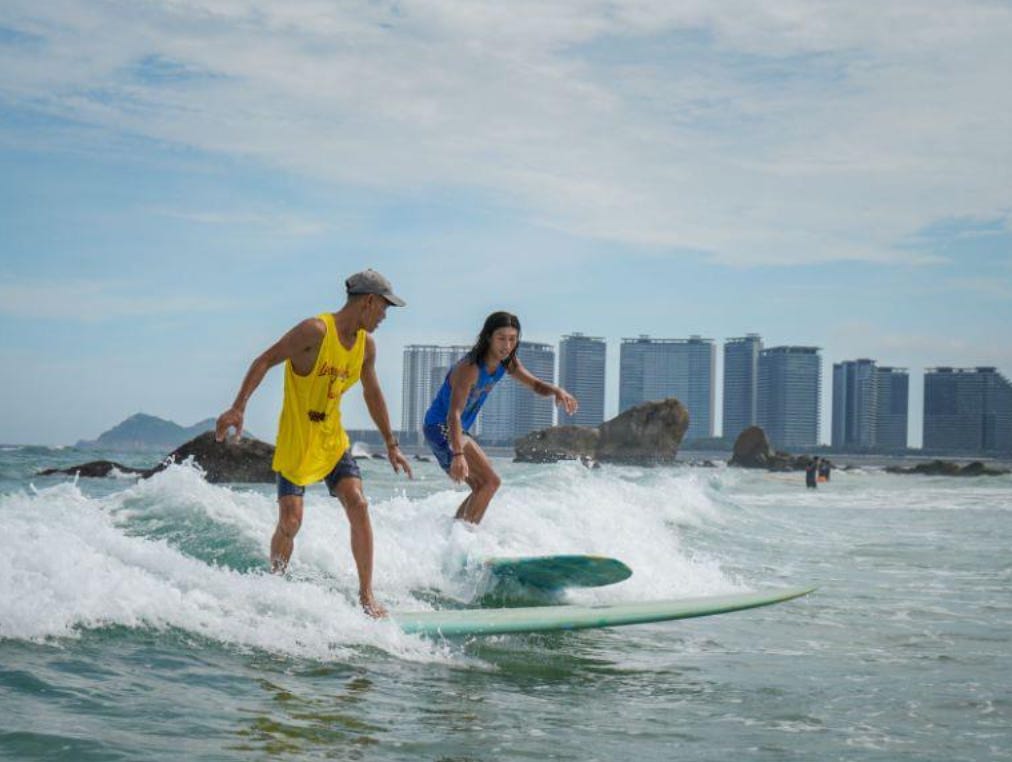
By the mid 2020s, Wanning’s surfing ecosystem had developed several mutually reinforcing functions.22 A community of surfers and local practitioners sustained activity at the bay, while clubs, coaches, training facilities and national teams supported the development of the sport. International competitions connected the destination to the wider surfing world, and the growing number of visitors created demand for accommodation, food, surf instruction and other services. This, in turn, opened up employment and business opportunities for local residents, extending the benefits of surfing into the surrounding communities.
The result was a place where surfing was no longer just a sport or a tourism attraction, but an increasingly interconnected part of the local economy.
Training gave Wanning a continuing sporting presence. Events brought attention and visitors. Tourism supported businesses, businesses created livelihoods for residents. The local presence of surfers, instructors and practitioners helped sustain the activity that attracted visitors in the first place.
Wanning had developed an ecosystem in which surfing was simultaneously a sport, a tourism attraction, a source of employment and part of the local economy.
But this configuration carried a tension.
The commercial economy depended on the appeal of the surfing community and the character of Riyue Bay. Yet as more businesses, visitors and investment arrived, they also began changing the environment in which that community had developed.
The growth of the ecosystem was creating new pressures on its original foundation.
That is where the story turns to the Shock.
The Shock

The mechanism worked. The community was the substrate; the events, the base, and the economy were the layers that grew on top. For a time, each layer reinforced the others. The community made the events authentic. The events made the base viable. The base made the economy sustainable. The economy gave local people a reason to stay.
Then the layers began to consume the substrate.
What Tested the System
The test was not a single event. It was the cumulative weight of the system’s own success.
By 2025, Wanning received 9.78 million tourists and generated 9.23 billion yuan in tourism revenue.23 The place that had been a fishing village with a restaurant was now a destination with an economy. But the economy had a different center of gravity than the community that had created it.
Freelance writer Chen Haiping arrived at Riyue Bay seven years before the pandemic. There weren’t as many people and it felt like a hermit’s paradise, he said. Now, it has become more standardized, industrialized, but also commercialized. Most of my group, who truly embraced surfing as a lifestyle, have gradually left. They’ve moved to more remote bay areas around the world.24
A local named Jay, who had surfed Riyue Bay for twenty years, described the same shift. This used to be so much more fun and authentic, he said. It was a fishing village and a hippie town.25 Another surfer, Yang, put it more sharply: Before, you came here because you wanted to surf. Now, many come because they want to take a picture saying they came to surf.26
The social media posts from within the community told the same story. One visitor who returned after years away wrote that the old surfers have all gone into the mountains, and that the surf shops that held memories were gone. They turned the culture into a business, but forgot business should be an extension of culture, not its gravedigger.27 Another account described the emergence of a board pushing instructor industry: people with no surfing ability, sometimes unable to swim, whose only job was to push tourists onto shallow waves for photos. Over commercialization destroyed the spiritual pure land of these surfers. Many just left.28
The erosion was not only cultural. It was structural. In 2021, a reporter for Workercn visited Riyue Bay and found that the rapid growth of surf tourism had outpaced the development of qualified instructors. A renovated house, a few surfboards, a few tanned coaches with these you can become a surf club and take tourists into the water, one instructor said. Many coaches had no certification, no lifesaving skills and no understanding of what qualifications they were supposed to hold.29 The community’s knowledge; the tacit, embodied understanding of waves, safety and teaching was being diluted by people who were there for the business, not the practice.
Then came the wave pool. In November 2025, the first Olympic level artificial wave pool in China opened in Riyue Bay, capable of generating 23 different wave types, from 0.3 meter beginner waves to 2.7 meter professional waves.30 A visitor from Australia called it awesome, all day, year round, uninterrupted surfing.31 For the tourism economy, it was a triumph. For the mechanism that made Wanning irreplaceable, it was a signal of something else entirely.
What the Disruption Exposed

The Shock reveals a limitation in the original explanation of Wanning’s advantage.
The Audit found that the barrier was the configuration; natural waves, institutional anchor and resident community, each reinforcing the others. That finding was correct. But the Shock shows that the configuration was held together by a substrate that the configuration itself was eroding.
The community was not a layer. It was the ground beneath the layers. The events, the base and the economy could grow on top of it, but they could also change the conditions that allowed it to exist. When the cost of living rose faster than income, when the beach filled with tourists taking photos rather than surfing, when the clubs hired uncertified coaches because the demand was too great to bother with standards, when the wave pool made natural waves optional, the community’s reason to stay weakened.
Chen Haiping listed the pressures: rent does not match income, the cost of living is higher than expected, many things depend on transportation, and even fuel prices are higher because Hainan is an island.32 These are not cultural complaints. They are material conditions. The people who were there for surfing could no longer afford to be there for surfing. The place had become successful enough to price out the people who made it worth visiting.
The wave pool did not cause this. It was the logical extension of a system that had already decided the community was a resource to be monetized rather than a substrate to be maintained. The pool made the natural waves replaceable. The commercialization made the community replaceable. Each substitution weakened the barrier that the Audit had identified.
What the Evidence Establishes
The Shock does not establish that Wanning’s advantage has disappeared. The waves are still there, the national base is still there, the events are still there, the brand is still there and the artificial wave pool is now part of the system, not outside it.
What the Shock establishes is that the advantage is not self sustaining. It depends on a community that the system has no mechanism to protect. The system can grow the economy, build the infrastructure, host the events and manufacture the waves. It cannot manufacture the people who are there for the thing itself rather than for the business of the thing. Those people can only be retained or driven away.
The unresolved implication is this: if the barrier is a community, then the strategy cannot be extraction. It must be custody. But custody requires institutional design, ways to keep the community viable, to prevent the cost of staying from exceeding the cost of leaving, to protect the practitioners from the machinery of their own success. Wanning has built an economy around surfing. It has not built a system to keep the surfers.
What Remains Uncertain
The evidence of departure is real but not quantified. A 2026 analysis noted that regarding the core concern of ‘old surfers leaving,’ almost no quantitative evidence can be found in public information.33 The anecdotes are consistent and credible; Chen Haiping, Jay, Yang, the social media accounts but they are not a census. Some practitioners have adapted, moving into paddleboarding or composite water sports. The wave pool has created a new layer of certified, professionalized instruction that did not exist before.34 The system has not collapsed. It has transformed.
The question the Shock leaves open is not whether the old community is gone. It is whether the system that replaced it can produce the authenticity that made Wanning irreplaceable in the first place or whether it has traded a barrier it could not see for an economy it can measure.
That is the question the Doctrine must answer.
The Doctrine

The Substrate Principle
Some advantages are built. Others accumulate.
A built advantage; infrastructure, capital, institutional status or a brand can be replicated by anyone with sufficient resources and time. A wave pool can be constructed elsewhere. A national training base can be established in another location. A brand can be created and marketed. These advantages are real, but they are not necessarily difficult to reproduce. They are layers that can be built around an existing foundation.
An accumulated advantage is different. It develops through the decisions and participation of people over time. It forms when people choose to remain, practise, contribute and build relationships for reasons that go beyond the commercial opportunities available to them. It cannot simply be purchased or installed. It has to develop through continued participation.
In Wanning, that accumulated advantage was a community of surfers who were there because they wanted to surf. They brought local knowledge, experience, relationships and a shared commitment to the practice. This community became the substrate on which the visible parts of the surfing ecosystem could grow.
The events, institutions, businesses and reputation expanded what Wanning could do. But they depended on the conditions that had allowed the original community to form and remain.
Significance of this Principle.
A place that mistakes its visible layers for its underlying substrate can eventually undermine the very advantage it is trying to strengthen.
More events, infrastructure, capital and visitors can improve a place’s visible position. But growth also changes the conditions around it. The cost of staying rises. Commercial interests reshape the culture. The practitioners who were there for the practice may find it increasingly difficult to remain, while new participants arrive primarily for the business opportunities.
The place may not recognise what is happening because it measures the growth of the layers rather than the condition of the substrate.
A destination can attract more visitors while losing the practitioners who made it attractive. An institution can increase its output while weakening the culture that produced its best work. A neighbourhood can become more valuable in the property market while losing the residents who gave it its character.
In each case, visible success can conceal the erosion of the foundation on which that success depends.
The Substrate Principle
A durable advantage often begins with something that cannot simply be built: a community of people who participate because they value the practice itself. This community becomes the substrate on which visible layers, institutions, events, economies and reputations can develop.
Those layers can be funded, expanded and replicated. The conditions that sustain the substrate must be cultivated over time. When a system grows its visible layers while eroding the community beneath them, it can become more successful by its own measures while becoming less difficult to replace.
Tend the substrate. Let the layers grow around it. Do not sacrifice the foundation to expand the structure.
Why This Is Transferable
The principle applies to systems whose value depends on communities of people whose commitment cannot be manufactured through investment alone.
Consider a craft town whose master craftspeople are priced out by the growing market for their products. The town may sell more, attract more visitors and become internationally recognised, even as the people who preserve its craft traditions disappear.
A research institution whose strongest researchers are gradually displaced by the demands of grant acquisition, publication targets and administrative performance will eventually die. Its output metrics may improve while the intellectual culture that produced its best work deteriorates.
A neighbourhood whose character increases its property values, only for rising rents to displace the residents and independent businesses that created that character, leading to loss of the very character that made it.
Or an institution whose reputation rests on a culture of experimentation and trust, but whose growth introduces systems that gradually discourage both.
The circumstances differ, but the tension is similar: the visible success of a system can begin consuming the conditions that made that success possible.
The Boundary Condition
The Substrate Principle does not apply to every form of competitive advantage.
Some advantages are primarily geographical, technological or institutional. A port may derive its position from a natural harbour. A business may depend on proprietary technology. An institution may hold authority through a legal mandate. In these cases, a community can contribute to the advantage without necessarily being its underlying substrate.
The principle applies when the community’s continued participation is itself essential to the value of the system.
It also does not mean that every existing community must be preserved unchanged. Practices evolve, new participants arrive, and technology can expand access. The question is whether those changes strengthen the underlying practice or gradually replace participation in it with commercial activity built around its appearance.
A wave pool, for example, can expand access to surfing and support professional training. Its existence does not automatically threaten Wanning. The question is whether the wider system continues to sustain the people, knowledge and culture that give the destination its distinctive character.
Recognising the substrate therefore requires more than measuring growth. It requires understanding what the system depends on, who sustains it and what conditions allow those people to remain.
What It Reveals
An advantage is not durable simply because it has accumulated over time. It is durable only while the conditions that sustain it continue to exist.
Wanning’s experience reveals a difficult possibility: a place can invest heavily in expanding its success while weakening the very foundation that made that success possible.
The task is therefore not simply to build more layers, attract more activity or increase the value of the visible system. It is to understand what must remain healthy beneath that growth.
The thing that makes a system valuable may not be the thing it measures, markets or celebrates. Sometimes, it is the thing it must learn not to consume.
Position in the Fortress
Doctrine Family
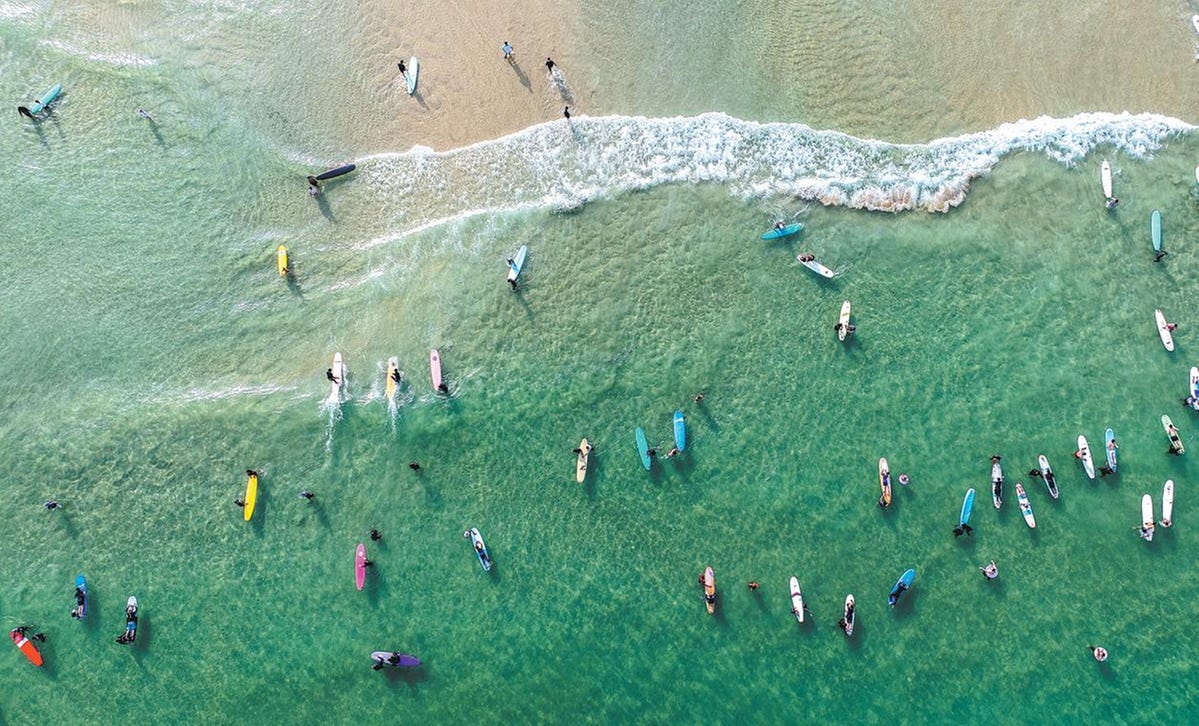
Family III: Grassroots Emergence | What happens when initiative is distributed?
Wanning belongs here. The community that made it distinctive was not designed from above. It emerged through the accumulated decisions of people who chose to live near the waves and make surfing part of their lives. The events, the national training base and the wider economy were layered onto that existing community; they did not create it. Wanning shows how distributed initiative can become the foundation of a national system.
The Substrate Principle
The most durable advantage is not built; it accumulates. It forms through the decisions of people who are there for the practice itself. A place that grows its visible layers while eroding its substrate may eventually lose both and the metrics it uses to measure success may not reveal what it has lost.
Why This Family?
Grassroots Emergence already contains three cities that show how distributed initiative becomes coordinated capability:
Quanzhou teaches that bottom up capitalism can become a lasting competitive advantage.
Yingkou demonstrates that community trust can be institutionalised into a wealth generating engine.
Putian showed us that diaspora networks can become invisible headquarters.
Each of these cities shows how distributed initiative can generate capabilities that no single institution could have designed on its own. But they also reveal different ways in which grassroots activity becomes a source of lasting advantage.
Wanning extends this family by identifying a distinct form of advantage: the accumulated capability of a community of practitioners. Its contribution is the Substrate Principle, the recognition that some of the most valuable foundations of an economic system are not created by the system itself. They develop through the continued participation, knowledge and relationships of people engaged in the practice.
Relationship to Previous Cities
Quanzhou (The Opportunism Engine). Quanzhou’s advantage is embedded in a culture of risk-taking that has become part of the city’s institutional DNA. Wanning’s advantage is embedded in a community of practitioners who are there for the practice itself. Both are grassroots in origin.
But Quanzhou’s culture has been institutionalised; it persists through the city’s commercial practices and institutions. Wanning’s practitioner community has not been secured in the same way. Its continued existence depends more directly on individuals choosing to stay. This makes Wanning’s advantage more exposed to changes in the conditions that sustain it.
Yingkou (Sovereign Trust Blueprint). Yingkou converts collective assets into a wealth generating engine through inheritable equity and algorithmic governance. It is a case of community assets being formalised into a sovereign entity. Wanning’s community was never formalised in this way. It was recognised by the state, but not constituted as an institution with the power to protect its own interests. The contrast reveals a boundary condition: emergence that remains institutionally unprotected can be vulnerable to the success built upon it.
Putian (Diaspora Trust Principle). Putian builds advantage by exporting trusted service providers who repatriate profits. Its community is dispersed but connected through trust networks. Wanning’s surfing community depends more directly on physical presence: shared access to the waves, the practice and the relationships formed around them. Putian’s networks can remain connected across distance in ways that a place based practitioner community cannot easily replicate. The comparison shows that the substrate principle takes a different form when the community’s value depends on being in a particular place.
Xinzhou (Living Heritage Principle). Xinzhou activates a living ecosystem of embodied knowledge as the primary economic engine. It is the closest existing principle to Wanning’s. But Xinzhou’s principle is about activation, how to turn living heritage into an economy. Wanning’s principle is about custody, how to keep the living community from being consumed by the economy it activates. Xinzhou describes the creation of value from a living system. Wanning describes the responsibility to sustain that system as its value grows.
Yibin (Cultivated Origin Principle). Yibin’s barrier is biological time: the years of adaptation that give the organism its distinctive qualities. Wanning’s barrier is social time: the years through which a community of practitioners forms and develops its knowledge, relationships and culture. Both depend on accumulated time, but they differ in their vulnerability. Biological adaptation cannot simply be reproduced on demand; a practitioner community can be weakened when the conditions that keep people in a place deteriorate. Yibin shows the value of cultivated origin. Wanning shows the fragility of accumulated human presence.
What Is Different?
The existing Fortress principles examine different sources of advantage:
Grassroots Emergence describes how distributed initiative generates coordinated capability.
Hidden Value Recognition describes how overlooked assets become sources of economic advantage.
Origin Sovereignty describes how distinctive origins create irreplaceable value.
Wanning adds a different source of advantage: the accumulated capability of a community of practitioners.
This is not simply social capital, local participation or collective enterprise. It is the knowledge, experience, relationships and practical capabilities that develop through sustained engagement in a shared activity. The community is not merely a group of people participating in an economy. It is itself a productive foundation from which new capabilities, institutions and economic activity can emerge.
The Substrate Principle gives this form of advantage a name and identifies its defining characteristic: it accumulates through practice rather than being created through design.
New Contribution
The Fortress now recognises the community of practitioners as a distinct source of accumulated advantage.
Distributed initiative does more than generate businesses, networks or institutions. Through sustained practice, it also produces shared knowledge, experience, relationships and capabilities that become a productive foundation for further development.
Wanning’s contribution is to identify this foundation as a substrate: an advantage that develops through participation over time, rather than through deliberate institutional design. The Substrate Principle extends the understanding of grassroots emergence beyond the structures it produces to include the human capabilities from which those structures can grow.
It establishes community generated capability as another source of irreplaceability within the Fortress.
What Wanning Adds to the Fortress
Wanning does not replace the existing principles. It adds a qualification that applies wherever people are the substrate of an advantage: what sustains the community must be protected and its condition must be measured.
That measurement cannot rely only on the visible success of the system, visitor numbers, revenue, facilities or events. It must also ask whether the people, practices and relationships that made the system valuable are still able to flourish.
The Fortress now has a principle for the maintenance of emergent barriers, not just their construction.
Wanning in Five

1. China’s Surfing Capital Has an Unusual Beginning
Wanning is home to China’s only Olympic-level artificial surf pool, but its surfing story began in 2006, when foreign surfing enthusiasts discovered Riyue Bay. They began visiting the then unknown bay and teaching local children to surf, laying the early foundations for what would eventually become the national team’s training ground.
2. Three Gifts from the Overseas Chinese
The Xinglong Overseas Chinese Farm resettled more than 13,000 returned overseas Chinese from 21 countries. They brought back three valuable introductions: pepper, rubber and coffee. Indonesian returnees brought pepper seedlings and coffee seeds in 1954, helping establish crops that would become important foreign exchange earners for the young People’s Republic of China. In 1960, Zhou Enlai praised Xinglong coffee as world-class after tasting it.
3. A Mountain Visited by a Monk on His Way to Japan
In 748 AD, the monk Jianzhen, famous for his voyages to Japan, was blown off course to Hainan and travelled to Dongshan Ling in Wanning to preach. Known as Hainan’s First Mountain, Dongshan Ling preserves nearly a hundred cliff inscriptions in different Chinese calligraphic styles, making it a remarkable record of centuries of writing and artistic expression.
4. A World Longevity Town
Wanning received the designation of World Longevity Town in 2013 and has renewed it twice. In 2025, the city recorded 132 centenarians and an average life expectancy of 80.44 years. Its selenium rich soil, 66.4% forest coverage and local dietary traditions are among the environmental and cultural factors associated with its longevity.
5. The Crab That Comes from Three Rivers Meeting the Sea
Hele crab, one of Hainan’s Four Famous Dishes, comes from the brackish waters around Hele town, where three rivers meet the sea. The mixture of fresh and salt water is associated with the crab’s rich roe. During the Spring Festival, a jin of female Hele crab can fetch 160–180 yuan, with sales reportedly doubling compared with ordinary periods.
9. Reflection

Some of the most valuable things in life are not built to a plan. They accumulate.
A skill develops through years of practice. Trust grows through repeated acts of reliability. A reputation takes shape through work done consistently. A community forms as people return, participate and build relationships around something they share.
At first, these things may not appear to have an economic purpose. They are simply what people do, what they care about and what they become good at. Yet over time, they can become the foundation for opportunities that would not otherwise exist.
A skill becomes a profession. Trust makes cooperation possible. A reputation opens doors. A community creates the conditions for businesses, institutions and new forms of collective action.
The visible opportunity may arrive much later than the accumulation that made it possible. By the time others recognise its value, years of participation, experience and relationships have already gone into creating it.
This is what makes accumulated advantage different from something deliberately constructed. You can build the structures that use it, but you cannot simply order the years of practice, trust or participation that give those structures their foundation.
It raises a different way of thinking about value:
What in your life has accumulated without you initially recognising its value?
Which opportunities exist today because of decisions you made years ago?
What are you building now that depends on something you cannot simply buy or recreate?
Next Week
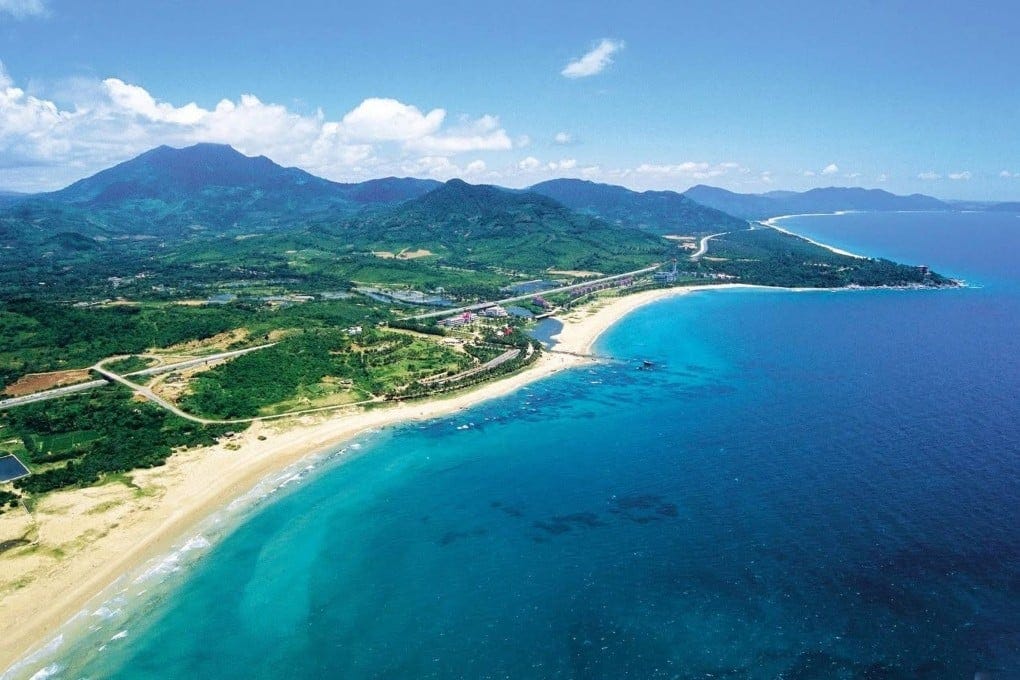
Wanning taught us what happens when the community that made a place irreplaceable begins to erode under the weight of its own visibility. The substrate was people. The layers grew on top. The layers consumed the substrate.
Next week, we go to a city where the substrate is not a community at all. Zhangzhou sits at the mouth of the Jiulong River in southern Fujian, facing Taiwan across the strait, a city most visitors know for its tulou and its daffodils, but whose real advantage may lie somewhere else entirely.
What makes a place irreplaceable when its most distinctive asset is not something you can see, grow, or visit?
SOURCES
China News Network: “Why do wanderers from all over the world love to come here?””, October 2, 2025.
China Daily, “Sun, fun, surf and what Neptune teaches,” December 28, 2019.
China Daily, “Beach events prove a global draw,” January 8, 2020.
China Daily, “Sun, fun, surf and what Neptune teaches,” December 28, 2019.
People’s Daily Online, “China’s Hainan promotes in-depth integration of tourism with sports, culture sectors,” July 5, 2023.
The General Administration of Sport of China announced that “Over 100 top surfers will compete fiercely in the 2023 Hainan Provincial Surfing Championship, which kicks off in Wanning.”” September 25, 2023.
China News Network: “A surfboard creates waves...” June 15, 2026.
Baidu Baike, “Huang Wen - China’s First Surfer”” March 6, 2025.
ibid10
Baidu Baike, “Riyue Bay Surfing Club”” February 21, 2026.
According to AiQicha, “Hainan Wanning Riyue Bay Surfing Service Co., Ltd.”accessed November 2, 2026.
ibid12
ibid12
Chinanews, “Senior executives from overseas Chinese-language media outlets visited the Riyue Bay surfing base in Wanning, Hainan.” September 3, 2013.
Nanhai.com, “Wanning International Surfing Festival: Surfing Figure - Awen in the Sea,”” November 7, 2010.
China Daily, "Beach events prove a global draw," January 8, 2020.
China Daily, "Sun, fun, surf and what Neptune teaches," December 28, 2019.
International Online: “Construction of the National Surfing Training Base and Riyue Bay Surfing Club Launched” March 16, 2017.
China Daily, “’Sportcation’ enthusiasts find place in the sun,” August 26, 2026.
DUKE, “Locals in Riyue Bay, China’s surf city, complain that it has lost its spirit,” September 2, 2026.
ibid24
ibid23
Xiaohongshu, “Documentary|A Tribute to Our Lost ‘Sun and Moon Bay’” October 10, 2025.
Xiaohongshu, “Thoughts Vol.1 Random Thoughts After Returning from Riyue Bay” March 8, 2025.
China Workers’ Daily Online: “Surfing is becoming more accessible to the public, but where are the qualified instructors? November 7, 2021.
Xinhua News Agency, “Spring Festival Visit to Grassroots Levels | From ‘Waiting for the Waves’ to ‘Making the Waves’ A Unique Spring Festival for Surfing Enthusiasts in Riyue Bay, February 23, 2026.
People’s Daily, “Hainan Wanning: Surf-themed Resort Welcomes Guests”,” December 5, 2025.
DUKE, “Locals in Riyue Bay, China’s surf city, complain that it has lost its spirit,” September 2, 2026.
Today’s headline: “The rules of the Wanning surfing community have been set; how will the struggle for the stay and departure of veteran surfers unfold?” August 12, 2026.
People’s Daily: “Say Goodbye to ‘Waiting for the Waves’! Wanning, Hainan Unlocks All-Season, All-Weather Surfing”” June 15, 2026.