


The market has a rule: the best product wins. Better soil, higher yield, superior technique. Chengmai was structurally unfit for that rule; barren volcanic land, low yields and crops indistinguishable from anywhere else. Competing on quality was a dead end. So Chengmai rejected the rulebook. It asserted a different principle: the truest origin wins. Instead of improving the product, it enclosed the place. It stopped competing on excellence and began legislating authenticity. The economy it built was not designed to grow the best, but to be the only.
Chengmai was not ignored. It was simply irrelevant to China’s growth logic.
1. The Barren County
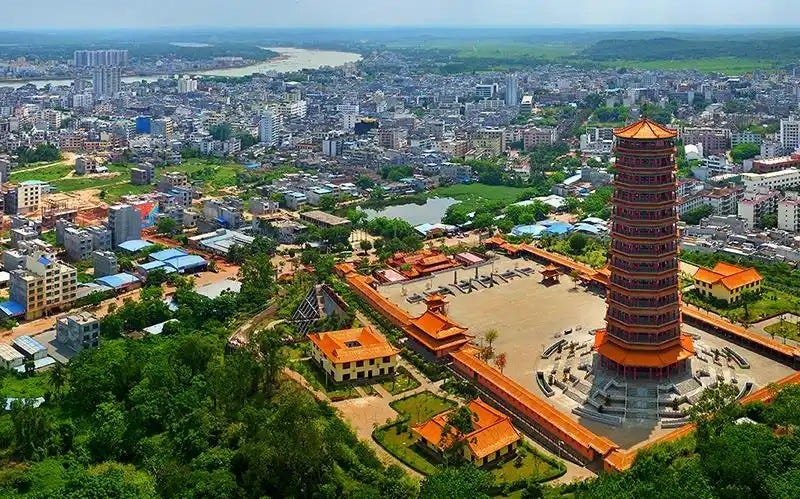
Twenty five years ago, the name Chengmai was synonymous with economic dead end. Locals called its administrative center Laocheng Old City a title that perfectly captured a place living on faded history, not future promise. Wedged next to the booming provincial capital of Haikou on Hainan Island, it suffered the cruel paradox of proximity: close enough to see the growth, but too marginal to catch its wave.
Its land was its curse. The soil in its key agricultural zones; especially around Fushan was notoriously barren red earth and volcanic rock, unsuited for the high yield, water intensive crops that powered modern farming. The local economy was trapped in low value commodity cycles: rubber, sugarcane, and subsistence rice. This wasn’t an economy; it was a holding pattern. Output moved outward, value accumulated elsewhere.
For Chengmai, the imperative wasn’t merely growth. It was existential. It needed an economic logic that did not fight its constraints, but used them. A form of value that could survive poor soil, low yields, and total interchangeability. Without it, Chengmai would remain administratively present but economically unnecessary; a footnote in Hainan’s story. The clock was ticking.
2. The Catalyst: The Coffee Proof of Concept
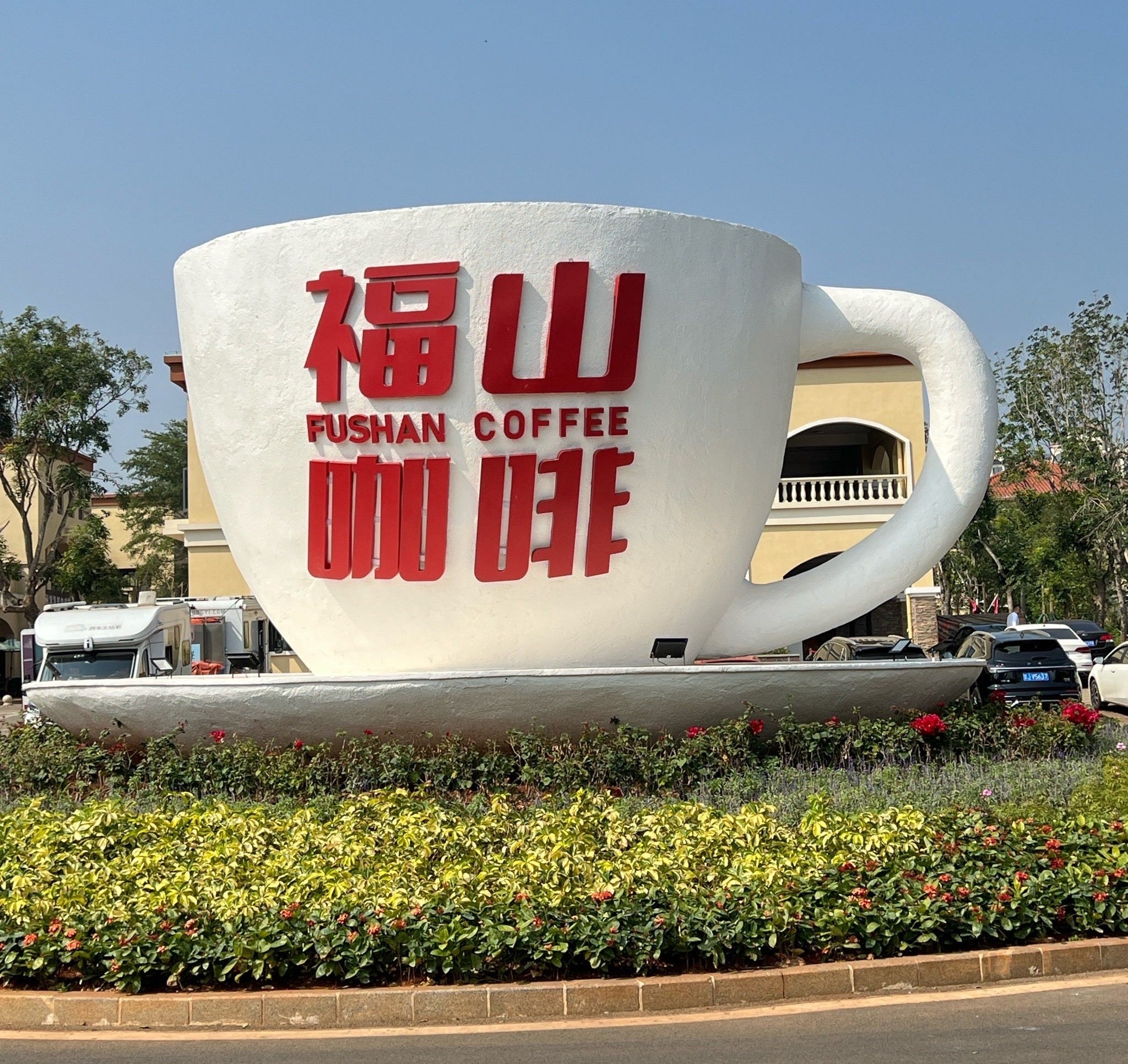
For decades, the logic of commodity agriculture held firm: poor soil meant low value. Chengmai conformed to that logic. The break did not begin with a grand plan, but with a re-interpretation of failure.
i. The Anomaly in the Old Crop
By the 1990s, coffee cultivation in the Fushan area of Chengmai was a fading tradition. Introduced by returning overseas Chinese in the 1930s, the old Arabica and Robusta strains produced low yields on the region’s acidic, volcanic red soil. By conventional agronomic metrics, it was a failed crop.1
Yet local enthusiasts and a small cohort of farmers observed a persistent sensory anomaly. Beans from these stressed plants, when properly roasted, developed a distinct flavor profile; unusually thick bodied, with pronounced chocolate and nutty notes and a clean, low acidity finish.2 This anomaly marked the first crack in the prevailing cognitive lock in. The barren soil was not merely a constraint; it was actively shaping a differentiated product.
ii. The Experimental Gamble: From Niche to Geographic Indication
The pivotal shift came with a legal and commercial leap: reframing this flavor from a local curiosity into a protectable territorial asset. In the early 2000s, a coalition led by the nascent Hainan Fushan Coffee Group, alongside agronomists from the Hainan Academy of Agricultural Sciences, made a critical bet.
They would not pursue yield maximization through fertilizers and hybridization; an approach that risked erasing the distinctive taste. Instead, they doubled down on terroir. Traditional, low yield production methods were codified. Most critically, the group sought the state’s highest instrument of recognition and control: National Geographical Indication (GI) Protection status.3
The hypothesis was radical. If the coffee’s identity could be legally fused to Chengmai’s specific geography, it could be lifted entirely out of the commodity price system. In 2003, the gamble succeeded. Fushan Coffee (福山咖啡) was officially registered as a Protected Geographical Indication by the former General Administration of Quality Supervision, Inspection and Quarantine (AQSIQ).4
iii. The Sovereign Calculation: Reframing the Value Map
This success triggered a fundamental re-audit of the county’s assets. Led by the Chengmai County Agriculture Bureau, the local government made a sovereign calculation. They recognized they were no longer promoting a crop; they were architecting a system of value capture.
The GI certificate was not a marketing accolade. It was a foundational piece of intellectual property and a regulatory instrument. Formalized through subsequent One Product, One Industry development plans, the county resolved to treat the Fushan Coffee GI as a replicable blueprint.5 This decision translated into three concrete moves:
i. Plan the Economy by Provenance: Agricultural zoning shifted from yield optimization to narrative eligibility, land was evaluated for its capacity to support future GI protected origins.
ii. Incentivize the Standard: Subsidies and technical support were directed toward farmers and cooperatives that adopted the GI’s strict production protocols, making compliance more profitable than yield driven modernization.
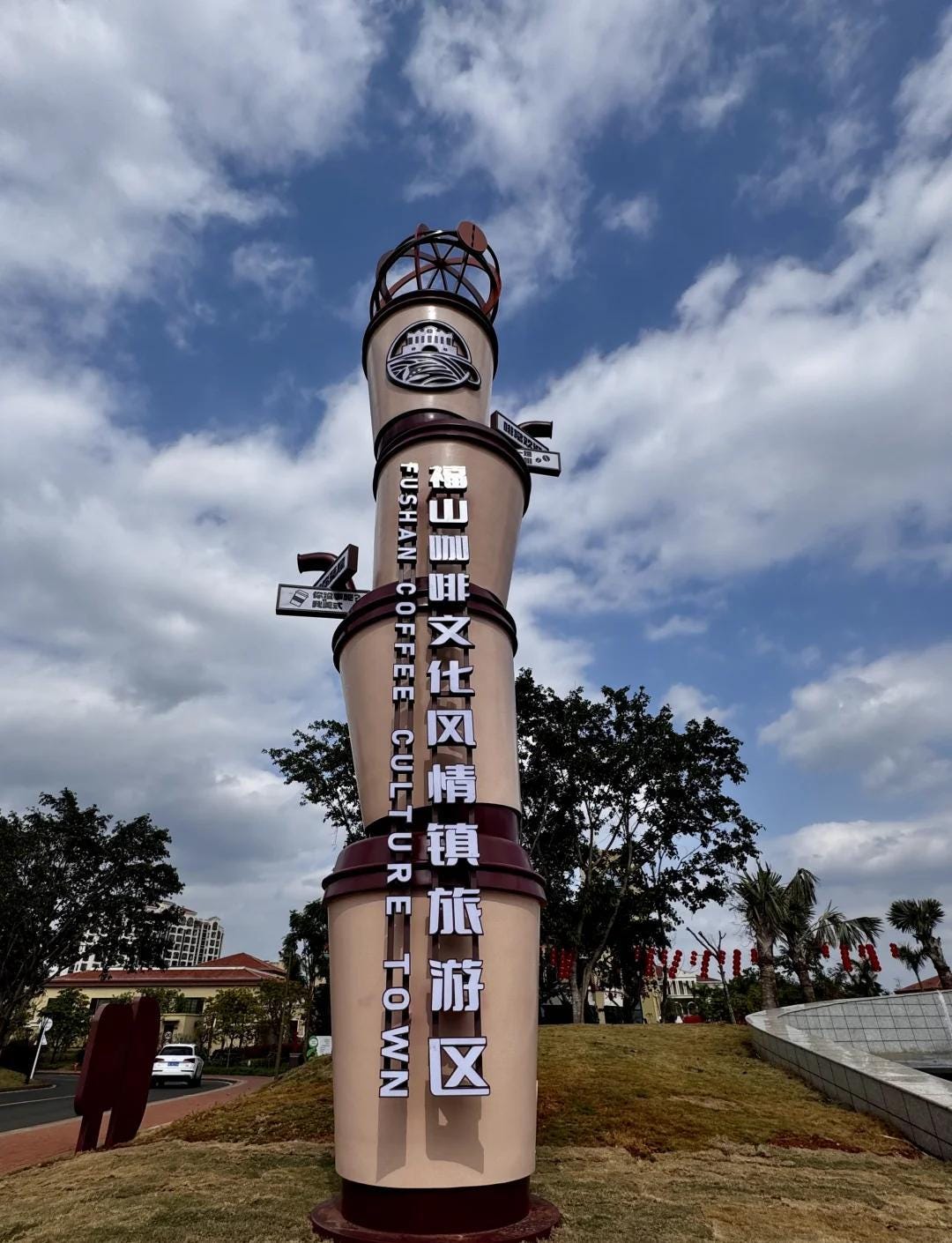
iii. Bundle the Experience: The county actively developed the world’s first dedicated Coffee Culture Tourism circuit in Fushan, transforming plantations into verification platforms where consumers could witness origin and process firsthand.6
The catalytic moment was not the discovery of a superior coffee bean. It was the realization that authenticity itself could be bureaucratized, legislated and monopolized. Chengmai stopped selling coffee as an agricultural output and began selling Fushan as a sovereign brand where the story of the soil became the primary ingredient.
3. The Replication: From One Crop to an Origin Empire

The GI for Fushan Coffee was not an endpoint; it was a master key. It proved a replicable model: identify a latent biotic asset, secure a state backed monopoly over its story and construct an experiential economy to enforce it. Chengmai’s leadership moved quickly to industrialize this logic. What began as a single product success was formalized into a process, one that treated the county’s apparent liabilities as feedstock for an Origin Monopoly machine.7
a. The Asset Audit & Legal Alchemy
Empowered by the coffee precedent, the Chengmai County Agriculture Bureau initiated a county wide Geographical Indication Potential audit. The objective was not to identify the best products, but those whose qualities could be credibly and defensibly fused to specific local conditions; soil composition, microclimate, husbandry methods and historical practice.
This triage produced a portfolio of candidates that could survive legal scrutiny and narrative enforcement:
Wanning Goose (澄迈万宁鹅):
A regional poultry breed known for lean, flavorful meat, attributed to free range foraging on herbs and insects in volcanic foothill environments. While the breed circulated beyond Chengmai’s borders, the county successfully anchored a distinct production standard and origin narrative tied to its grazing ecology. GI protection was secured in 2008.8
Fuling Pomegranate (福岭石榴):
Cultivated on the rocky, well drained slopes of Fuling, its exceptional sweetness was linked to high diurnal temperature variation and mineral rich soils. A common fruit was reframed as a geological outcome. GI protection was secured in 2010.9
Chengmai Winter Melon (澄迈冬瓜):
The most aggressive act of alchemy. A universally available, low value vegetable was recast as a premium origin product. Its superior texture and shelf life were attributed to local soil chemistry and traditional cultivation techniques. GI protection was secured in 2012, transforming a commodity into a branded asset.10
The significance was not the crops themselves, but the proof that even biologically generic products could be monopolized through jurisdictional narrative and legal enclosure.
b. Architecting the Platform: The Franchise Model of Origin
With multiple GIs secured, Chengmai transitioned from product promotion to platform governance. The county assumed the role of system architect, establishing a governed monopoly with three core control layers:
The Standard Setting Body:
For each GI, the county issued binding Product Quality Technical Specifications. These standards codified inputs and processes in granular detail; from permitted seed varieties and feed composition (for poultry) to planting density, harvest timing and post harvest handling.11 Use of the GI label was conditional on full compliance,
The Traceability Backbone:
A unified, government supervised traceability system was deployed. Each GI unit; whether fruit, meat, or processed goods was assigned a unique QR code linking it to its farm of origin, batch data and inspection records.12 Authenticity was no longer asserted; it was audited and logged.
Franchise Licensing:
Designated leading enterprises (龙头企业), such as the Hainan Fushan Coffee Group, were licensed as exclusive operators of specific GI brands. These firms contracted with thousands of smallholder farmers, supplying inputs, technical training, and guaranteed procurement at 30–50% premiums over non-GI market prices. In return, farmers surrendered autonomy to the standard.13
The county did not farm. It owned the rules.
c. Stacking the Model: The Experiential Amplification Loop
Replication was not linear; it was cumulative. Each new GI product was embedded into an expanding Verified Origin ecosystem that amplified trust, demand and price.
The Fushan Coffee Cultural Tourism Zone functioned as the primary demand anchor.
Picking tourism routes were layered onto Fuling Pomegranate and other orchard zones, extending visitor duration and spend.
Specialty restaurants elevated products like Wanning Goose into high margin culinary experiences.
County organized festivals; Coffee, Pomegranate and seasonal harvest events created cyclical demand spikes and recurring media attention, reinforcing the origin narrative for both on site tourists and remote e-commerce consumers.14
Replication was complete. Chengmai was no longer a collection of farms. It had become a closed loop brand factory, where generic biology entered, was stamped with sovereign geographic IP and exited as a premium, experience verified product. The Fushan Coffee playbook was no longer an experiment. It was the county’s operating system.
4. The Present: Chengmai’s Engine of Value
Today, Chengmai functions less like an agricultural county and more like a vertically integrated branding, verification and enforcement platform. Its economy operates as a tripartite engine, in which each component reinforces the others in a closed loop of value creation, capture, and amplification.
a. The Revenue Stack: A Triangular Monopoly
Chengmai’s output is no longer measured by tonnage. It is structured as a deliberate portfolio, with value extracted at three distinct points along the Origin Monopoly chain:
Leg 1: Premium Product Monetization (The IP Royalty).
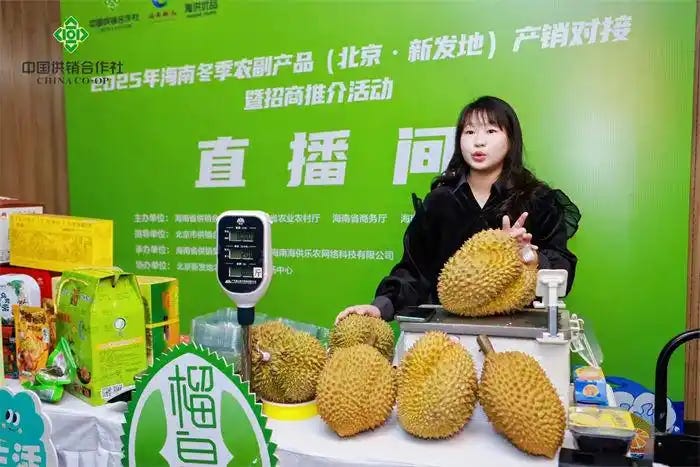
This is the direct monetization of geographic intellectual property. Certified GI products sold through e-commerce platforms (Tmall, JD.com, Douyin live commerce) and high end mainland supermarkets command prices 200–400% above non-GI equivalents. Fushan Coffee, for example, retails at ¥300–500/kg, compared to ¥80–150/kg for standard commercial Yunnan coffee.15 The premium accrues primarily to licensed enterprises and contracted farmers, while the county captures value indirectly through taxation and downstream activity rather than volume expansion.
Leg 2: Experiential Verification (The Proof Economy).
Agri-tourism functions as the system’s physical verification layer. In 2023, Chengmai recorded over 2.1 million tourist visits, concentrated around its GI themed circuits.16 Revenue flows from farm stay lodgings, orchard entrance fees, specialty dining and on site direct sales. More critically, this is not discretionary tourism, it is trust manufacturing. A consumer who personally harvests a Fuling pomegranate converts from a price sensitive buyer into a long term premium customer, having verified the origin narrative firsthand.
Leg 3: Downstream Value Capture (The Industrial Upgrade).
Beyond raw output, Chengmai has developed processing capacity for roasted coffee, fruit wines, preserved delicacies, and prepared goose products. This captures a greater share of the consumer spend while extending the GI’s relevance beyond harvest cycles through shelf stable, branded consumer goods such as packaged Fushan Coffee gift sets.17
b. The Governance Core: Platform Command
The durability of this engine is enforced by a deliberately structured public–private governance system:
The County as IP Holder and Standard Setter.
Through its Market Supervision Bureau, the Chengmai County Government retains legal ownership of all GI trademarks. It operates as the platform sovereign, defining technical standards, maintaining the traceability infrastructure and expelling violators who undermine brand integrity.18 This enforcement function protects not just reputation, but price stability across the entire system.
Enterprises as System Operators.
Licensed leading enterprises function as franchisees rather than independent brands. They execute the model: managing supply chains, operating processing facilities, running tourism assets and conducting marketing. Their profitability is structurally tied to the health of the GI brand, aligning incentives toward strict compliance rather than volume expansion.
Farmers as Contracted Guardians.
Smallholders are no longer exposed price takers. They operate as integrated suppliers under contract, bound to production standards in exchange for guaranteed procurement at premium rates. Economic security replaces yield maximization, making farmers invested custodians of the methods that sustain the monopoly.
c. The Market Reality: A Self Reinforcing Loop
The clearest evidence of success is the emergence of a self reinforcing demand logic. Consumers no longer search for coffee or pomegranate. They search for Fushan Coffee and Fuling Pomegranate. Origin has become the category.
Digital platforms and tourism itineraries amplify this effect. Online sales generate curiosity that drives physical visitation; physical experiences convert into long term digital loyalty. Each cycle deepens brand lock in and raises switching costs.
Chengmai has effectively executed a hostile takeover of its product categories. It does not compete on quality metrics defined elsewhere; it defines quality within its own geographic jurisdiction. The present state is one of orchestrated, legislated premium an origin monopoly in full operation.
5. The Future: From Soil to IP, From Product to Platform
The soil to product monopoly is complete. Chengmai now faces a different strategic horizon. Having captured the value of place, the next task is to capture the value of method. The future lies in a dual ascent: deepening the biological intellectual property embedded within its territory, while exporting the institutional IP of its governance platform.
a. The Vertical Ascent: From Certified Output to Engineered Input
The logical next step is to move upstream, from certifying the final product to owning the biological capital that defines it. This marks a transition from Geographic Indication to Genetic Indication.
Proprietary Germplasm Banks.
Chengmai has begun investing in R&D to identify, isolate and protect the genetic signatures of its most successful GI cultivars: coffee varietals most expressive of volcanic soil stress and pomegranate strains optimized for sugar mineral balance. The objective is not merely protection, but control. Over time, this allows a shift from selling Fuling Pomegranates to licensing Fuling Pomegranate Clone Series F-1 through F-5 including certified saplings, cultivation protocols and usage rights turning terroir adapted biology into a royalty bearing asset.19
The Chengmai Standard as a Biotech Filter.
The county’s existing production standards position Chengmai as a natural validation environment for agricultural biotechnology. Developers of bio-fertilizers, biological pest controls and soil amendments can treat Chengmai as a proving ground; a kitemark environment where compatibility with premium GI output is tested and certified.20 This adds a new revenue layer: standard backed validation and partnership licensing.
b. The Horizontal Expansion: Platform as a Service for Origin Governance
Chengmai’s most valuable export may not be a product at all, but its playbook. The fully articulated Origin Monopoly model; from GI application to traceability infrastructure to experiential verification is a transferable system.
Sovereign Consulting and Franchising.
The county could formalize this capability through a Chengmai Rural Revitalization Model Institute, offering advisory and licensing services to other Chinese counties and select international regions. Rather than exporting crops, Chengmai would export architecture: governance templates, compliance software, traceability systems and brand logic; priced via fees, revenue share or equity participation in new GI ventures.21
Digital Sovereignty Expansion.
The existing traceability system can evolve into a blockchain based Provenance Ledger, offered as a white label service. Other regions would plug into Chengmai’s verification infrastructure, paying transaction or subscription fees to anchor their products inside a trusted network of certified origins. Trust, once territorial, becomes infrastructural and monetizable at scale.22
c. The Synthesis: The Sovereign Wellness Ecosystem
The final integration fuses agricultural IP and experiential control into a single lifestyle platform. Leveraging Hainan’s broader longevity narrative, Chengmai can move from selling discrete products to curating health outcomes.
The Chengmai Reset Program.
A premium long stay wellness offering one or three month origin based immersion. Participants consume exclusively Chengmai GI products, engage in supervised agricultural activity, and undergo environment linked wellness regimens. Coffee becomes diet, pomegranates become protocol, provenance becomes therapy.23 The county no longer sells food; it sells metabolic realignment through place.
B2B2C Health Alliances.
Partnerships with high end wellness clinics, functional medicine practices and longevity research institutes in Shanghai, Beijing, and Shenzhen would embed Chengmai products into elite health protocols. Chengmai becomes the prescribed source for traceable, controlled origin nutrition one of the most defensible, regulation aligned and high margin demand segments available.
The Future Verdict
Chengmai’s past was defined by escaping the commodity trap through legal alchemy. Its future will be defined by compounding that legitimacy into standards, platforms, and protocols. It is no longer content to own the story of its land. It is positioning itself to license the framework through which value is extracted from place itself.
6. Global Kinship: Cities at the Crossroads
Chengmai’s principle is a blueprint for sub-national sovereigns trapped in the commodity cage. Its true kin are county level governments worldwide that administer land, enforce local regulations, and possess the legal standing to pursue certification but currently lack the strategic model to do so.
1. The Genetic Treasury: Uva Province, Sri Lanka

A global center for spice exports; cinnamon, pepper, cardamom. It operates purely as a bulk exporter of graded commodities. Its latent asset is the unparalleled genetic library of heirloom spice cultivars (like Sri Lanka Type A Cinnamon) and the traditional, integrated spice garden agroforestry systems that produce more complex flavor profiles than monoculture plantations. This bio-cultural IP is unprotected; the spices are sold by grade (e.g. Alba cinnamon) but the specific cultivar and growth system are invisible and uncompensated.
The Uva Provincial Council, with the national spice board, could create an Uva Heritage Spice Garden Certification. This GI like system would legally bind specific, superior flavor and aroma compounds to spices grown from heirloom cultivars within the traditional, shaded, polyculture garden system. It moves the value metric from visual grade to guaranteed biochemical profile and story. This certified output would be sold directly to high end culinary institutes, Michelin starred restaurants and premium consumer brands in Europe and Japan, who will pay a steep premium for traceable, flavorful and story rich spices that are impossible to replicate on a plantation. The origin monopoly is over the living recipe for flavor.
2. The Sacred Commodity: Jalisco Highlands, Mexico
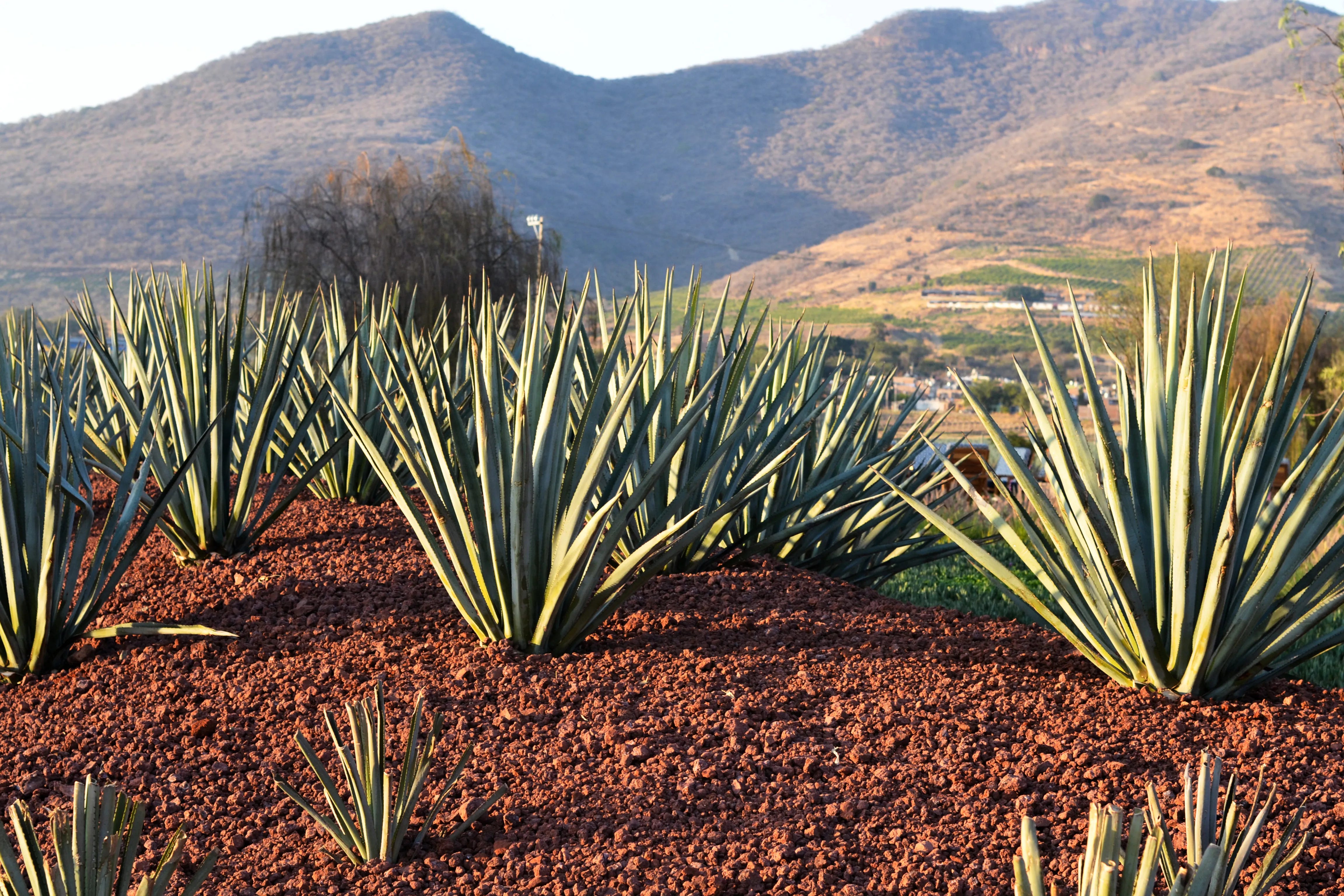
The undisputed heartland of tequila’s agave. The Denominación de Origen (DO) for Tequila is federally controlled and geographically broad, designed for scale. The specific terruño (terroir) of the Jalisco Highlands; the iron rich red soils, altitude and microclimates that produce the slowest growing, sweetest agave; is a latent asset owned by individual ejidos (communal lands) and farmers, but its premium is captured by global liquor conglomerates who blend highland and lowland agave. The farmer sells a commodity weight of piña (agave heart); the brand sells a myth of heritage.
A coalition of ejidos and municipalities in the Jalisco Highlands (e.g., Arandas, Tepatitlán) could break from the industrial DO system. They could establish a supra DO certification: Agave de Altamira - Jalisco Highlands. This would be a legally defensible, farmer owned collective mark that codifies not just location, but specific soil types, traditional cultivation methods and a minimum maturation period longer than the DO standard. They would then license this certified, superior raw material exclusively to boutique and luxury tequila/mezcal brands at a massive premium, or even vertically integrate into their own shared boutique distillery. The move is from supplier of an input to owner of the premium raw material standard.
3. The Mono Resource District: La Convención Province, Cusco, Peru
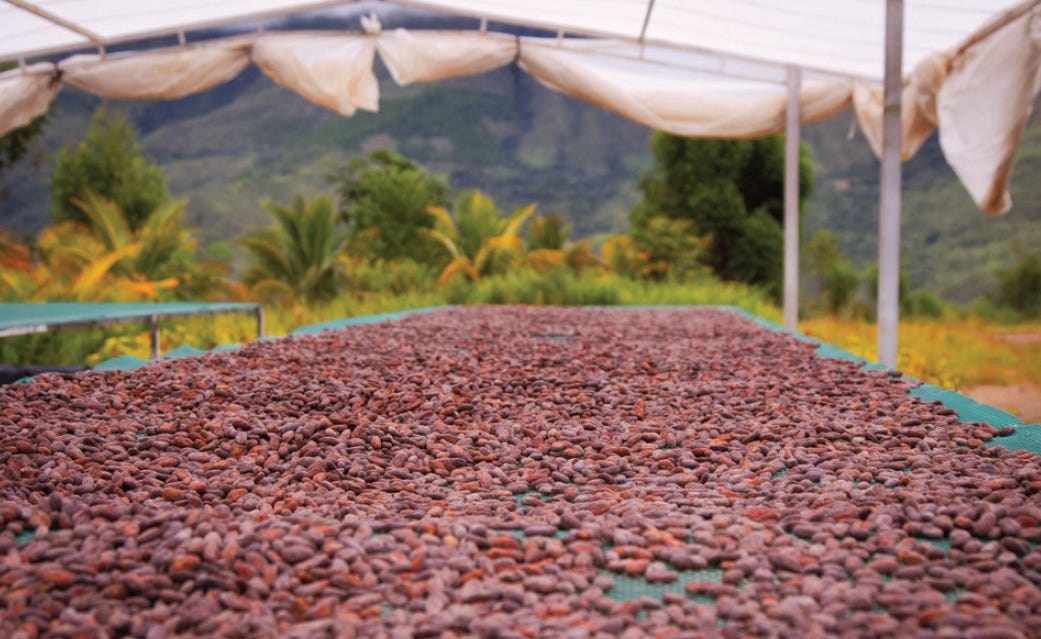
Known globally for one thing: Coffee. It is the top exporter of organic coffee in Peru, yet remains a price taker, its farmers’ income dictated by the volatile C-market. Its Cusco origin is a geographic descriptor, not a sovereign brand. Its latent asset is the hyper specific micro terroirs within its valleys, each with distinct taste profiles currently blended away for volume.
The Provincial Municipality of La Convención could stop exporting Peruvian organic coffee. It could define and certify a series of Denominación de Origen sub regions (e.g. Santa Teresa Valley Washed, Quillabamba Natural). By legally owning these origin definitions and building direct trade relationships with global roasters based on traceable lot specific quality, it could capture the roaster’s margin and build a tourism circuit around origin tasting.
4. The Depopulating Prefecture: Shimane Prefecture, Japan
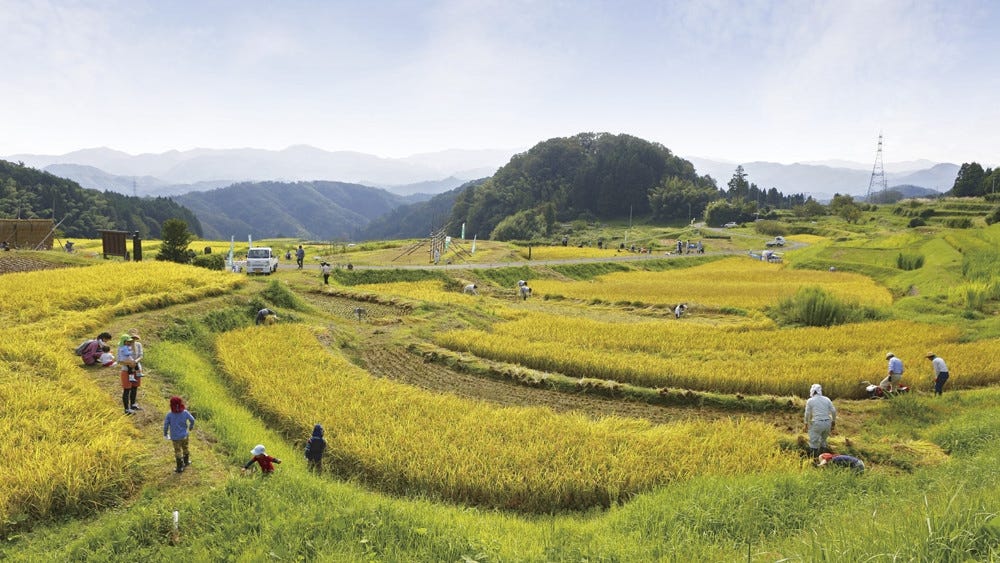
Pre-Pivot Parallel: A rural prefecture facing severe depopulation and aging. Its economy relies on subsidies and dwindling sales of generic agricultural produce (pears, dairy) to wholesale markets. Its latent asset is not a crop, but a curated scarcity and a narrative of pristine tradition. Its backwardness low mechanization, small plots, elderly farmers is seen as its death sentence.
Chengmai Logic Applied: The Shimane Prefectural Government could leverage its demographic crisis as a narrative asset. It could create the Shimane Eldercraft Seal a legally protected certification for produce grown using specific, documented traditional methods by farmers over a certain age, on sub hectare plots. This turns inefficient into irreplicably authentic. The premium product, sold via prefecture run e-commerce to Tokyo and Osaka, comes with the story of the specific farmer, making consumption an act of cultural preservation. The origin story is one of dignified, vanishing craftsmanship.
5. The Forgotten Spice Coast: Mtwara Region, Tanzania

Pre-Pivot Parallel: The southern coast of Tanzania was historically part of the legendary Spice Coast, known for nutmeg and cloves. Today, it is a peripheral region, its spice production fragmented and informal, its output blended anonymously into global commodity streams. Its latent asset is historical provenance combined with specific coastal microclimates that produce spices with distinct, potent volatile oil profiles. This is currently untracked and uncaptured.
Chengmai Logic Applied: The Mtwara Regional Commissioner’s Office could catalyze a coalition of village cooperatives to reclaim this history. They would define and legally protect Mtwara Coast Nutmeg as a Tanzanian Geographical Indication. The standard would encode traditional sun drying methods and the specific terroir of the coastal belt. The region would then build a traceable, export ready brand, bypassing Zanzibar’s dominant spice auction and targeting the premium organic and fair trade markets in Europe. The tourism loop would be spice safari tours to historic plantations, selling the experience of the origin. The monopoly is over the revived narrative of a legendary terroir.
Kinship Summary
These five are not imitators. They are Chengmai’s strategic cohort places where the raw material of a monopoly already exists in a state of latent, unrecognized potential.
Jimma, Jalisco, La Convención, Shimane, and Mtwara each sit atop a pre-annexed origin. Their respective assets; the mother coffee genome, the perfect agave terroir, the hyper specific valley microclimate, the curated scarcity of elder skill, the historic spice soil are currently global public goods. The world consumes their uniqueness while paying them a commodity price for its generic shell.
Chengmai’s model offers them the same decisive maneuver: to move from being a source to being a sovereign certifier. It is the playbook for transforming a geographical fact into a legal and economic fact. The conversation between these jurisdictions is not about aid; it is a tactical exchange on enclosure: How do you codify the uncodified? How do you police the standard? How do you build the verification pilgrimage?
The future of value for these places is not in producing more, but in legally defining what part of their production is the only real version. The Origin Monopoly is their shared path from being a name on a map to being the name on the certificate that makes the map meaningful.
From Kinship to Standing Intelligence
These kinships are not static case studies.
They are live systems operating under different legal regimes, political constraints, and market pressures.
The risk for any county or region attempting this transition is not conceptual failure, but temporal blindness: moving too late, copying the wrong certification logic, or misjudging how origin, standards and narrative are being captured elsewhere.
For this reason, the work does not end with identification.
Some jurisdictions require ongoing strategic vigilance; the continuous decoding of how origin monopolies are being built, defended, challenged, or quietly pre-empted across comparable regions worldwide.
This is the function of a Standing Intelligence Mandate.
Not to advise on implementation, but to ensure that a governing authority is never structurally surprised by how its land, locality, or biological assets are being reclassified, certified, or rendered obsolete by parallel moves elsewhere.
The question is no longer whether an origin monopoly can be built.
It is who is building one first and under what rules.
The Mtwara kinship is pulled out for closer examination in a short applied essay, for readers interested in how this logic appears before it hardens into a blueprint.
7. The Only Real: Your Toolkit Preview

The Origin Monopoly isn’t a strategy for places. It’s the law for escaping the commodity trap.
This decode has exposed the architecture for turning generic land into a sovereign brand. But architecture alone is not enough. The harder question is operational: how do you build it? How do you identify your volcanic soil, enclose it through legal and narrative alchemy, and construct an economy in which your origin is the only thing that cannot be substituted?
The complete, applied Origin Monopoly Toolkit; including the Liability to Legend Audit, the GI Gambit Playbook and the Verification Loop Builder will be released as a standalone masterclass on Monday.
Until then, there is a single, non-negotiable diagnostic you must complete:
Identify the one thing in your life or work that you are currently selling as a commodity.
Your time, billed by the hour.
Your insight, given away as free consultation.
Your creative skill, packaged as a generic service.
Your hard earned knowledge, diluted into content.
That is not your product.
That is your unclaimed terroir.
Your premium, your authority and your long term leverage begin the moment you stop selling coffee and start defining and defending Fushan. You must refuse to let your context be flattened: your history, your constraints, your methods absorbed into a bulk market. You must codify them, certify them and build the pilgrimage to them.
The toolkit arrives Monday.
Stop selling your crop.
Start legislating your origin.
8. Conclusion: The Sovereign Ingredient
Chengmai’s lesson is elemental. In a global economy optimized for the fungible, the only durable advantage is the irreducible truth of a specific place.
Chengmai did not win by producing the best coffee. It won by ensuring that only its coffee could legally be called Fushan Coffee. The battlefield shifted from agronomy to jurisprudence, from yield to narrative, from commodity exchange to sovereign certification.
This is the real escape from the commodity cage. It is not about adding value to what you produce. It is about becoming the legal author of what that production signifies. Power no longer belongs to those with the richest soil, but to those who can define, defend and enforce the meaning of their dirt and build an economy where that meaning compounds.
That is the sovereign ingredient.
The 707 Cities Project continues.
Next week: a city that turned a single, fleeting event into a permanent gravitational field for capital and talent.
SOURCES
Chen, W. (1998). The History and Present Condition of Coffee Cultivation in Hainan. Hainan Agricultural Journal, 15(2), 45-49.
Hainan Fushan Coffee Cultural Festival Committee. (2005). On the Unique Flavor Profile of Fushan Coffee: A Symposium Report.
Liu, M. (2004). "From Local Specialty to National Brand: The Application Strategy for Fushan Coffee's Geographical Indication." China Intellectual Property News, August 12, 2004.
General Administration of Quality Supervision, Inspection and Quarantine (AQSIQ). (2003). Announcement on Approving the Protection of Fushan Coffee as a Geographical Indication Product (Announcement No. 2003-117).
Chengmai County People's Government. (2006). *The 11th Five-Year Plan for Chengmai County (2006-2010): Chapter on Brand Agriculture and the "One Product, One Industry" Strategy*.
Hainan Provincial Tourism Development Commission. (2008). Planning Outline for the Fushan Coffee Culture Tourism Zone.
Chengmai County Agriculture and Rural Affairs Bureau. (2011). Report on the Survey of Geographical Indication Product Resources in Chengmai County.
State Administration for Market Regulation (SAMR). (2008). Approval Announcement for the Geographical Indication Product 'Chengmai Wanning Goose'.
State Administration for Market Regulation (SAMR). (2010). Approval Announcement for the Geographical Indication Product 'Fuling Pomegranate'.
State Administration for Market Regulation (SAMR). (2012). Approval Announcement for the Geographical Indication Product 'Chengmai Winter Melon'.
Chengmai County Market Supervision Administration. (Various Years). Product Quality Technical Specifications for Chengmai Geographical Indication Products (Series of Documents).
"Chengmai Implements Full Traceability for GI Agricultural Products." (2015, March 22). Hainan Daily, p. B2.
Wang, J. (2017). "The 'Company + Cooperative + Farmer' Model and Premium-Sharing Mechanism in Chengmai's GI Agricultural Sector." Rural Economy, (5), 112-115.
Chengmai County Culture, Radio, Television, Sports and Tourism Bureau. (2019). *Chengmai County Agri-Tourism Integration Development Plan (2020-2025)*.
"E-commerce Sales Data Analysis of Hainan Characteristic Agricultural Products in 2023." (2024). Hainan University Institute of Agricultural Economics Report, Table 4.
Chengmai County Bureau of Statistics. (2024). Chengmai County 2023 National Economic and Social Development Statistical Bulletin, Section 10: Tourism.
"Chengmai Accelerates Integration of Primary, Secondary, and Tertiary Industries to Extend GI Value Chain." (2023, November 10). Hainan Daily, p. A3.
Interview with Director, Chengmai County Market Supervision Administration. (2023, December). On the Governance and Enforcement of Geographical Indication Brands.
Hainan Provincial Science & Technology Department Project Proposal: "Germplasm Innovation and Intellectual Property Protection Strategy for Chengmai's Geographical Indication Crops." (2024, Draft).
Strategic Cooperation Framework Agreement between Chengmai County Agricultural Bureau and Syngenta Group (China) Co., Ltd. (2023).
Internal Discussion Document, Chengmai County Reform and Development Office. (2024). "Feasibility Study on Establishing a 'Chengmai Model' Output and Consulting Entity."
Patent Application Filing: CN2024XXXXXXXA. "A Blockchain-Based Multi-Region Agricultural Product Origin Traceability and Brand Co-Construction Management System." (First Applicant: Chengmai County Government Information Office).
Concept Note, Chengmai Culture, Tourism, and Health Commission. (2024). "Project Pegasus: Developing a High-Value, Integrated Wellness Tourism Product Based on Certified Local Provenance."
Incredibly interesting -- and demonstrates your deep research and knowledge.
I need to get myself some of that coffee!